Episode Transcript
[00:00:19] Speaker A: Hello, everyone, and welcome to Odd Trilogies with Logan and Andy. I'm Logan Sowash.
[00:00:23] Speaker B: And I'm Andy Carr.
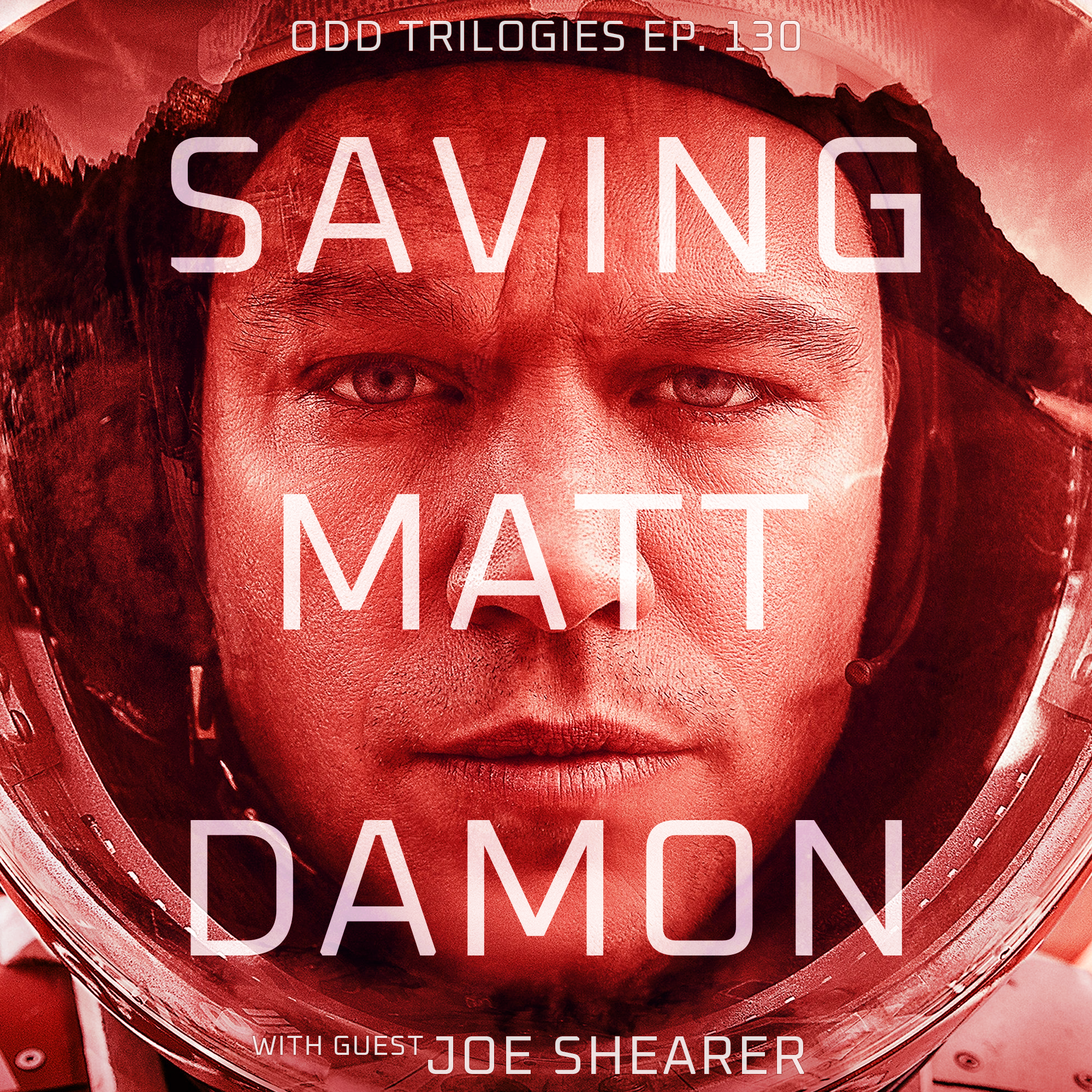
[00:00:24] Speaker A: In Odd Odd Trilogies with Logan and Andy, we take a trio of films where they're tied by cast and crew, thematic elements are just numerical order, and we discuss the good and the bad and the weird surrounding each film. And today for July, to end off the month, we decided to have two trilogies that in our last trilogy we discuss are tied to the probably the biggest release of the year, especially for the summer, the Odyssey by Christopher Nolan himself. We discussed the rise of Nolan earlier this month. And to finish it off, we're talking about technically the real star of the film because he is leading the film. But, you know, Nolan can sell things. He can sell a paper bag if he put his name on it. So of course, he's just as much of a star in some ways. But in honor of the star of the Odyssey, today we are talking about three films that have one goal usually, or maybe multiple goals. But there's always one thing they must do, and that is to save Matt Damon. This is a curated trilogy for the pod, and that is the Saving Matt Damon trilogy, which includes 1998 Saving Private Ryan, 2014's Interstellar, and 2015's The Martian. But thankfully, Andy, we are not going on this expedition by ourselves now, are we?
[00:01:39] Speaker B: No, no. Much like the the arduous journey that Matt Damon embarked on with a trusty, trusty team of filmmakers, including none other than Christopher Nolan, we are bolstered along our journey by venerate and veteran film connoisseur, film critic, film analyst, action action aficionado, and frequent writer for Midwest Film Journal, Joe Shearer. Joe, glad to have you.
[00:02:12] Speaker C: Thank you very much. Yeah, I am here. My first time on the pod.
[00:02:16] Speaker B: Yes.
[00:02:17] Speaker C: I'm not really sure why it took so long, but here we go.
[00:02:20] Speaker A: Honestly, we don't either. It just is a long time coming. We're so glad you're here.
[00:02:25] Speaker C: Yeah, I was thinking about that not that long ago. I was like, I've never been on Trilogy.
You know, I've been on a couple of others around here quite a bit. But yeah, no, I'm excited to be here. I'm glad we could. We could get together and do it and looking forward to talking about these three really fun movies.
[00:02:43] Speaker A: Yeah, we're happy to have you here. And because you're our guest, we will throw this to you.
In terms of these three films, do you see yourself as more of the Nolan of us, The Spielberg, the Ridley Scott. How do you feel? Which.
[00:02:55] Speaker B: Oh, among the three of us.
[00:02:57] Speaker A: The three of us.
[00:02:58] Speaker C: Okay, so we're each one.
[00:03:00] Speaker A: Well, we'd have to be. I don't want to. Okay, so if one of us was all three of them, that's too powerful.
It's like the.
It's like the elements kind of like one cancels out the other. We got to find a little space for that.
[00:03:13] Speaker C: Yeah, that's true. I'd probably have to call myself a Spielberg. If I'm anything. I've got, you know, a little bit of schmaltz to me, and, you know, I'm, you know, crowd pleasing, I guess, is. Is kind of as easy as anything. Nolan's probably a little too cerebral for me.
And Ridley Scott, I don't know. I could match up with Ridley Scott, but.
Yeah, I would probably have to claim Spielberg, though.
[00:03:42] Speaker B: I think that's a very fair claim.
[00:03:44] Speaker A: Absolutely. I was. I was worried that you're gonna say Spielberg because of something stupid, like because you're the oldest of the three of us. It's like. Stop it. No, no, no, no.
[00:03:53] Speaker C: Besides that. I'm not.
[00:03:56] Speaker A: Yeah. Joe just turned 29 as of today.
[00:04:00] Speaker C: Today, Andy.
[00:04:02] Speaker A: All right, you get the next pick. I'll let you have the next.
[00:04:08] Speaker B: It's tough.
[00:04:09] Speaker A: I was gonna say, if you don't want to keep going with this bit, you can abort as you go. Well, I play down to it for a little bit.
[00:04:15] Speaker B: I don't feel I. Before Joe even said anything, I was. I would have said I don't feel worthy of claiming Spielberg.
And I think being designated either of the other two, I would feel some strange, undefined resentment about. So I'm gonna. I'm gonna abstain.
[00:04:37] Speaker A: I mean, again, I'd say it depends. Again, also depends on the mood. Like, right now, if I was more curmudgeony, if I had a bad day, I'd probably go, Ridley Scott, sure. Yeah, I'd probably go. But if I. If I feel like I'm more in the vein of wanting to smash cars together or do, like, fun little, like, scenes in my head, I'd probably pick Christopher Nolan.
[00:04:55] Speaker C: Yeah.
[00:04:56] Speaker A: But, yeah, today we have three vastly different films overall, Honestly, in a lot of ways, even with Interstellar and the Martian being sci fi films in space.
[00:05:06] Speaker B: Very different approaches.
[00:05:07] Speaker A: Vastly different. Yeah. And with their through line being, will Matt Damon be saved? And while we'll get to Interstellar and how the fact that that's not the main goal.
[00:05:16] Speaker B: Right.
[00:05:17] Speaker A: Film.
[00:05:17] Speaker C: Sure.
[00:05:17] Speaker A: Just so happens to kind of work out in that Kind of favor.
It's kind of fascinating just to think in terms of, you know, Odyssey being a film about, you know, Odysseus trying to find his way back home. It's just funny to think that like, Matt Damon has made hilarious, wonderful career decisions, but wonderful career decisions that lead to him usually being stranded or having to be helped.
[00:05:38] Speaker B: Yeah. The subject of some rescue mission or something like that. And that's why I thought, because I mean, we.
I think I was the one who first thought of this idea as kind of, kind of a gag trilogy in a way. But I thought of it long before the. The Odyssey was on our radar.
But I think once the Odyssey had materialized and certainly once it got a release date, I was like, okay, now there's no better time to bring up the fact that Matt Damon has three times previously found himself in a predicament necessitating an epic journey to rescue him.
[00:06:21] Speaker A: Yeah. And it's fascinating too, especially going into the first film of our trilogy where it's. When this film is coming out, Matt Damon is still technically up and coming.
Like in terms of like his career at this point. Good Will Hunting has already happened. He's already kind of popped and it started to become a well known star on the up and up. But Damon has, in every single one of these films, at least in a certain part of Interstellar, but mostly in the Martian and the Saving Private Ryan has to be, as an actor, convey the necessity, convey the idea that he is worth saving. Hilariously enough, like, it seems so grim, but there is kind of that energy of just like especially with the first film. Because what's so great about Saving Private Ryan is that the whole premise about Saving Private Ryan is kind of pushed upon the team led by Tom Hanks that has to do it. And then the majority of the film, which is nearly three hours, is them being like, is it even worth saving this fucking kid?
[00:07:22] Speaker C: Yeah.
[00:07:23] Speaker A: And so it's. I mean it is again because with all the jokes around the fact that Damon has been saved so many times in his career, it is kind of, it is fun jumping into this first film. Well, let me say this. Saving Private Ryan is fun in different ways. It is not fun because of the, the carnage or the chaos. And while those can be fun certain instances, it is the fact that the movie, it is funny how the one Spielberg film, Damon, is this. Is this the only film Damon is in for Spielberg? Is this his only film?
[00:07:55] Speaker B: I think so.
[00:07:57] Speaker C: I'll do an unofficial scroll here too. Yeah, I'm trying to think maybe He's. He has like cameoed or something.
[00:08:04] Speaker A: But it's just in terms of starring a Spielberg film. It is fascinating to star in a Spielberg film film where 1. You don't show up until about 2 hours into a 2 hour 49 film.
You are the. You are the crux to what the team is doing. You are the one thing. You are the journey to. You're the destination.
And also this is one of the most, I guess, un. Like non traditional Spielberg films. I think what Andy was watching is because Andy. Andy beat both Joe and I in terms of rewatching, I think all three of these films. So he would text me from time to time before I got to this rewatch of this one.
Which to clarify, I think all three of us have seen all three of these films before, correct? This is all a rewatch for all three?
[00:08:47] Speaker C: Yeah, for me.
[00:08:48] Speaker B: Yeah.
[00:08:49] Speaker A: So I mean going into it, it just was. It was funny how I think you texted me, Andy, about like how fascinating it is that like there are so many Spielberg moments in this movie, but anytime the action is present, that is the most un. Spielbergy.
[00:09:04] Speaker B: Yeah, well, yeah, a lot of the.
Almost all of the quieter, dramatic or more conversational scenes are shot. You know, I mean, I'd been kind of, you know, re familiarizing myself with Spielberg prior to this trilogy because of Disclosure Day. And I was kind of, you know, marking some old Spielbergs off my list and revisiting some that I'd seen before and just kind of, you know, living in his, you know, particularly in his early work, his very distinctive style. And I had never really done that and watched Saving Private Ryan in close proximity. It's been many, many years since I've seen this movie.
And so it was, you know, really kind of enlightening to like watch this movie and be like, oh, wow, this really does still have a ton of, you know, kind of traditional, very dynamic camera Spielberg where like, you know, it is one shot, but there's like five or six compositions within a shot. And it's all one scene of characters just standing around and talking or walking and talking and you know, crane moves and things like that.
But then, yeah, whenever it's wartime and you know, guns start firing, tanks start rolling in, the visual language really changes. And it, you know, I think that helped emphasize for me how much this movie was a, like a change of pace or a stretch for Spielberg. Like especially, you know, especially impressive given where he was at in his career at the time. I mean, basically at the peak, you know, like 90s was kind of, you know, you know, he was both kind of old guard at that point and still innovating and making huge waves and stuff. And actually, that's something I would love to hear you talk about, Joe, because you're probably the only one of us who remembers that period of time.
[00:11:10] Speaker C: Yeah, yeah, yeah. I mean, no, I think you're absolutely right. It's pretty much his peak. I mean, and I'm just kind of scrolling through his filmography as you were talking too, and it's, it's just, it's so weird if you look at just what he had, what he had done during that period, just, let's just say the 90s. He did hook. Yeah, like, Hook.
Like, what movie is more unlike Saving Private Ryan than Hook?
You know, it's like he did that, he did a draft. He did two Jurassic Parks and then Schindler's List, Amistad, Saving Private Ryan. These are all like, these are wildly different in terms of tone. And, and then he did catch me if you can if you, you know, in Minority Report years after that. So it's like, yeah, he, he was really all over the place as far as, you know, as far as thematically what he was doing, being serious versus being, you know, sci fi action blockbuster kind of movies or being, you know, kind of trying to be a little quieter and making, you know, something that's a little more, I don't know, just not, not that dead serious. I mean, you know, this movie is very serious and very respectful of its source material. Schindler's List was, you know, the same way. It's kind of his, you know, World War II duology, I guess, from the 90s. But that's.
They just. These movies that are just so stone cold serious for most of the runtime, you know, Saving Private Ryan and Schindler's List also, they have their little moments of levity here and there, but they're, for the most part, they're heavy thematically.
And, you know, you, you are meant to be in tears by the end of them. And, and if you're not, you know, you are, you know, a more emotionally stable person than I, because those are, these are two super powerful films.
Probably, probably two of the top five of my career in terms or my career, my lifetime, as far as, you know, the emotion of it goes. But, you know, he, he, he was, he was the absolute master. I mean, you know, at this point, he, you know, he was through the first three Indiana Jones films already.
[00:13:19] Speaker A: Crazy to think in a decade.
[00:13:22] Speaker C: Yeah, yeah, three, three Raiders movies. Or, you know, Indiana Jones movies, E.T.
close Encounters, Jaws. I mean these are all time classics. And then you get, you know, the Color Purple.
[00:13:35] Speaker B: Yeah.
[00:13:35] Speaker C: You know, people kind of sleep on it.
The Empire of the sun did that win Best Picture.
[00:13:41] Speaker A: I don't know if it did the year.
[00:13:42] Speaker C: I don't know. But again. And that's, that's one of the ones, you know, again, another kind of slept on Spielberg. I'll be honest, I've never seen it,
[00:13:50] Speaker B: but I only just watched it this spring.
[00:13:53] Speaker C: Yeah, but you know, that's like these are, these are kind of big time movies. These are all timers and he is just, just cranking them out and, and they're so different too. It's not like he's, you know, making a living just making sci fi blockbusters, you know, movies that make a billion dollars, which, you know, a lot of these movies did or you know, certainly would have, you know, given inflation and all of that stuff. But it's, yeah, it's pretty remarkable that he just carries on, you know, for all of these decades and is still doing it today. Even if they're not, you know, even if, you know, you can say, I mean, what has he made in the last 10 years that matches up with any of those? It's like, I mean, arguably none of them are, you know, kind of stand up to that run, but they're still solid movies at the very least.
[00:14:40] Speaker B: Well, and you could even say it like, you know, even if they're not as good, like he, you know, west side Story, something very different for him.
The Fableman's a kind of uncharacteristically autobiographical. I mean he's obviously used pieces of his own life in movies before, but to basically adapt his own life as a film.
Um, very different. And yeah, yeah, there's Disclosure Day.
[00:15:05] Speaker C: Yeah. And he even played with animation, you know.
[00:15:08] Speaker B: Yeah, right.
[00:15:09] Speaker C: And the Adventures of Tintin. Yeah, that's, you know, that's, that's pretty, you know, that's pretty, you know, not just resting on his laurels. He's, you know, he's really going for, for mixing it up a little bit and being out of his comfort zone.
[00:15:23] Speaker A: Yeah, the 90s were definitely, least now we can retrospect respectively. Look is I think one of the biggest turning points in his career because there's a lot of, I think post Jaws, I think he talks about, especially in the, we talked about a little bit, I think in the Rise of Spielberg episode. But you know, the, the HBO documentary, the three hour one where he describes kind of, like, where he was in his career post Jaws and like, in the 80s, there was this energy of trying to prove to other people that he was more than the populist filmmaker that people would say him as. And he's more than just schmaltz. He's more than basically a chip on his shoulder that I feel like when you watch his 90s run, whether the. All of them are just the big hits, you see a confidence there that clearly comes from just spending the last decade prior, you know, building a franchise inadvertently with, you know, the Indiana Jones films or, you know, playing around with things like with Empire, the Sun or even doing the Color Purple, which I. I bet at the time was kind of wild to have Steven Spielberg do that film, especially with that cast.
[00:16:26] Speaker C: Yes. Yeah.
[00:16:28] Speaker A: And it just to get into the 90s to see a change of, you know, personally wanting to be, I think, more attuned with his faith growing up. And why I think Schindler's List is so impactful for him is because that was kind of like him dealing with so many things in his past, as well as his, like, kind of crisis of faith and like, rediscovering that in the process of talking about such a tremendously horrific tragedy during World War II with the Holocaust and then using that film. And I think this was Saving Private Ryan almost as films to not only kind of reclaim parts of his, you know, past that he wishes he probably should have done earlier but had until then. But with Private Ryan, if it's more with his father, because the big thing about Spielberg's relationship with his father is that it wasn't great for a solid few decades. And saving, Saving Bravan Ryan is in part, while the story itself is not based off his father, it's based off of different accounts of the war as well as different novels kind of come together into like a unique, a fictional, but based off of real stories of the D day and onwards of the kind of that part of the theater of World War II. But his father, being a soldier, used that as kind of like an emotional connection to that narrative and built from there and leads to. I think one of I, I. It's one of the hardest things about doing this trilogy is as much as I like all three of these films, this is my favorite.
[00:17:54] Speaker B: Sure.
[00:17:56] Speaker A: I like this is the one I, I was wondering going into this would. I think it's not perfect because I. Because I think I told you off mic before. Andy. I don't think I've ever told you this, Joe. The first time I watched Saving Private Ryan. I double featured it with Schindler's List.
[00:18:11] Speaker C: Oh my God.
[00:18:12] Speaker A: I. It was just like for years and years I had watched so many clips of both, it just never felt like I'd ever watched it in full.
And basically one day I was like, well, I clearly can't watch both of these. They're so long. So I got to pick one. And so I started with Private Ryan because in my, in my household, my family growing up, like, we watched Band of Brothers every year, or at least it was always on in the background for certain times of the year, of course. And so like, I basically just watched Band of Brothers Episode 0 because that's basically what Saving Private Riot is.
And I was so caught, just so shocked at how much I had never seen of that film and how much I just gravitated. Despite knowing the D day scene, despite knowing how it ends, and despite all these things, just watching it in full, I was like, I'm in the Spielberg mood.
Should I just go for Schindler's List? And then I did.
[00:19:07] Speaker C: Yeah.
[00:19:08] Speaker A: And then I. It was again, it does not sound like a fun double feature and it really isn't in terms of like, tone. But I think both those films just show like how insane his range can be, especially when he's so confident and connected to the source material.
Which is why we all think Ready Player One is the best Spielberg film in the last 20 years.
[00:19:32] Speaker C: I like Ready Player One.
[00:19:34] Speaker B: Yeah, it's a fine.
[00:19:37] Speaker A: That was entirely a joke. But I do like, yeah, yeah, I
[00:19:41] Speaker C: know people love to, to hammer it down, but yeah, yeah, it's good. And that, but that's kind of what that. I think that is. It's just like people are people. Some people are like, oh, it sucks. Or people are like, well, you know, it's good. Like I like, I'm like, yeah, it's good. It's not, I mean, it's not top 10 favorite Spielberg, but it's, it's a good time.
[00:19:58] Speaker A: But Saving Private Ryan, it. I understand people out there who probably haven't seen in a while, who have maybe never seen it because, you know, you're worried that the film is too over hyped. And while I understand that sentiment, is it like. The sentiment is very valid because the D day scene is 20 minutes of a 2 hour and 49 film and it's honestly its own mini film in it.
[00:20:22] Speaker B: Yeah.
[00:20:22] Speaker A: And it's crazy how it basically feels like you could stop watching the movie at the end of the D day scene and Be like I am fulfilled in some way, shape or form in terms of what I'm looking for for this. Yeah, it's like, well, good news, there's another 2 hours and 20 minutes with this.
[00:20:38] Speaker C: Yeah, you're just, you're just exhausted at the end of that scene, right? Oh my God, it's so punishing.
Just as a viewer. And you know, I, it's. I told my, I watched this with my two of my kids, two of my three kids and I said to them before it started, I said now the thing to, to think about as this movie starts is that when my grandfather was your guys age, this was what he was doing. This is what he did. Like the people during this time signed up for this. A lot of them signed up for it willingly. You know the, and I, you know, we mentioned the draft too but you know, but it was like think about just the, the plot of Captain America about how he went out of his way to sign up to go to World War II. It's like this is what he's signing up for. And then that part starts and they're just like, oh my God. Yeah, this is, you know, it's, it's something. It's one thing to watch a John Wayne movie where you know, there's explosions and you know, machine gun fire and people fall down. It's another thing to watch this scene and see, you know, people throwing up before they, you know, as they're about to go into the war and they're like, oh, why are they throwing up? It's like, I mean they're about to go and someone's going to try to kill them. And then as soon as the action starts, it's like, you know, people are drowning, jumping out, just trying to get to the beach. They fall in the water and they can't. Their gear weighs them down and they're dead. Like they literally made it five seconds and it's just, and then just watching it, it's just. And it goes on and on and wow. It's just like, it just doesn't stop and it's just brutal and. Sorry, I think I interrupted you anyway, but.
[00:22:19] Speaker A: No, not at all. I mean it's talking about the D day scene, it is kind of just, it's mere discussion of the film of thus far is, does not do it justice. Like it genuinely is experiencing it for the first time.
It is anytime even with this film being as it is and knowing it is full blown a Spielberg film, it still always takes me. Like it genuinely pulls me out and Puts me back in. In a millisecond where it's like, when you think of a Spielberg World War II film after the 70s and the 80s, and how much he loves classical cinema and how much he loved the black and white cereals growing up. I mean, just like where India Jones comes from, the first thing you think about for what a World War II Spielberg film would look like is not this. I would even say the first five or six ideas are not this type of movie.
[00:23:09] Speaker C: Yeah, but.
[00:23:09] Speaker A: But yet when it happens, God, it shows how much of a master filmmaker he is with the fact that, like, you have pretty much in this D Day scene, every.
Every male actor of the 90s, just like showing up on this beach, whether in the background with no lines. Apparently Andrew Scott.
[00:23:28] Speaker B: Yeah, the British actor.
[00:23:31] Speaker A: I mean, you know, hot priest from V Bag is in it for like a second in the background and all these actors are showing up on the beach. And the amount of explosions, the amount of character stuff that's happening with like, the guy who gets shot in the. In the helmet and then it freaks him out and he looks at something shot in the head.
[00:23:50] Speaker C: Yeah, yeah.
[00:23:51] Speaker A: And the guy that loses his arm and then just like all these little things where it's like the film begins with this swelling, gorgeous, patriotic orchestra kind of piece and showing you this old man going to a cemetery for all these fallen soldiers of World War. Of the beach, as well as just World War II in general.
Hard cut to Tom Hanks. And then from that point forward, it is just like, oh, this movie isn't fucking around. No, you weren't expecting it to, but it really does try to make sure, you know, hey, just so you know, this is how we're setting the foundation.
[00:24:29] Speaker C: Yeah.
[00:24:29] Speaker A: This is what's considered a win. Remember how we heard we did D Day and we actually took the beach? Yeah, this is how we took it.
[00:24:37] Speaker C: Yeah.
And that's legendary that, you know, this. This is obviously legendary, you know, historically, but even in cinema, I mean, you think about other movies of reference to Stand By Me is the one that jumps out to me where Teddy's dad was, you know, that. That was the thing that he always said, like, people would, you know, his dad had, like, I don't know, been in trouble for abusing him. And he says, you know, like, he always defended him, was like he stormed the beaches at Normandy and it was like he was a man, you know, it was like that was. That's just that. That's the thing that. That hit me, that. Because that's what I knew that, you know, D day, that's what I knew from that sequence was just from. Mostly from Stand By Me and then what little I would have heard, I mean, let's see, when it came out in 98, I guess I had already graduated high school, I would have have known about it. But that still is always my reference point is that. And you know, we were. Again, another thing we were talking about was how, how different their journeys were than from ours today. All of those people came back who, who did. Who storm that beach and they came back and they were not the same people. They could not be the same people after witnessing that. And you know, it went from, oh, you know, Grandpa doesn't talk about the war.
[00:25:50] Speaker B: Yeah.
[00:25:50] Speaker C: And then you like transition up to Vietnam and it's like, you know, dad doesn't talk about his time in Vietnam. And you know, but then it's like we, we kind of slowly started seeing the, just the impacts of that, that we didn't pay enough attention to it. Certainly not post World War II.
And you know, then going into something like Korea, then Vietnam. And it's like we kind of started realizing slowly, it took us decades. How stupid are we that, you know, it was like these are, this is not just like guys gloriously like running out into the sunset and shooting their guns into the air like they were tearing apart human bodies. Yeah, it was. And you can't. It was something that, until I saw this, I never really understood it myself. I always kind of thought like, man, war must have been weird. Like, you know, everybody's brave and it's like, yeah, let's go get him. And then it's like you get there and you're a 17 year old kid and the guy next to you just had his face blown off by a bullet. Like you were talking to him four minutes ago. Now there he is dead with, you know, like exploding, like his whole body is now nothing because, you know, because of this thing that you are now still in the midst of. And it's. And you also have no time to process it because you're running for your life. And you know, it's, it's just insane the way that, that we glorified war and now here, you know, we see this. It's like, it's kind of like that, that slap in the face, it's like come back to reality because this is not, this is not something to be proud of. This is something, I mean you could be proud you survived. But you know, that's just, just the most traumatic thing a human being can go through.
And, you know, and it's.
It's. It's just. That's kind of the testament more than anything to Spielberg that he made that movie and had guts enough to not, you know, not in any way glorify this and make this war seem like it was something just. I mean, he. He kind of doesn't. I would say maybe he doesn't exactly acknowledge the politics of it, of, you know, whether it's, you know, whether the United States was in the right or not. But at the very least, he's not saying these are the good guys and we're the just people.
All of these characters are, you know, have their own moments of selfishness or, you know, moments of doubt or, you know, they are insulting people that, you know, that are other main characters. And even Matt Damon's character, you know, has some of those things, you know, where he is not also exalted when he could be, you know, there. There's all those people and, like, you better, you know, grow up and cure a disease or something. You know, you better go back home and do this. Do something really great or, you know, you don't deserve this. And it's.
It's really. It's really incredible how he just. All of the little moving pieces he put together.
[00:28:49] Speaker A: Yeah, it's.
Go ahead.
[00:28:52] Speaker B: Well, and I mean, you also have to think about even the context of Spielberg's own career kind of aside.
War movies weren't really like this prior to this movie. I mean, not that there weren't intense and brutal depictions of war.
Certainly there were even in the 70s, but just the sheer grit and level of immersion that Spielberg is committed to in this film with all of the, you know, very shaky in the action, kind of handheld photography, and of course, the brutally realistic special effects and things like that.
You know, it's just. It was kind of a total package in a way that, like, war, modern war had not really gotten in terms of, like, a cinematic treatment. And I think, you know, it shocked the shit out of a lot of people in that way. And like you were saying, Joe, you know, it's like people had this vague idea, vague, glorified idea of what war was. And, oh, yeah, Grandpa went out and did that thing, and, you know, that's what made him a man.
And then, you know, that. That's what I think is so special about, like, the. The framing device of older Private Ryan.
Because, like, when I was a kid growing up watching this movie, you know, I was kind of like, well, the. The old man stuff at the beginning and end is just kind of boring and, you know, like, get me to the war stuff. And then, you know, you grow up. And I remember listening to stories from my grandpa who was in World War II, and just all of the realities of war that have recontextualized this film as I've begun to understand them as best I can without having ever experienced them.
Just the head on collision that is the transition from there's this old man standing in a graveyard and his family's nearby, this kind of reverential scene transition to these terrified teenagers in a tin can landing on a muddy beach and getting their arms blown off.
Just such a, I don't know, landmark moment. And not just cinema on a whole, but, you know, our kind of cultural ability to understand war warfare in a visceral way. Yeah, I just think that's something that's really special about this movie.
[00:31:45] Speaker C: Yeah, yeah. I think that it also is.
I feel like this is kind of the peak of filmmakers depicting war in that way. I mean, you know, we, we did, you know, we're talking about, you know, Spielberg as, I guess, a trailblazer in this. In some ways, though, he's kind of taking the ball from Oliver Stone, who did, he did Platoon.
[00:32:08] Speaker B: Yeah.
[00:32:09] Speaker C: And then, you know, But a lot of the movies, I mean, we had in the 80s, we had a lot of, you know, there was Stallone and Schwarzenegger. You know, there's Rambo and First Blood, which First Blood started as a commentary on Vietnam War and then turned into just, you know, Stallone mowing down macho. Fateless. Yeah, just. Yeah, like just him mowing down foreign looking people, you know, with a machine gun. And it, it's still, there's still that glorification. And I mean, Platoon obviously is very critical of Vietnam and, and has some of that, I think, to it. But a lot of the movies, there's stuff like the Deer Hunter and this, you know, like Those are the 70s, but the Deer Hunter and then born on the 4th of July. Movies that deal with the aftermath, even for something like Forrest Gump few years before this, you know, is dealing with the aftermath of it. And we don't see. We see just a little bit of, you know, like actual quote unquote, you know, war depiction. But obviously it's. That's a different kind of movie. But we, we were dealing with that as in the emotional impact that it had for years afterward. But this one does that and puts you in the middle of it in a way. I think even Oliver Stone didn't really truly do and I don't know that anybody else had done it before.
So it's. It was.
Yeah, it really is kind of an anti war war movie in that way where, you know, we're, you know, we're going like these, sure, these guys are heroes, but you don't really know the extent of what they went through. And in calling them a hero, even a short, changing them, because it was so much more impactful than that.
[00:33:46] Speaker B: Right. And it even, I mean, it stands out too, from those kind of prior, more grisly depictions of war because so many of those were so overtly and staunchly kind of political comments.
And this film is not, I mean, I'm almost kind of, you know, obtusely, so you could argue, is really not engaging with the politics of. Of war at all so much as just saying, like, you know, you know, that look your grandpa gets in his eye when you ask him about when he served, like, this is what he's thinking about, you know, this is what he experienced. And that's really all it is, is this is what it was like.
[00:34:27] Speaker C: Yeah.
[00:34:28] Speaker B: And if you can talk about any sort of, you know, political machinations of who was right, who was wrong, who, you know, how we run the army and things or the military and things like that, but, you know, at the end of the day, these were guys who were in over their heads and didn't know what they were about to experience and experienced some of the most horrifying things you can experience.
[00:34:50] Speaker C: Yeah, yeah. And. And he makes. He makes some maybe lower level, I would say they're very, they're very subtle, comparatively speaking, political statements that he, you know, he gives those scenes where they go into the. The war offices where, you know, the women are typing up the letters and, you know, all of the generals and the higher ups are making their decisions and it's. It's a little more sepia toned and a little more, you know, it's a little more schmaltzy looking. Yeah, that word again.
But also that's a bit of a. That's maybe a bit of a subtle commentary, but you're right. The mo, for the most part, it's the soldiers themselves and they're just doing the normal, like complaining about the things that they've been asked to do. And then you get in and it gets into kind of a bigger philosophical argument about that, you know, the risking the lives of. Of multiple people to, to save one person.
And that's, that's really most of, you know, what that Is. So, yeah, I think you're. You're right about that. But it's. He's very subtle about kind of the US's role in that, but he's. But he also still kind of is leaning against that, you know, that, that not. Not glorification, but the, the older style. The older, like, good old days. Yeah, yeah. Being reverent toward the material without, without, without judgment, so to speak. So, yeah.
[00:36:13] Speaker B: Yeah.
[00:36:13] Speaker A: I mean, I think especially compared to like Schindler's List, which feels like very staunchly grounded to a degree that I feel like is even more. Even less Spielbergy than I think this movie feels like. It is kind of bold, though, especially on a rewatch to realize that in the first 20 minutes, the film basically reveals to you by the end of the D day scene that the man at the beginning is not Tom Hanks. Because they show the eye color of Private Ryan as an. As an adult. And then hard cut to Tom Hanks. And at the time, you don't. You're not able to really assern what Tom Hanks's eye color is, but you assume due to just classic filmmaking style with the, you know, the match cut, that this is clearly the younger version of him. And then at the end of the D day scene, you realize the old man's got blue eyes. Tom Hanks is very, very brown. Has very, very brown eyes. And almost telling the audience from the get go, you are not gonna. You're not gonna see him make it until you find out the end. It's like, oh, so we're just watching a guy that we can. We're watching America's man, Tom Hanks.
[00:37:17] Speaker C: Yeah.
[00:37:18] Speaker A: Like, show us into D Day.
Literally follow all the way through this film and then ultimately does not get to live past the war.
And from the very beginning is showing the audience this very, like, Sanchi, like, okay, so this guy isn't Ryan. Then who is he? And then to show Hanks build this ragtag group of soldiers who are clearly just like people from his. From past, you know, expeditions and like, operations that he's done with Tom Sizemore being kind of his close, closest friend.
[00:37:48] Speaker C: Yeah.
[00:37:49] Speaker A: I think out of all of them. And then getting some younger guys with like, Rabisi, like Vin Diesel, Giovanni Ribisi, all these other guys that are just kind of like hodgepodge together. Barry Pepper.
[00:38:00] Speaker C: Yeah.
[00:38:00] Speaker A: And they're basically like you. At a certain point, there's this era of you survive D Day and I've seen you shoot Nazis and you do well at it and you're still here. So I get to choose the team. I think we could do this together. And they're all like, why are we doing this? This feels like not a great allocation of resources. And he's like, I have my orders. It is fascinating how. How much great, I would say double speech is. Double speak is in the script and in the performances where it's clearly them being like, I clearly, as a person, do not support what we're doing here. But as a part of the military of my rank, I should not talk down about my superiors to you. You can talk about them to me. I'm just not gonna let them know. And I won't talk about that to them. Like this kind of. This there's. Because I love how Hanks's performance, which I would probably argue is one of my favorite performances from him. It's. I. I knew he didn't win an Oscar for this film, but I was constantly like, who the fuck did? Who won the Oscar the year. And of course, the year that he was up for it, he lost to Roberto Bonini for Life is Beautiful, which is not surprising in the slightest.
[00:39:11] Speaker C: Yeah.
[00:39:11] Speaker A: All that time. But it is just kind of fascinating considering how Hanks's career has been post this. There's just considering his career, especially after this movie, feels like he is trying to balance with characters that may be a little bit more scummy, maybe a little bit more antagonistic or maybe more hardened. You know, there are certain films where he tries to do. Do that, and I don't think it's. He's the best fit for that. And I think with this, he is the perfect amount of mysterious, hardened, but reliable soldier who can literally rally everyone together to go save Matt Damon from wherever the he is in France. And it is. It is fascinating to. Yeah, like what you both have said, like how much the film, you know, isn't fully pushing political, you know, ideologies in your face, but is showing just, you know, realistically at the time there were American soldiers not following protocol and just shooting surrendering Nazis and how like, you know, constantly the higher ups were just doing dog decisions that were ultimately leading to the deaths of others. Like later on they find out that a general wanted to be taken with his jeep in a plane and it fucked up the plane and it leads for the plane to explode and fall apart.
And least all these, you know, really fascinating discussions that of course, you know, later on they'll do more in depth with. With Band of Brothers in especially with the Easy Company and whatnot, which easy Company in a sense does show up in this film which is wild when I heard the. The paratrooping team in a way but was just fascinating to see this hodgepodge group of soldiers and how each one of them I think has such a distinct voice and I think clearly has their own opinions on the mission itself and how much the mission hardens the more kind of like hopeless things get and leads to some very fascinating discussions and little subtle kind of choices and performances.
Yeah. There's so many great moments in between all this. And of course in the middle of all this, you know, people that you see during the D Day fight, they add someone to the team who wasn't a part of that which is Upham who is their translator who which is crazy about this movie. I think I told Andy about this off mic Upham. Now most people if you if you've played video games in the last decade, you would probably know is the antagonist in the God of War remake. He is Balder in the 2018 God of War film or the God of War game.
[00:41:41] Speaker B: Yeah.
[00:41:42] Speaker A: And hilariously enough in God of War Ragnarok which has Thor as an antagonist, he is played by the soldier in this film who is hard of hearing and tells them where Ryan is in France.
[00:41:53] Speaker B: Oh yeah.
[00:41:55] Speaker A: Which that actor is the quarterback from saving or remember the Titans.
[00:41:59] Speaker B: Yes, that actor.
[00:42:00] Speaker C: Jeremy Davies.
[00:42:01] Speaker A: Yes.
[00:42:02] Speaker C: You're talking about Jeremy Davis.
[00:42:03] Speaker A: Yeah, yeah. All the both is actually. I mean it's just seeing them so young and seeing especially with yeah. Jeremy Davies. He gosh the Upham performance. It is so fascinating how.
[00:42:13] Speaker C: Yeah.
[00:42:14] Speaker A: When he shows up he's technically supposed to be our kind of surrogate because it's like, you know, have you seen any kind of actual war. No. Okay, good.
We just need you to translate and then to see kind of him asking questions and leading to the team just going to be like you weren't on D Day you and honestly even just like yeah, they're being mean. But yeah, you weren't a dj. You're not going to be part of the team.
[00:42:38] Speaker C: Yeah.
[00:42:39] Speaker A: And it's.
It is fascinating just to see up them being basically the audience at times bringing up the conversations of like you know, in a normal world we wouldn't have. We shouldn't kill a prisoner. Like when that comes the dilemma later with the Nazi that's he's credited a Steamboat Willie in the credits.
[00:43:01] Speaker C: Is he really?
[00:43:02] Speaker A: Yeah. Yes. Yes he is.
At least an IMDb I think it says he is but there's the upper is constantly the one that's bringing the conversations. And I think other war films have an Upham. And I think in other war films, sometimes that character is excessively obnoxious.
But I think in this film with him, it is so fascinating how it's basically seen how this war can genuinely, you know, harden, but also corrupt somebody's emotional state and their morality when it comes to just so many bullets and bombs and bloodshed being thrown at them time and time again.
And it leads, you know, him to kind of give a bit of levity overall and bit more of a humanity to a team that has been so hardened because of, you know, one of the worst military operation days for any military whatsoever.
And just to see, especially for the American military, to see him be almost the guy that's like, well, I'm here to save Private Ryan, because that's why I'm here. If that's what you want to do, we should do that. And then, like, he's always kind of the one who is staunchly, like, it is your call.
We can do, like, in terms of the mission and leads to, you know, some very interesting dynamics and leads to also, like, when people are starting to get picked off. Like, again, Vin Diesel as an actor, depending on who you ask, can go either way in terms of what kind of talent he has, but. But he's really fucking good in this. And he's in a very small part, but just this whole bravado and just, like, his confidence. And he is probably the closest in terms of how he acts. Both him and Barry Pepper, I think, are the closest to soldiers acting like hero soldiers in, like, a classic World War II film.
[00:44:47] Speaker C: Yeah.
[00:44:48] Speaker A: Whereas in terms of, like, Vin Diesel, Vin Diesel's literally, he dies basically because he's just in the open trying to save a little girl from a destroyed building with no cover and then does something he shouldn't have done and then just gets shot and pretty much dies for nothing, which is unfortunate. And then Barry Pepper later on the film, despite being as good as he is, again showing the casualties of war, despite being a sniper just savant and being incredibly good at killing people from afar.
[00:45:20] Speaker C: Yeah.
[00:45:20] Speaker A: He can't stop a tank from shooting him if it seems to happen. And it's kind of just interesting to watch the team deteriorate mentally and physically and just realize, you know, leads to some phenomenal conversations throughout the film. I mean, my favorite scene in the whole film is probably the I'm a school teacher scene. I would probably say is, like, one of the best moments in the entire film.
[00:45:44] Speaker C: Yeah.
[00:45:46] Speaker A: But there's other. You know, every time they meet, you know, more soldiers that are trying to explain where everything's going. Like, I forget about Paul Gatti every single time I watch this movie. And he's so much fun.
[00:45:56] Speaker B: Ted Danson.
[00:45:58] Speaker A: Yeah. Ted Danson always throws me off.
[00:46:01] Speaker C: Brian Cranston. Brian Cranston. You know, that surprised me. This I remembered, you know, with. With Ted Danson. I was waiting for that because my fiance and I have watched, you know, the Good Place, and then we watched the other one that he just did recently where he's the. Like, he's an investigator. I can't remember what it's called now. It's a Netflix series. It's like an old, total old person show. But we watched those recently and enjoyed them. And I was like, oh, she's gonna get a kick out of when Ted Danson shows up. And then Paul Giamatti shows up. And I'm like, oh, yeah, Paul Giamatti. And then there's Brian Cranston. I'm like, damn, Brian Cranston is in this.
[00:46:36] Speaker B: Yeah.
[00:46:37] Speaker A: And what's so funny, too, is Cranston talks about how since his. I mean, they never really. They never discuss it out loud, but, like, he has one arm. He's an amputee.
[00:46:45] Speaker B: Yeah.
[00:46:45] Speaker A: And he talks about how apparently he knew his character was written to have only one arm, and he basically trained himself to work with one arm and almost in a method way. And Spielberg just basically went, that's cool. We're not going to do what you're asking for. That's what I want you to do. Also.
[00:47:01] Speaker C: You're in one scene.
[00:47:03] Speaker B: Yeah, yeah.
[00:47:04] Speaker A: Again, it's so funny how many people are just. Just hear for five seconds, then they go. I mean, it goes, paul Giamatti, Ted Danson, Nathan Fillion. Which is one of the scenes that genuinely shows how good of a director Spielberg is, because I bet with another filmmaker, this scene would probably be considered, you know, poor taste, having this whole scenario about, you know. Oh, the joke is, is that there's more than one Private.
[00:47:30] Speaker C: Yeah.
[00:47:31] Speaker A: Because there's so many, like you said, Joe, there's so many people through the draft and also just signing up. There's so many kids that are. Of course, you're seeing. You're looking for a young white boy who's in, like, in his late teens, early 20s with the name Ryan.
You're probably going to find a lot of people like, yeah. And Fillion nails it in that scene. And it's a great moment of just like a little bit of levity without taking away the seriousness of the situation.
[00:47:58] Speaker C: And it's. It's really.
I think you're right. Only Spielberg really could have made that and have it not feel like a. Like a joke in poor taste because.
[00:48:09] Speaker A: Yeah.
[00:48:10] Speaker C: Yeah, because it is really just the perfect amount of. You have empathy for him in this situation, and it's completely believable.
But you also. But it's also funny, you know, it's, you know, because he's like, oh, you know, my brothers are in grade school, you know, and it's like. And you immediately see them both all just go, like, you know, and it's like, you know, but. But then him. Him continuing on. It's like, you have to. You have to have some empathy for his. His plight because he. He can't jump on a cell phone and text his mom and be like, hey, are my brothers okay? It, you know, that this is, you know, the 1940s. It's still. It's going to be months and months at best before he is even able to have any contact with them at all, if not longer than that. And it's, you know, in those days, it's just such a. It's. That's just such a thing that I think today we can't understand even, you know, old people like me who, you know, who lived before cell phones. It's like your cell phones and the Internet and the whole world being interconnected. It's. You're waiting for letters that take days to arrive. When you write them, you know, you write them, you put a stamp on them, you send them. Days later, they arrive, you know, somewhere else far away and maybe. And with, you know, during the war, I imagine that was delayed even more certainly in the 40s. I think mail was probably slower than it even was in the 80s and 90s when, you know, you could send something across the country in a day or two, but, you know, so it would be weeks, honestly, at best, before you're going to have any kind of really real answer to that other than, oh, I'm sure they're fine, you know, because. And that's just. Just what the trauma of that is for. For a person. You know, just think. Thinking about that, like, imagine if someone just told you your brother is dead, and then they're like, oh, never mind. And then it's like, you. You'd probably jump on and text your. Your mom or text your brother or whoever and just try to be like, I just want to hear your voice. I just want to understand that you're okay. And he can't even do that. And that's. That's just kind of as much as anything, one of the big tragedies of the war is that that's the case for everyone, basically.
[00:50:21] Speaker A: Yeah.
It is constantly against the clock of wondering is this moment of us taking a moment of time to reflect and rest.
Is Ryan dead? Like, are we chasing after a ghost?
And when do we kind of stop? When do we find a place where we go, we're done?
And the thing that I think leads to some fascinating conversations and moments is the fact that none of them want to have an answer as to when are we stopping this? When are we gonna do this? When is it? When we have gone too far.
Because, like, there's great little moments, like the dog tag scene is another great example where they're using so good poker chips, where they're trying to give themselves levity over what they think is a hopeless situation.
But it's only. It's. They're basically being absolute assholes to the teams that are showing up and are trying to meet up with the rest of the army or the messr. Military and just, you know, of course, the attack on the. The radar dish or like the. The comms kind of tower, which honestly leads to one of the most.
I mean, the movie is filled with sad moments all the way through. The D Day scene is literally 20 minutes of sad. And it's meant to be. It's most. It's. That is the impact of this film is committing to that. But like, through. Throughout the film itself, you know, as much sadness as there is throughout the movie, like, to me, one of the biggest, saddest moments is, of course, is when Ribisi dies.
[00:51:43] Speaker C: Yeah.
[00:51:44] Speaker A: Because not only is it just sad because it's like he is calling for his mother. And of course we get a whole scene about him talking about how he regrets. It's such. Again with how war films, basically every war film, especially World War II film after this, is basically going like, without saying out loud, how do we not redo Saving Private Ryan? How do we what? How do we justify making a war film at this level without it feeling like a knockoff?
[00:52:12] Speaker C: Yeah.
[00:52:13] Speaker A: And while I think, you know, literally year, like Blackhawk down is like, what, five years later from this? Or like four, three. Four or five years later. And also is, you know, doing Desert Storm and. And is trying, you know, doing something vastly different as well as, you know, in the 2000 and tens, we get 19, 17.
We get Dunkirk, of course, which we'll talk about with Another Nolan connection, as well as a controversial film, unsurprisingly, Hacksaw ridge in the 2010s, where it's like all these films, even when they're not in World War II, there is that feeling of, like, are they gonna have some Saving Private Ryan DNA? Because this film just knows how to balance, you know, between the human interactions, between the soldiers in the. The. The true moral degradation of just being in a war, while also being able to show the importance of remembering compassion and empathy in such dire, like, dire moments. Like, it is kind of like it. You would think we're how old this movie is. We would get to a point where people are like, you know, honestly, it's really stupid that the military let this happen, but, like, at the same time, they do such a good job having the higher ups explain how, like, we're not saying Private Ryan is technically special, more special than anybody else, but we have a moment where we're just genuinely compassionate for such a tragic family that has just lost three out of their four children.
[00:53:46] Speaker C: Yeah.
[00:53:46] Speaker A: And so the least we could do is see if we can hopefully find a glimmer of hope in this just dog of a situation and maybe find Private Ryan. And, I mean, when we finally get to Private Orion, I also love the fact that when he's introduced, it is not with fanfare. It is entirely. He's just doing his thing. He shows up and they go, by the way, this is Private Ryan. And then there's the. The silent shot of them on the tank all looking at him. Yes. Realizing, holy shit, we've actually done it.
[00:54:20] Speaker C: Yeah.
[00:54:20] Speaker A: And then now the film becomes, all right, we love these guys. Tom Hanks, killing it. Tom Sizemore. Love him. He's a curmudgeon. We love him on this team. Everyone's doing great. How the am I supposed to care about Matt Damon? And how am I supposed to really want to be on his side when he goes, that's cool, guys, but I need to stand here and stand my ground? And I think, of course, it's mostly writing, but I think also Damon sells it so well. Like, it just when you get full blown, classic baby Face Damon, and you just have him be so, you know, selfish, selfless and selfish with the decision of being, like, it's not fair for them to not leave, but I get to. That doesn't seem right. Like, these are my brothers. The. I think the biggest line he has, at least for me, is like, well, what do you. What do we tell your mother that you didn't come with Us. And he goes, tell. Tell her that I died with the only brothers I have left.
Which is wild, but, yeah. And that is a line that I think if you don't get the right person to say it, you're like, you're fucking stupid.
But the way he does it, the way he says it, with such a naivete, that is understandable for someone who has been in this war for as long as he has, but also is still so young. And to show that, like, this is one of those moments where you cut to one of Hanks's crew and they go, okay, I kind of like him. It is kind of like. It's interesting how the whole back half of the film is just the team being like, I got a minute. This. Ryan's not a piece of. He's not. He's not a net. He's not an EPO baby. He doesn't have any. He's just a good guy that we've been asked to find.
[00:56:04] Speaker C: It kind of begs the question that if any. Not. Not Hanks, you know, not Captain Miller or Horvath, but all of the people below them, if they had been in that situation, what would they have done? If they were Private Ryan with a group of people coming up and going, hey, you're. You're going home. Let's go.
Would they have what, you know, would. Would Edward Burns character or Adam Goldberg.
I know. I know what Upham would have done,
[00:56:32] Speaker A: but you know, what.
[00:56:33] Speaker C: What would these other guys have done if they were in that situation that have been like, you know, give me the fuck out of here, guys. You know, Upham would have. Would have ran, I'm sure. But the rest of them, you know, Ryban, you know, Edward Burns is kind of like the one in my head. I'm like, what would he have done? Because he was, as much as anybody, the. The rah rah, like, you know, yeah, we're doing this thing. But also, he's real jaded about everything. And that's kind of the. The thing that we know about the. The entire group is they're all pretty jaded about the war, and they're not. They don't have that attitude of, you know, necessarily. This attitude of, these are my brothers. They. You know, I mean, kind of. On the contrary, they. They bicker through most of this. At one point, they're pointing guns at each other. You know, it's like.
It's like, what would have happened? I mean, I know they. They still would have. There still is obviously a respect and a love between them. But, you know, what would they have done if they were in that situation? And, you know, does that make Private Ryan worth it? It's like, who could say? But, but, you know, they, they were still pretty confrontational and, you know, pretty angry with him when they first meet him. And, yeah, I think you're right. It, you know, it certainly took them by surprise that he was like, no, I'm not leaving. You know, I've got to protect this bridge and this is what we're going to do. It's like, you guys could get. You guys go on over there and when, you know, once this bridge is taken care of, I'll come with you guys. But yeah, it certainly is just such an interesting dynamic for, you know, looking at those characters where you could, you could ask that question, you know, what would you guys have done in the same situation?
And you know, what. What would we have done in that situation? And it's. I, I don't imagine I could have, you know, I would have done that and been like, yeah, I'm going to stay here and, you know, I'm going to stay here and, and let some, some Germans shoot at me some more. You know, it's like, no, I'm going to get the hell out of here. I'm going to go home and, and not die.
[00:58:27] Speaker A: I mean, yeah, it's. It is showing very much so how there's so many people that are there that are just like, you know, outside of the war. Yeah, you hear that. You're like, that's so fucked up. Why would you stay?
[00:58:41] Speaker C: Yeah.
[00:58:41] Speaker A: And then you just hear, like, everyone in the team being like, you know, there's a part of me that probably would have done the same thing. Like, I even think up him. There's a small chance he's got the smallest sliver, but I think there is a kind of the chance that he'd be like, no, like a little. A bit of a sunk cost fallacy. Like, what is I am here for to stop this war and if I leave before it gets, like, what do I have to show for it? And honestly, the unfortunate truth. And I think Spielberg handles it as best he can without being, like, super depressing about it. Without being, of course, understandably, emotionally tragic is most of them get death by the end of it. Like, it's. It is fascinating how Damon's big moment is his kind of put his foot down. I'm staying. And pretty much after that, it's. He's kind of a part of the crew and they're doing this thing and then, honestly, he's. He's still a private. So when things get rough, there are moments where he does crash and it shows just like, you know, at the end of day is like, is it worth saving Private Ryan? And the answer is no. Yes. It depends on the person. It depends on if you make that sacrifice worth it and whatever that means to make it worth it.
And I think it just is phenomenal idea of just being like, there is no quantifiable kind of sacrifice that, you know, Dave, there's not a month. There's no amount of Nazis where it's like, well, Ryan killed this many Nazis. Clearly he's good enough to leave.
[01:00:05] Speaker C: Yeah.
[01:00:05] Speaker A: And so it's just kind of like what makes it worth it, and. Which leads to, you know, the. One of the best lines from Hanks on his deathbed, when he's like, you know, earn it. Like, if that's just. And then, of course, you know, one of my favorite gifts of all time, both at a serious and in a hilarious way, I use this every time I feel old. It's the shot of Matt Damon turning into old man.
[01:00:29] Speaker C: Yes.
[01:00:29] Speaker A: It is a phenomenal, genuinely still a phenomenal VFX shot. Even though I'm like, you're. You're waiting for it. It is that whole, like, kind of one, two punch of hearing clearly one of the most important things in his life, from Hanks's character to him as an adult almost being reverted back to Private Ryan, looking to his wife, saying, like, am I a good man? Yeah, that was. That's still the scene that, like, those talking my girlfriend about the movie, and she's like, how does this movie. Like, you've seen this movie before. Why is it still get you? And I'm like, well, when that old man who's in two scenes of this two scenes, looks to his wife and goes, am I a good man? Did I live a good life?
I'm. I'm a wet paper bag.
Like, I.
[01:01:17] Speaker B: Well. And after probably presumably decades of never asking a question like that or, you know, you know, be showing that kind of vulnerability.
[01:01:27] Speaker C: Yeah. Yeah.
I'll tell you the truth that, you know, as it was everyone's first time, you know, in the room with me, it was everyone's first time watching it except me.
And we got to that part where, you know, Tom Hanks is shooting at the. You know, the. The detonator thing to blow up the bridge, and I'm like, oh, Jesus. He's gonna. He's gonna be like, tell me I'm a Good man. And I'm gonna just, like, lose my shit. And I did. I was just like, you know, and I'm like, you know, trying to not be like, I'm not gonna be loud. I'm not gonna snort. I'm not. You know, it's just like, don't do it. Don't do it. Because it's like, there. Yeah, there was no. And. And it almost happened a couple of times throughout the movie. To me, the. That, you know, you mentioned the Giovanni Ribis. Giovanni Ribisi story about his mom, and I. You know, I was like, that is just so heartbreaking that, you know, just for him to think about that in the midst of this war, it's like this is the moment that he thinks about for going back home is this regret for, you know, this. This one minute, this one time that he did that to his mom. And. And I. And I think about it, and I go. I have done that before, you know, as a. As a little kid, you know, your. You know, your. Your mom comes in to check on you, and you pretend like you're asleep.
[01:02:43] Speaker B: Yeah.
[01:02:43] Speaker C: And it didn't necessarily. Maybe not. Didn't necessarily have that same. That same meaning because she wasn't coming in to have a conversation, but, you know, that was so relatable and that he did it, you know, as a way to not talk to her. And now, you know, he's sitting there as an adult and can't fathom why he did that and just how much it breaks his heart. And that was such a great scene anyway. It was filmed so well. He's telling that story if, you. If. You know. And I didn't really pay much attention to it, but if you watch it, you're getting that point of view shot from the other privates from, you know, Adam. Adam Goldberg and Edward Burns, I think, are the two that are there. And they're sitting on the other side of this wall that has holes in the concrete from this church, and you see those the entire time. So he's framed between these two essentially concrete pillars, right? And it kind of just real slowly pans, you know, zooms in on him. And so, you know, his face is just getting bigger, but there's these just, like, black slats basically through the scene. And it's such a great shot. And it really.
It really was so emblematic just of his feelings during that time. And, you know, what. You know, how. How it was kind of pausing the movie, and then it leans in, you know, then it leads into these other Just really emotional things. Like, you know, those end scenes and of course that the big one at the end with, with old man Damon.
And it's like that, yeah, that's, that's just so as, as a, as a man, of course, who, you know, even, you know, even my generation was still the ones of like, don't show all the emotions, don't show everything. It's like that's, that's kind of the ultimate in vulnerability, to use your word, Andy, that you just allow yourself that, that moment and that he did. It was just. Yeah, it is just so, like, just rips your heart out. And.
Yeah, it's, it's just, it's just a great moment. And you know, you, you said at the beginning of this, Logan, I think you were asking yourself if it was a perfect, you know, perfect movie or not. I, I, as soon as it was done, I was like, jesus, that's a perfect movie. Like, that is just a perfect. That is a five star film right there.
And, and I, and I think it is. I'm like, I will just go ahead and say it is.
There's, there's not a moment that I could look at and say, we should know. Oh, we should have changed that. You know, we should have changed this. We should have changed that. There's one. I'm, I'm gonna wait and see if we talk about it, but.
Because we're kind of like right in the area. But there's one scene that maybe isn't, but I still think it is.
It kind of feels like a moment of, oh, that didn't age real well with a little, maybe a little bit of misogyny. I don't know if you guys can. It's all right, I'll go ahead and say it. It's Matt Damon when he's, When Matt Damon's telling the story about the last moment with his brothers and you know, he mentions this, you know, this ugly girl or that, you know, that his brother is like, you know, trying to hook up with. And they, you know, they come in and I'm like, this is a little bit of cringe, but also I'm like, number one, it's very on point for someone talking in the 1940s, you know.
[01:05:49] Speaker A: Absolutely.
[01:05:49] Speaker C: Yeah. It's like, that is absolutely what men would have thought. And it's also something that someone who is immature, who is someone who was in their early 20s would look at and, and not feel bad about and you know, not have the self awareness to, to realize, you know, that's something that maybe 10 or 15 years down the road, he might regret a little more. But now he just looks at as a funny story with his brothers.
[01:06:12] Speaker A: Yeah. I mean again, Spielberg in this movie. Yeah. Because it's. Especially since we just watched Jaws for the Rise. It's kind of just wild in a two decade span going from like his first creating the blockbuster through Jaws, which I would argue is a perfect film as well.
[01:06:27] Speaker C: Yeah, absolutely.
[01:06:28] Speaker A: And just being like 20 years later with Saving Private Ryan. And then there's. And I mean this in the genuine, the most endearing just. Just blovingly, lovingly way possible. When Spielberg hits well, it's hard not to go, oh, go fuck yourself. You did that way too well, man.
[01:06:44] Speaker C: Yeah.
[01:06:45] Speaker A: I cannot believe how this scene already works well enough with the acting and the writing. But yeah, it's the little pants. It's the fact that the dedication from here and there. And also this one thing I wanted to bring up too is the cinematography because this is I believe, the second film to his longest running cinematographer, Janus Kaminsky, who from pretty much this point forward, I think he worked on Schindler's List with Spielberg. And then I think there's the Amistad and Hook. I think he might have also helped with Hook a little bit. But like basically from Saving Private Orion on, it's like Kaminsky's involved with pretty much every single Spielberg film up to Disclosure Day. Like I. When I think of the, the blues and the stark kind of colors of like the early O.T. spielberg, like with like Munich and Minority Report and even Catch Me with youh can in places, it's all your news. I mean, even Disclosure Day, there's moments where I go, this has to be him. Look, there's no way this guy's not back. Yeah, it's. I mean it's. And just seeing just the start of this relationship and how just like Kaminsky gives Spielberg this kind of, this visual style that you don't really think. Because I. When I think of visual style with Spielberg, a lot of times I think of like the classical, almost like Vaseline over the lens, like this very beautiful, almost like fairy tale glorified, you know, action adventure. Kind of feel like you get in Hook or any of the Indiana Jones films, not really Temple, but there are parts in Temple that are like that. But yeah, it is kind of just fascinating to see just how sharp and stark the lighting, the colors and the style is throughout and how it still evokes that emotion so well to the degree where like I, I completely understand that scene. I could see so Many people being like, you know, maybe not the best story in the world, but to me, that scene still hits as well because it's, you know, the first time I think we see Ryan smile.
[01:08:39] Speaker C: Yeah.
[01:08:40] Speaker A: And laugh. I think it's the only time he laughs. And also it's one of the only times we see Hank's laugh because I think he's laughing at just how silly and juvenile the story.
[01:08:48] Speaker B: Yes.
[01:08:48] Speaker C: Yeah.
[01:08:49] Speaker A: But. But very similar to the Ribisi scene, where in my head, the Ribisi scene, that whole story about his mother is like, oh, this is a very heartwarming, sad story. It's the final line, I think, in the Ryan scene that really just punches you in the gut, which is.
That was the last time we were all together because my oldest brother was shipped off the next day. And it's like, fuck, they're still doing it. They're still getting me. They're still getting me even this late in the movie.
Because, like, I think now, especially with modern cinema, especially when we talk about it, when you're two and a half hours plus an audience member is basically sitting there being like, with a notepad and a pen going, all right, justify it. Why is this so long?
[01:09:29] Speaker B: Yeah, why?
[01:09:30] Speaker A: Especially with all three of these films. All three of these movies are hitting at least two and a half, with the Martian, I think, being the lowest.
[01:09:37] Speaker C: Yeah.
[01:09:38] Speaker A: It is just kind of like watching this movie be like, I'm now more curious about what points we hit and, like, the 30 minute mark, the hour mark, the 90 minute mark. And to be honest, every time it hit, I think why I think this is perfect is like. Well, I. I wouldn't cut that. We're getting. We're getting there. We're getting there at such a good pace that literally when. When we get to Damon, there's like an hour left and it's like, okay, I. I will take it. Yes, of course. And I will watch another war scene. I will take a big seat.
[01:10:08] Speaker C: Well, yeah, if you'd asked me in 2001 how much Matt Damon was in Saving Private Ryan, I would have been like, I don't know, the last 20 minutes, you know, until the very end. But, yeah, but, yeah, you're right. He's. I think he's. There's about an hour left when he comes in.
[01:10:21] Speaker A: Yeah, he just comes out of a bush. He, like, just comes out of the grass and goes, hi, I'm Private Ryan.
[01:10:27] Speaker C: Yeah.
And it's so nonchalant, too. That's. That's another thing that really is impactful. That he walks up and he's the second of three people who introduce themselves.
[01:10:38] Speaker B: Yeah.
[01:10:38] Speaker C: And it's just like, you know, this guy, Ryan. This guy, and he's like, wait, wait,
[01:10:44] Speaker B: Tom Hanks kind of does a double take. Like.
[01:10:47] Speaker C: Yeah.
[01:10:47] Speaker B: Would you say Ryan?
[01:10:49] Speaker C: Yeah.
[01:10:51] Speaker B: Oh, sorry. But I mean, to kind of, you know, bring. Bring this movie or discussion of this movie back to, you know, kind of the trilogy, the saving Matt Damon of it all. It's like, it's.
It is funny to think how much Ryan, I guess, how much Matt Damon intentionally and maybe also incidentally brings to the character and makes it such a. An effective kind of, you know, reveal at the end. Because, like, when Spielberg cast him when they were in production, he wasn't a known commodity. I mean, Goodwill Hunting came out during the production of Saving Private Ryan and exploded. Matt Damon was kind of instantly a household name after that. But, you know, he was very young, hadn't done a whole lot else.
So, you know, the movie wasn't done around that idea of like, oh, we need a, you know, plucky, young, you know, heartthrob to play this role. He. He just ended up being that.
And the same sensibilities that make him so fascinating to watch as Will Hunting make him fascinating to watch as the kind of surprisingly committed, yet still naturally juvenile Private Ryan.
He's very multidimensional, despite being, you know, on screen, maybe the least of the. Of the main crew.
[01:12:29] Speaker C: Yeah, yeah. And he had. And this is the thing. This is one thing that actually surprised me in looking back. Looking back at his filmography last night, he had. He had headlined a movie before that. He was the. The star of the Rainmaker, which I think came out. I'm looking for. I think it came out before Good Will Hunting. Yeah, they Both are in 97. I'm gonna check. I'll check these dates. Because it surprised me that, I mean, Francis Ford Coppola directed that, which I didn't even realize I did not know.
Yeah, yeah. I'm so like, oh, damn, Francis Ford Coppola.
But which I could talk a little bit about some of his stuff that came out in November of 97.
[01:13:18] Speaker B: Yeah. They opened.
[01:13:19] Speaker C: Maybe IMDb has conflated this a little bit, but because I feel like Good Will Hunting came out a little bit before November 97.
[01:13:28] Speaker B: It actually had a limited release in December 97 and then open wide in January. So it was really like a month or two between the two. Real close.
[01:13:37] Speaker C: Yeah, yeah. And it did have a lot of buzz around it. So maybe it, you know, Depending on when it.
When it was really hitting. I know Good Will Hunting was a Sundance darling, and.
And, you know, it was a hot property. So maybe as that. You know, that was probably the year before, honestly, before, you know, the movie was probably done for a year and had a lot of buzz behind it, so maybe it contributed more to him being cast in that role than anything. But it. That really surprised me. I was like, oh, yeah. I mean, and there were other. He. He'd done other roles, obviously, before Hunting.
[01:14:11] Speaker B: Yeah. But he wasn't. You know, the name. Yeah.
[01:14:14] Speaker C: Yeah.
[01:14:15] Speaker B: The face that everybody knew.
[01:14:17] Speaker C: Yeah.
[01:14:17] Speaker A: School ties is early 90s, right?
[01:14:20] Speaker C: Yeah. School ties is 92. Yeah. And then he was in Courage Under Fire with. I think that's Denzel Washington and Meg Ryan. I'm looking at the thumbnail. That was in 96. He did, chasing Amy in 97.
Yeah. Which is. Which is weird because even then, in my memory, it was one of those moments when he shows up. It's like, oh, look, there's Matt Damon. And it's like, that's 97 again. Listed before Goodwill Hunt. Well, I guess after. But it's, you know, indicating that it was.
That it came out earlier. Yeah, but that came out, and I'm looking for that one.
[01:14:58] Speaker A: No, I mean, yeah.
[01:14:59] Speaker C: April of 97. So that was still before that. But, you know, he. He co starred in that. That's your trivia question. Co starred in a movie with Ben Affleck before Goodwill Hunting.
[01:15:10] Speaker A: Yeah, But I mean. Yeah. To pull it back. Yeah. Because I. Andy's made it clear we are. We have derailed a little bit and just sa.
[01:15:19] Speaker B: We are well over an hour in our.
[01:15:21] Speaker C: On our first movie. You'll be asking us to justify.
[01:15:24] Speaker A: Okay, okay, I'm. I'm sorry.
[01:15:27] Speaker C: My fault, too. I'm gonna take that.
[01:15:29] Speaker A: No, but at the same. I think is a great. Yeah. Bring it back around. Because it's like of all three of these movies, this is the one Matt Damon King character that is not talked up as incessantly as. He's a good scientist. He's a great man. He's this, like. This is a film that basically has to go. Go get this kid.
[01:15:47] Speaker C: Yeah.
[01:15:48] Speaker B: Yeah. There is nothing known about him. And. And all of the other characters don't care to know anything about him. Like, they're like, this is a pain in my ass. And so when he. When he arrives, he really, you know, it's on.
It's on the script, and it's on Spielberg, but it's also on Damon to sell the View the audience on this guy. On, like, why should I care? Because I'm kind of with the soldiers right now. I mean, growing up, I remember even when he finally appears and through the end of the movie, I remember thinking like, this Ryan guy, what a bitch. Like, he has a slow mo shot of him crying, what a pussy.
All these guys fought and died to save his skin. And he's a little annoying.
Obviously, I grew up and I appreciate it a lot more now.
[01:16:33] Speaker A: But yeah, yeah, but I think it's when, when Burns character, like right before the final fight of the film happens and you see Burns's character, look at Ryan and the one guy who probably hated Ryan the most, you see a moment of recognition where it's like, this kid's good.
[01:16:51] Speaker B: Yeah, kids.
[01:16:51] Speaker A: All right. You know, he's, he's a good one. I think it's a great moment of just like, regardless of whether it's worth it or not, doesn't matter at the end of it because you understand, you understand why the whole team decides to go, well, this is a last ditch effort and we're going to do it for this kid. And it doesn't seem ridiculous and leads to, you know, with the first of these three films, a draw. Great example of how Damon can really hold his own even with a great cast and only having an hour of a two plus plus, like two and a half plus hour film.
[01:17:23] Speaker C: Yeah.
[01:17:23] Speaker A: To really sell you when he's not even the main character and you know, going from, you know, that amount of screen time to probably the next film in our trilogy, which he probably has the least amount.
Because in case you're listening to this trilogy and you don't know what we're about to talk about in terms of Interstellar, in terms of who Matt Damon is in this film. Well, Interstellar is in 2014 is what it is. It's been 12 years. Yeah, don't worry about it. But, you know, cutting to 2014, with Interstellar, we have Nolan doing this, you know, big budget sci fi epic after all the Batman films, after the Prestige, after getting this big bump after Inception, in this kind of situation of, you know, building this, you know, world of, you know, what the world is in this kind of desolate nature of nature and just kind of like desolation in the kind of ecosystem and like, what if we go to space to, you know, what if space is our next frontier? Which is of course a question that's been asked multiple times and thousands of times in other films. But it's, you know, while you Know, they're setting the groundwork of this movie. You know, spoiler alert. There's a character that they talk about early on named Dr. Mann.
A fascinating. Everyone loves Dr. Man. Well, make it perfectly clear.
[01:18:48] Speaker B: Yeah, he was. He was what, like the captain of the previous expedition? Yeah, the Lazarus, basically.
And, you know, was. Yeah, he's. He's kind of deigned as like, well, if, you know, he was the natural pig. He was, you know, kind of the Neil Armstrong of that mission, you know, and kind of lauded as like, well, this guy is why. Why we do what we do and shit like that.
[01:19:13] Speaker C: That.
[01:19:14] Speaker A: And, you know, they say that this man's great. He led the Lazarus missions. Like Andy said, he was the leader of the last missions, which I think a decade prior.
[01:19:23] Speaker B: Yeah.
[01:19:23] Speaker A: In the film. And the whole premise of interstellar going to these three planets that could be the most feasible for humankind. You know, basically the one planet, the last ditch effort planet that they go to is of course, the planet with Dr. Man. Who is a surprise. Matt Damon.
[01:19:40] Speaker B: Yeah. And worth noting too, like, not a complete surprise cameo. I mean, he was not publicized at all. I don't. I don't recall ever having any idea he was in the film until I saw it.
And, you know, that. That kind of makes it a fun companion to Saving Private Ryan. And I don't think he was hidden, his presence in that movie necessarily, but he just wasn't known as much until right around the time, you know, you know, Good Will Hunting and things like that.
And then, you know, contrast here. It's like, Matt Damon is such a name, such a face. You can't put him in your movie and not tell people, but here he is. You know, of course, then later he does goofy cameos in. In Thor and things like that.
[01:20:33] Speaker A: But this is. This is post Jason Bourne.
[01:20:37] Speaker B: Matt Damon. Yeah.
[01:20:38] Speaker A: That is like, you know, you know, he's trying to find what's next in his career after getting such. One of the biggest, you know, espionage action thriller series of the 2000s at that time.
[01:20:50] Speaker B: Yeah.
[01:20:50] Speaker A: And figuring out where to go next. And I think. Yeah, they never said that he was in this movie, but I think there's always rumors that I. Apparently Damon was talking to Nolan.
[01:20:59] Speaker B: To be in a film.
[01:21:00] Speaker A: Yeah, to be in something. And hilariously enough, when I saw this movie in theaters, for some reason, I still think to this day, tars, who's voiced by Bill Irwin, sounds like Matt Damon. Yeah, I don't.
[01:21:13] Speaker B: So you thought he was playing.
[01:21:15] Speaker A: Yeah. So I was like, did I hear that Matt Damon's in this is like a secret role. And then when he comes out of his little cocoon, I went, oh, shit. Yeah, he's Dr. Man. And I should have known better, especially back then, because when they show all the astronauts the Lazarus mission, the only one they don't show in a close up is Dr. Man.
[01:21:33] Speaker C: Yeah.
[01:21:34] Speaker A: So that should have been a clear indication that he was somebody that he was gonna pop up. But, yeah, there's a lot to discuss about Damon in this film. I will. I. But I want to leave it with you guys in terms of, you know, maybe a quick where are you with Interstellar? And also in terms of Damon's reaction involvement with the film, how do you feel? It kind of, you know, hinders helps.
[01:21:56] Speaker C: Yeah, I'm. I'm so on the fence about it. I. So I like that. Yeah. About the movie and about Matt Damon's role in it, because it represents such a kind of shift from what the movie was about to that point. You know, it was like. Yeah, because this was about this, you know, the connection between, you know, Coop and. And his children and, you know, especially Murph. And it was, you know, like, that was the. The journey we were on. And then suddenly it turns into this, like, action thriller thing where, you know, they're having a fight and he's, you know, he's the secret bad guy. And it's like he has these motivations.
Yeah, it is. It's pretty goofy.
[01:22:45] Speaker B: And.
[01:22:46] Speaker C: And I was just like, that's so. It's so weird. I was, you know, I was. And I was thinking about kind of the thematic connections, you know, the. Just kind of, you know, the. Number one, the.
The Martian to Interstellar, to Saving Private Ryan is like, this has to be the movie in the middle, honestly, because it's very thematically similar to the Martian in a lot of ways in that he's stranded on a planet and, you know, people are rescuing him.
And, you know, but also in Interstellar, I don't know that they necessarily knew that they were rescuing him. They were. They were going after him. Yeah, it wasn't, you know, it was
[01:23:28] Speaker B: really the mission to save him. It was really like, oh, well, he.
He is a checkpoint for us on our mission. Kind of like he could be a key ingredient to what we're trying to do. And ultimately, like, if he's there, like, yeah, we're saving him or whatever, but
[01:23:43] Speaker C: like, yeah, yeah, but that's not in that way. That way it sort of connects with Saving Private Ryan where it's like, well, you know, we're going to go see this guy. Maybe, maybe he's dead, maybe he's not, you know, maybe he's, you know, has the. Maybe he's the kind of the key to our salvation in some way, but maybe nothing also. Yeah, so that's, you know, but then it's. It's kind of the. He's the evil twin. His, you know, Dr. Man is like the evil twin almost of. Of Mark Watney in the Martian because, you know, Stranded. But he's a bad guy. You know, his, you know, his main goal is kind of, I guess, glorifying himself or establishing this, you know, this legacy. He doesn't want to be looked at as, you know, a failure. But I, But I'm like, it kind of. It almost brings the movie to a halt in some ways.
And, you know, kind of looking back on it, I was like, you know what? I left the theater seeing this for the first time and I was like, oh, such a great movie. Like, I mean, it was real long and there was kind of some boring stretches, but, man, it was. It was so great in a lot of ways. And, you know, and the greatness of it is still there, but there's also some, you know, kind of. Kind of a Dark Knight Rises kind of situation where it's like, you know, I. I'm not going to say I dislike the movie now, but, you know, it's not perfect, you know, but it's, you know, Christopher Nolan is still probably smarter than anybody in the world in a lot of ways in terms of creating a film. And, and, you know, it's just like you just look at how effortless that movie is made with, you know, just the things in that are so complicated, the ideas are so complex and they're just all out there. There's so much there that's just not addressed or highlighted that could be a half a movie by itself.
And, you know, and I think this part of Matt Damon's arc deserved a little more build up, I think, than it got.
And it's. Maybe it's just. Maybe it was just a little too ambitious that it. It kind of had to gloss over some of this. And it's a. There's a subtlety to it. Also, kind of to your guys's point from earlier, there's a subtlety to it that, you know, that they're showing how important he actually was, even as they're not necessarily talking about him a lot. But I, I wish there had been a little more overt discussion about it, at least. In a way that, you know, that identified him as like, this is a major checkpoint in the movie. Again, I'll use your word, Andy, that this. This is kind of a pivotal point in the movie, but it's kind of just a little stopping point going into the larger.
The larger kind of message of this movie, which I'm going to get into a little bit later, which, I mean, at this time, last time I jumped into and gave it away. But I've got, like, the real secret as to what this movie is about. We'll bring it up later. Maybe one of you guys will touch on it before I do.
[01:26:38] Speaker B: Yeah, I mean, yeah, certainly before we get to that point. Joe, I am curious because, I mean, you and I have talked about lots of movies. I don't know that we've ever really talked about Nolan in any depth, and Lord knows, Logan and I have just. On the previous episode and many hours before that even.
But where are you with Nolan? I mean, if you want to be specific about around the time this movie came out, go for it. Or if just today, generally, how you feel about him as a filmmaker.
[01:27:09] Speaker C: I think he's. I think he's amazing. I mean, he's. He is.
I don't know. I'm going to see the best working today. I mean, I don't know. He's probably top three, you know. You know, there's, you know, Paul Thomas Anderson is there and he's there. They're probably, to me, I don't know, throw somebody else out there that's on their level.
Maybe there's one other. One other. Two other people that maybe could be in that range. But he's brilliant in so many ways, and he has.
His style is. So it lends itself to kind of a little bit of everything, you know, and he. And you. You just kind of see that through the stuff he's done and, you know, even. I mean, he made three comic book movies almost back to. Back to back, for God's sake.
And they're great films. I mean, I would. I would argue they're great films and they somehow made a take on arguably the most, you know, overdone of the superheroes he did three times in a row. And. And, you know, if they're not all home runs, they're at least doubles, you know, triples, arguably home runs for all three of them. But. Except maybe that last one was, you know, like I said, has a couple of glaring holes, but it still was a good movie, emotionally. It was impactful. It was, you know, thrilling and exciting. And did all the things, but, you know, there's a couple of moments where you're like, well, wait a minute, what about this? You know, but it did. There were three very different movies that used a lot of the same characters in, you know, and in different ways in each one of them. And it was fascinating. And every one of his movies are like that. You know, he. He attracts big stars. Going. You go all the way back to Memento, where he, you know, he had Guy Pierce as his lead. And it's like Guy Pierce was hardly a star at that time. And I mean, not that, you know, I mean, you know, Evan might listen to this and get angry, but I mean, calling him a star now, I mean, I love Guy Pierce too, but it's.
[01:29:12] Speaker B: Excuse me. He had already done Ravenous at that.
[01:29:15] Speaker C: Yes. I mean. I mean, he's done some great work. I mean, LA Confidential is one of my favorite movies also. But, you know, he's not Matt. He's not Matt Damon, you know, for example. He's not Matthew McConaughey, certainly in terms of box office clout. So, yeah, just that. That movie was so. Just completely imaginative and just such a. Just such kind of a wonderful way to introduce most audiences to Nolan's work is, you know, through Memento is just fantastic. And every one of his movies are just incredibly ambitious.
And even when. Even if it's something like Tenet, which I have still have no idea what the hell that movie was even about, but it was. I still couldn't stop watching it. I'm like, what the hell is happening?
Like, what are the rules of this. Of this world?
And.
But still, I was like. When it was done, I was like, no, that was a. That was a. That was a four and a half star movie. I'm like, no, it wasn't.
It's like, listen, calm down. But, you know, it's hard not to think that way for any of his movies because they're just so intelligently made and they're so. The attention to detail is just amazing. You know, like you said that just that moment where they don't show his face, you know, kind of on a close up to. You know, that's just a little bit of a. Throwing you off. Like, you know, think about something like Inception. Just the achievement of that movie is amazing. And he just, just. It's like every one of his movies seemed to be on that level. And, you know, it's. It's hard. I think it's hard for anybody to replicate something like that.
[01:30:56] Speaker B: Yeah, it is.
[01:30:57] Speaker A: It is fascinating because when we talked about, of course, course, with Rise of Nolan, watching his first three films and realizing, you know, just how he's always been there, you know, in. In the kind of creative, like, creatively even when, you know, it doesn't fully work, like an insomnia or he's got like the enough money for like a hamburger and fries for following. Like, there's. There's always been that creative drive. And it's fascinating with us talking about Interstellar, especially just talking about his first three films because literally his decade run after Insomnia is Batman Begins, Prestige, Dark Knight, Inception, Dark Knight Rises, Interstellar. Yeah, like, this is going from us talking about, like, before peak Nolan mania to genuinely where I think the cult of Nolan is at its strongest. And I agree with you, Joe, I think he's one of the best directors we have working today. And I think he's just, you know, even at his most boring, I guess at times there is still some fascination to the decisions, especially when it comes to set pieces and whatnot, and even when he's so crazy.
But it is just kind of like fascinating to watch this now and be like, by this point in Damon's career, he is Mr. Jason Bourne.
And to basically just be like, oh, by the way, I'm gonna go do this movie that I am not being anywhere in promotional stuff. I'm not doing interviews for. I am.
I am going to just show up halfway through this movie.
[01:32:24] Speaker B: Yeah.
[01:32:25] Speaker A: And just really show how much I trust this, you know, product in this project. Because I am going to play, you know, the late, the least expecting character, which is this guy that we've just been hearing about this whole time.
And at this point you're like, of course it makes sense with Nolan, I guess, to want to work with Damon because, like, at this point, he's worked with Christian Pale, Leonardo DiCaprio, Joseph Gordon, Levitt. Can wanna, like all Hugh Jackman, like, all these big actors are just like, I want a piece of the Nolan pie. So unsurprisingly, you know, Damon wants to be involved in that.
It is, though, I will say, going in. I mean, try, because I could probably do 90 minutes on this alone. And I don't want to make Andy's head explode. But this is probably my. Of the three Damon films, I think I genuinely kind of despise his involvement in this in terms of his character.
[01:33:20] Speaker B: Sure.
[01:33:20] Speaker A: Like, I will. I will give Damon this. Damon goes, like, hard in this movie as best as he can. I think as soon as he shows up the dynamic between Coup, brand, Rom and him, it does have this kind of like, oh, thank God, there's somebody else here. We've actually done something. Because at this point in the movie, it has been failure after failure after miscorrection of just like, we need to find something.
[01:33:45] Speaker C: Yeah.
[01:33:46] Speaker A: And basically, almost not only saving Matt Damon from being, you know, alone for the rest of his life, but also saving, you know, you know, like, saving the team itself from being. From feeling like they're complete failures at finding any kind of hope for them.
But I will say I think it's a lot to put the act. The second act, mostly on Damon. Like, I feel like very much so, like, everything around Damon, he does bring the plot to a halt. The. The twist. I forgot that the Interstellar. Basically, halfway through the film, Interstellar has a twist where Michael Caine's plan A.
[01:34:21] Speaker B: Plan B.
[01:34:22] Speaker A: Like, it's supposed to be like, oh, yeah, this is bullshit. Like Kane.
[01:34:26] Speaker B: Basically, the. Yeah. The whole premise they were operating on was like, our plan A is find a planet that humanity can move to and hope that. That the scientists back home, led by Michael Cain, can figure out how to get us there in that amount of time. Plan B is we start a new colony with the embryos we brought with us. And, yeah. It's basically revealed that Michael Caine, the whole time was like, I knew I could never do this. I just needed to get somebody there.
[01:34:55] Speaker A: He's like, I need to be put in a black hole to discover what the rest of this equation is.
And it's like, that's insane. And then just to have Damon just, like, outright, like, Damon doesn't lie to them at all. He goes like, yeah, I know. I knew about that. Like, everyone a part of the Lazarus missions knew that that was the case.
[01:35:13] Speaker B: Yeah.
[01:35:13] Speaker A: And then when we're already having to figure out what that revelation means for coup and friends, we also have everybody back on Earth being like, you know, because in the whole, like, the whole. Another big thing with Interstellar is halfway through the film, we have this huge time jump that is completely accidental, but it happens regardless. Where. You know, now Coop and his daughter, who, when he left, she was 10 years old. And now she is Jessica Chastain.
[01:35:38] Speaker B: Yeah.
[01:35:39] Speaker A: And she's the one who reveals the Michael Caine heel turn.
[01:35:45] Speaker B: Yeah.
[01:35:46] Speaker A: To the team through messaging and whatnot.
It's like when you're trying to figure out what the film is going to be now that Matt Damon's in Evolved and now plan A is not going to go into fruition.
The film. Yeah. Decides to give Matt Damon a heel turn in a way that I. It's hard to just describe how baffling it is to see a film that is supposed to, you know, is so much, you know, entrenched in the idea of being scientifically accurate and gorgeous and build these kind of set pieces that are so invigorating on the big screen and feel as accurate it as possible without getting full science fantasy. But really toeing that line and feeling like you're really in. Like, Nolan wants you to really feel like you're in space and does it incredibly well to a point. Like the whole wormhole scene, the black hole scene later. Got perfect scenes. Don't really have any notes about that. But the fact that those films are in between. Or like on the ends of a scene where Matt Damon basically tries to. Tries to kill Matthew McConaughey with the rock or with his helmet.
[01:36:50] Speaker C: Yeah.
[01:36:51] Speaker A: It has three monologues back to back to back.
[01:36:55] Speaker B: Yeah.
[01:36:55] Speaker A: As he's just like, I'm gonna. I'm gonna leave now. Yeah, I'm gonna let you die now. But do you see your kids? I was like, yeah, why are we doing this?
[01:37:04] Speaker C: Yeah.
[01:37:05] Speaker A: This is not what needs to happen. Dudes, he turns. He's not even crazy. Like, I feel like that's. That's giving too much credit.
[01:37:11] Speaker B: Yeah.
[01:37:11] Speaker A: He just is desperate.
[01:37:14] Speaker B: I think that was my memory of what the scene was. It's like they get there and they're like, oh, this Dr. Mann from the Lazarus Project, he'll be able to help us out and teach us all about this planet. And it turns out he's basically lost his mind.
That was my kind of memory of the scene. I'd entirely forgotten that. It's all built upon them learning that Michael Caine had been lying the whole time.
And then Daemon confirms it. But he's not, like, losing his grip on reality. He's just like, that was. I'm at the end of my rope.
I really needed somebody to come get me.
And here you are. You fell for it.
[01:37:57] Speaker C: Yeah. As a character, looking at. I think it makes sense. I think it's that he.
His priorities shifted. His view of everything shifted because he was. I mean, for all he knew, he was the last living human in the universe.
[01:38:15] Speaker B: Yeah.
[01:38:15] Speaker C: You know, at the time that they find him. And then suddenly a lot of things come flooding back, and it's like, oh, man. Like, okay, Earth is still there, you know, and it's like, what is. What are his motivations at that point?
[01:38:28] Speaker B: Right.
[01:38:29] Speaker C: And it. I think that makes sense.
And for, you know, from him. But it's. Yeah, he. He's not the. He certainly isn't just like the mustache twirling bad guy at that point. It.
[01:38:44] Speaker B: You.
[01:38:45] Speaker C: It's. It is a very effective heel turn in that way because, you know, it's like, why, why. Why is he doing all this? And he's just like, you know, and I think he just wants to kind of control that narrative. That's kind of what I took from it was that he could.
[01:38:59] Speaker B: Couldn't.
[01:39:00] Speaker C: He could handle a lot of things, but, you know, not being the hero seemingly wasn't one of them. Because now he's, you know, now it's like, well, he was wrong about it. And it's like, you know, I don't know. You. We. We didn't see those scene. Any of those scenes before to know, you know, how contentious it was at that point, you know, where it's like, how sure was he that this was the right planet? And, you know, everyone else doubted it, but they went along with it. It's like we don't. We don't really get much of a sense of. Of all of that. We just know he's one of these missions, you know, it's kind of. What was it, like a one and three, basically. Right. Like, which one is the right one? And. Yeah, well, his seem to be the best, so let's go do that. You know, so we. It's. It's like a whole unexplored part of. Of the film. And to me, that's why.
Feels like a hiccup in the script more than anything.
[01:39:48] Speaker B: Well, and I, Yeah, I think too, it's like.
I think. I can't remember which one of you said it a minute ago, but, like, it is almost just too much all at once because, you know, it is riding on the coattails of the Michael Caine reveal. And it's like that kind of would be enough of a fundamental rug pull for these characters at this point in the journey. And then on top of that, you know, the one guy they've found at this distant end of the. Of the road is also, you know, breaking out the mustache. But, like, you know, we sit here describing the scene and where it, like how it defines man as a character. And I, you know, I almost like, really like it when we think about it. But when you're sitting there in the movie watching it, it kind of, I think, for me, brought on this cascading feeling of like.
Yeah. There have been so many moments throughout this movie where, despite how, you know, Beautifully it's shot. And you know, how believably it's staged and brought to life with special effects.
Like, so many moments already before we even get there are just, like, kind of surprisingly stupid.
[01:41:12] Speaker C: Yeah.
[01:41:13] Speaker B: Why in this movie that is so heady about, you know, space and time and the hard science of it and also the existential questions of where does humanity go from here? How do we address this?
Why is every character we meet, like, two scenes after we meet them saying the dumbest thing you've ever heard or, like, doing something that feels entirely out of character? And it's just such a. It's a bizarre script and. And, you know, not really helped by, I think, some of the kind of not choppy, but breakneck editing and pacing of the film.
[01:41:54] Speaker C: Yeah.
[01:41:55] Speaker A: I.
So I. I don't know if I told you this, Andy. My. My girlfriend's favorite Nolan film is this one.
[01:42:03] Speaker B: Yeah.
[01:42:03] Speaker A: So when I watched.
[01:42:04] Speaker B: It's a lot of people's favorite. It's. Yeah.
[01:42:07] Speaker A: But when I watched it and she was aware that I wasn't a huge fan on it, and unfortunately, like, again, I like this movie, I think, enough that I would give it, you know, a well enough score that I'm, like, this movie is worth watching solely for visuals and also, like, this is my
[01:42:21] Speaker B: favorite zimmer score and McConaughey's performance.
[01:42:24] Speaker A: McConaughey. And I would even say, like, pretty much the cast is not the issue of this movie. No, the visuals are not the issue.
The. The score is incredible. It's just. I think what I found out at some point that this film was originally a Spielberg project early in development, and then it didn't come to fruition. And then Nolan picked it up, and then Chris and his brother Jonathan, who we talked about in the last.
[01:42:50] Speaker B: Yeah.
[01:42:51] Speaker A: Trilogy, basically. You know, Jonathan is known for Westworld, the Fallout series. He's written a lot of Chris's films.
[01:42:58] Speaker C: Yeah.
[01:42:59] Speaker A: It is not. It's hard not to watch this movie and be like, I know I might be giving Spielberg too much credit, but it's hard not to feel like, you know, there are little moments that I think Spielberg would have put so much effort into or added into the film to give these heel turns or these emotional moments more of an oomph.
Because it's like, in the film, I feel like rewatching it. You can probably tell that Damon's heel turn probably comes from the fact that Coop says, hey, I'm actually gonna bounce. I'm gonna go through that black hole back home because I need to go home. Because the whole thing, like, he basically does all this because. Because he's trying to kill Coop so he can take his spot and just leave Rom and Brand behind.
And, you know, I think we talk about how with, like, saving Private Orion, you know, even though he's in it for an hour of the film, you know, Spielberg gives at least Damon two scenes, two big scenes with the. The story with his brothers and the big. I'm not gonna leave stuff to really let you go. Okay, so this is who Ryan is as a character. Do I know him top to bottom? Maybe not. But I feel like in the broad strokes, for what I need to know, this is Private Ryan. And I think with man. When we get to what I think that scene's supposed to be, which is the fist fight on ice planet.
It really.
It really just like. Yeah. From. From 15 to 20 minutes into this part of the movie, we are introduced to an ice planet planet that no one wants to, like, fully explore, even though the clouds are crystallizing and freezing because of how cold it is. We get introduced to our first human from the Lazarus missions because, spoiler alert, everyone else is dead, supposedly. Yeah, we get the plan. A twist reveal. We get Coop being like, okay, I guess the new plan is, I'll help for a little bit, but I'm bouncing. And then after that is the Damon heel turn, which inadvertently leads to Rom's death with the.
With his robot being exploded, you know, explosion. And you have the fact that, like, you know, Damon.
[01:45:03] Speaker C: It just.
[01:45:04] Speaker A: It's so weird when I think about this movie, about how, like, I love the wormhole scene. I love the black hole scene, the docking scene is probably my favorite of those three.
[01:45:13] Speaker B: Yeah.
[01:45:13] Speaker A: In every way. And that's a perfect scene. But the fact that that scene is preceded by Matt Damon being the dumbest scientist we have seen in this entire film, when he has been put on a pedestal as the best of the best.
Going from Ryan being like, you don't know who this kid is, but now you admire him because he's got moxie. Let's just say that to, like, they are talking up the wall about how man is smarter, better, maybe faster, stronger than all of us.
And then he. And then he shows up and he's just a dumbass. He is so desperate. You could really make his cowardly turn. Because he calls himself a coward. He admits, like, I thought I could do this. I can't.
[01:45:56] Speaker B: I think. I think that's my favorite bit in his whole character, his whole 10 minutes in the movie. Is like when He's. He's letting McConaughey die and he turns and walks away, he's like, I thought I could watch. I can't.
[01:46:08] Speaker C: Yeah.
[01:46:10] Speaker A: I think my favorite moment with him is when he's. He's in the airlock and he's trying to be like, brand. Just so you know, when I. And then before explodes, it's like the most hilariously baffling death in this movie.
[01:46:24] Speaker B: Yeah.
[01:46:24] Speaker A: Except even with. Even with Wes Bentley getting killed by a wave and you don't even know what happens after that.
[01:46:30] Speaker C: Like, it's.
[01:46:31] Speaker A: Yeah, it is a movie that has some strange pacing and dialogue decisions. Definitely character decision decisions throughout. And, man, I think is just the epitome of all the worst parts of all of that.
[01:46:43] Speaker B: Yeah.
[01:46:44] Speaker A: To the degree where I think it's like, when he's gone, movie's automatically better.
[01:46:50] Speaker C: Yeah.
[01:46:50] Speaker A: Movie's automatically more interesting. It doesn't matter. Like, I agree with you, Joe. I think there's so much in this movie that by the end of it, it's just like, word dumping. Everything you need to know about the tesseract, about the black hole hole, about how this works time wise, everything. Even with that, I'm like, okay, there could I. We could have so much more time in here, but we're trying to get to the end. I get it. I'm just glad Damon is not on screen.
It says a lot like.
[01:47:18] Speaker C: Yeah, it's.
[01:47:20] Speaker A: He's. He's just. He's a genuinely good actor, and I think he does good enough in this. Yeah, he does have some insane.
[01:47:30] Speaker B: I think. Yeah. Unfortunately, it's not. It's just not a very satisfying leveraging of what, at face value, Matt Damon would bring to this movie. Because, like, you know, I mean, I think Nolan, in some interview, Nolan basically said, like, I cast Matt Damon in this role because the idea is when Matt Damon shows up on screen, you trust him and everything's gonna be okay. And that's what I was trying to, you know, work on people with that twist and like, yeah, perfectly good thought. Perfectly good concept for stunt casting Matt Damon in your. In your space movie. But I just. I just don't think the script or the. The time that he gets in the film really capitalizes on that. I mean, like, I feel like once, maybe not the moment he shows up on screen, but like, very shortly thereafter, it seems like there's a clear indicator, like something's off. This is not, you know, the Matt Damon I know and love. This is some skeevy piece of Shit, like. And, you know, some of that may be deliberate, you know, like, foreshadowing or trying to build the tension, but it just doesn't feel like. If your idea was to cast Matt Damon to make me feel safe, I think you feel failed in. In how you used him.
I do think he does a good job. And I love. I love the moment. As stupid as that, that whole kind of fight scene is, I love him kind of cowardly running away and moaning to himself.
But, yeah, it just feels like kind of. Kind of a swing and a miss choice.
[01:49:15] Speaker C: Yeah, yeah. And his character, that. That whole. His whole death scene was just. And you guys were touching on this earlier. It just. It feels like.
It feels like a contrived moment for the film because it's like. Like you said, he's this brilliant scientist. He didn't know that it didn't dock properly. He didn't know that when he opens this door, it's gonna suck him into space and explode. And.
[01:49:42] Speaker B: Yeah, it's the basic concept. The basic concept. I can sit here as Nick, not an astronaut, and tell you that. The basic concept of, like, you know, pressurizing and depressurizing a chamber in the vacuum of space. And he just. He thinks he doesn't need to do that.
[01:49:59] Speaker C: Yeah, yeah. It's suddenly, like, not important. Don't worry, you know?
[01:50:02] Speaker B: Yeah.
[01:50:02] Speaker C: But, yeah. Yeah, it was just mystifying to me, that whole. That whole part where literally there are two different people telling him, if you do this, you're going to die.
And he's just like, ah, screw you guys. And then the ship is like, if you do this, you're going to die. And he's like, what?
[01:50:20] Speaker B: Have you noticed all the noises?
[01:50:23] Speaker A: It's just so funny because I do think Damon has the ability to be the antagonist. I understand where Nolan's going with that, but it's just like, hilariously enough, the way that he describes it, it's. He's like, Ben Affleck could have also done that if it wasn't for the fact that he has such an un. Like a mistrusting face.
[01:50:43] Speaker C: Yeah.
[01:50:43] Speaker B: Ben Affleck shows up in the movie, you're like, oh, I keep him away.
[01:50:46] Speaker A: Yeah. Like, honestly, he. It feels like if he just. If he looked less like he did in Gone Girl, just like two or three steps below. I think Ben Affleck would be better for this because I think Ben. Ben has played, I think, more of a douchebag and an. And an antagonistic force, more so than I think Damon did in his Career by this point. Like. Yeah, I mean, yeah, he's. Damon has been an. In fact, films, of course, school ties in his early years as well as just in other films. I mean, he is a bit. He's a villain in Dogma, per se.
But, like, it is kind of this thing of just like I.
[01:51:19] Speaker C: He.
[01:51:19] Speaker A: It's funny, watching Damon and Interstellar sometimes reminds me of like, Tom Hanks and Cloud Atlas where it's like, Hanks is a town. I love Tom Hanks, but there are times when Tom Hanks is evil Tom Hanks in that movie. And I go, this isn't. This isn't what, working fully how you want it to. I see what you're trying to do.
[01:51:37] Speaker C: Yeah.
[01:51:37] Speaker A: But it's not. It's. It's not going past the kind of like the threshold that you want it.
[01:51:42] Speaker C: Yeah.
[01:51:43] Speaker A: And yeah. It also doesn't help that he's so stupid.
[01:51:49] Speaker C: I almost wish this had been two movies. They had broken this into two movies and given this part of it a little time to breathe.
[01:51:57] Speaker B: Yeah.
[01:51:58] Speaker C: And, you know, it's.
Because it almost. I'm. I mean, the whole ending of the film is just kind of a rush to, you know, once. Once it's like, oh, yeah, Yeah.
[01:52:11] Speaker B: I mean, even despite.
[01:52:13] Speaker C: Especially at the end. Yeah, especially that. That point it's like Matt Damon dies and then it's almost just a blur of like.
[01:52:20] Speaker B: Yeah.
[01:52:20] Speaker C: I don't know. We're gonna go to the black hole and we're gonna. Now he's gonna meet his daughter again.
Going to go with.
[01:52:27] Speaker B: They follow up the cascading twists in the Matt Damon sequence with the McConaughey twist of, you know, I'm shooting you off to go to the Edmonds planet or whatever, and I'm going to go into the black hole. Like, it's just one thing after another. Kind of ramping up in pace.
[01:52:47] Speaker C: Yes. And trying to explain that whole sequence at the end with the book. And I'm like.
Because we're, you know, again, my. My fiance was watching that, watching Interstellar with me, and she's like, what? What? She's like, oh. I mean, she got it immediately. She was like, oh, okay, yeah, he's in the books now. Like, he's in the other side of the wall at their house when she's a kid. And it was like, yeah. And I mean, that was very obvious, you know, but it's like.
But also, how did we get there? It's like these, like, little bits of dialogue. It's like, oh, yeah, these aliens and they you know, did this thing, and they, like, set this all up for us, but also, maybe it wasn't for us. I don't know. I don't know. He's in. He's in. He's behind the bookcase. Okay.
[01:53:29] Speaker B: Like, yeah. And the coupe is somehow able to kind of discern that, like, no, it wasn't aliens. It wasn't them.
It was us. We did it for us. It's us. And it's like, yeah. How do you know that?
[01:53:43] Speaker C: Yeah. And how did we do that?
[01:53:45] Speaker A: This hilariously, Even though I would probably say of Nolan's films the most, I would say Shyamalani kind of like.
[01:53:54] Speaker B: Yeah.
[01:53:55] Speaker A: Esque, like, twisty thing would probably be either, I guess, Memento or, like, the Prestige.
[01:54:00] Speaker C: Yeah.
[01:54:00] Speaker A: I would say this feels so much like the era of Shyamalan, where it's like I have to keep adding new types of twist. Like, this movie is twist after twist
[01:54:09] Speaker B: after twist after twist for, like, 2010 Shyamalan.
[01:54:12] Speaker A: Yeah.
And it's like, we don't need that. Like, I think it's like. Because the funny thing is when. When Andy and I are re. Watching something, what happens is when Andy re. Watches something, he sends me two texts, maybe three texts, and then we kind of talk back and forth. And when I watch it, I'm live. I'm basically live.
[01:54:29] Speaker B: Yeah. Play by play.
[01:54:30] Speaker A: Text. I'm doing a play by play because it's just baffling concerns, like, because this movie, I'm just like, I'm not ever bored while watching this, but I can't not be just perplexed by how many of these characters. Characters. And how many of these people do not talk like people like, they don't. They talk like, yeah, movie. Movie characters that are like, this means something.
What I'm about to say, like, Matthew McConaughey is fantastic in this movie, despite every one of his lines being basically, America's not the greatest country in the world, or we built this off of, like, this basically just.
[01:55:03] Speaker B: Yeah.
[01:55:04] Speaker A: Big monologues that are just like. He does a good job with them, but I don't feel like he's a real person.
[01:55:10] Speaker B: Well, it feels like he's stuck in.
Oh, God, what's his name? Rust.
Rust mode in True Detective, which I love that show.
[01:55:20] Speaker A: And, like, even.
[01:55:21] Speaker B: But, you know, even that show is kind of making a comment on the Persona that he is doing in that film, you know, but then in this, it feels 100% earnest of just, like, this guy who just has a comment for everything.
[01:55:36] Speaker C: And.
[01:55:36] Speaker B: And, you know, knows exactly what humanity really is. And, you know, all of that at any given moment.
[01:55:44] Speaker A: Help. Yeah. It doesn't also help that, like, he is technically right most of the time. Almost every time feel like he's, like, he is very realistic in a way where, like, all the scientists are like, he's maybe a bit of a loose cannon. I don't know if we could trust him with certain decisions like this.
[01:55:58] Speaker B: No, he's just. He's kind of a Gary Sue.
[01:56:01] Speaker A: Yeah. Like, he really. He literally. And it's funny how, like, I.
[01:56:04] Speaker B: It.
[01:56:05] Speaker A: The funniest thing is when they have the conversation about picking the ice planet for where they go where it's like, listen, Anne Hathaway, you brand. You just want to go to the other planet because your boyfriend's there. And it seems like, I think the other plane would be better. And it's so funny now that, like, rewatch the movie. It's like, oh, that's why the planet that's supposed to be better is the ice planet. And the other planet they could have gone to just kind of looks like Arizona.
[01:56:28] Speaker B: Yeah.
[01:56:29] Speaker A: Like, what the.
[01:56:30] Speaker C: Yeah, but. But it seemed like a. It seemed like a perfectly reasonable and settleable planet, certainly compared to the ice planet. But now. Now we're getting right to the point where I'm going to give my. I'm going to give you my ultimate point about this. And again, this is courtesy of my fiance, but before I do that, I need to give my dumb Matthew McConaughey line of the movie, which was. Which was just post Damon's death when the ship is now careening out of control and now they have to dock and. And A.D. hathway says. He's like, oh, I'm gonna. I'm gonna match the spin and I'm gonna dock. And you know, and she says, that's not possible. And he says, no, but it's necessary. And I was like. And we both laughed and we were like. I was like, that is such a dumb line.
[01:57:15] Speaker B: It's an 80s action hero line.
[01:57:17] Speaker A: Yeah.
[01:57:17] Speaker B: You expect.
[01:57:18] Speaker A: You expect to hear a pistol get cocked off screen just like, he's ready to go, right?
[01:57:24] Speaker C: It was such a. Just a dumb hero line that just fell flat. It reminded me of. Of Avengers Endgame when.
When they're going to face Thanos again at the beginning when they kill him. And Black Widow is talking to Captain America and she's like, is it going to work? And he says, yes, because I don't know what I'm going to do if it doesn't and it's just like, what a weird. Just like, shot at a hero line that just didn't work at all.
And it was just weird to me that, you know, that that line just felt so parallel with that. He's like, well, I'm gonna do this impossible thing because we. Because we have to do it. I don't know if I can do it or not, but we're gonna. But at least.
[01:58:07] Speaker A: At least at endgame, with lines like that, they're built to have the character look off into the sky.
[01:58:12] Speaker C: Yes.
[01:58:12] Speaker A: Supposed to be like a monumental. Well, as in that scene. Scene. It's like, it's again, a movie that's supposed to. Trying to be as grounded as possible.
[01:58:18] Speaker C: Yeah.
[01:58:19] Speaker A: Like with space travel. And to have those lines right. It's like, okay, that's settled down. Yes.
What is your. What is your. Okay, so take.
[01:58:30] Speaker C: So the point of this movie. So. And you guys mentioned. Though you mentioned it, I think, Logan, where you were like, well, Coop was right most of the time. I'm gonna argue. No, he wasn't. Because then you immediately talked about Anne Hathaway and how. So Anne Hathaway is ostensibly. Was right. And he dismissed her.
Murph at the beginning of the film was right about the ghosts and about the message that was coming through. And Murph or Coop dismissed her. The point is, listen to the women because they're the ones who are on the right path. And if you go through that, like. And also, like, as the movie progressed, like, no one really listened to Jessica Chastain. Like, we don't see people listening to her as the movie goes along. And the only moment that was weird about that. But that. That's kind of. That's. And that's what Elisha, my fiance, said at the time. She was like.
And she was almost, like, kind of mad about it when it was done. She was just like, no, the point was that you got to listen to women. Who's like, Murf was right. And he was just totally like, ah, go back to bed. Go back to bed. Murph is actually literally the first thing that I typed in my notes for Interstellar. Go back to bed, Murf. When she's, like, trying to talk to him and, you know, she was right that he shouldn't have left. And in the end, that's him saying it to himself. Right. He's like, that was. His message was stay.
And it was like, no, you don't have to. You didn't have to go on all this big mission. It's like, you could have. We could have solved it right here.
And, you know, so. And then she was the one going after the answers the whole time, and everybody else was telling her she was crazy. And then Anne Hathaway's like, we should go to this one. And they're like, oh, you just want to go. You just want to go hang out, make out with your boyfriend? Like, you know, typical woman. You know, it was like. I mean, obviously they don't say that, but that's kind of the implication of it. And she was kind of half mad about it, but I was like, I mean, I can't. I can't find a crack in the armor there to argue that that's not the real point of that movie.
[02:00:27] Speaker A: I mean, again, even though the most. One of the most controversial parts of this movie, I think even with people who love this movie, is the. Love is the quantifiable force.
[02:00:36] Speaker C: Yeah.
[02:00:37] Speaker A: Space.
Even though that line, you know, I remember in the theater being like, that's an interesting. I would never. Because Nolan, to me, feels very, very robotic emotionally. Not in a bad way, but, like, in terms of his films, they're very stark, very straightforward.
This is probably his sappiest film that at the time. Yeah. And I think, like, it is kind of fascinating that, you know, Hathaway is doing her absolute damnedest to sell that scene. And while I think it's still very clunky, I agree she's not wrong. It ends up being the. The fourth dimension. Tesseract is.
Is his love for Murph, and ultimately hilarious. He goes on a space trip just to get sucked into a black hole, gets stuck in a Tesseract and then gets shot out of Saturn.
[02:01:22] Speaker C: Right.
[02:01:23] Speaker A: And I mean, I do. I think even with, you know, the flaws, with how the pacing and how, like, it kind of speeds through the ending, I mean, I do get the film props for the fact that, like, when he gets back and they. He realizes he's on Cooper Station. Like, the funny moment in that is that it's like, oh, it's not named after you.
[02:01:39] Speaker C: Yeah, yeah, yeah.
[02:01:40] Speaker A: Named after your. Your daughter.
[02:01:42] Speaker C: I. I loved. I did love that moment. But maybe the dumbest thing of all to me is was he finds his, you know, his now elderly daughter comes to see him, you know, comes to see him, and she's, you know, not really able to do much. She's. Maybe she's dying. She doesn't have much time left, and she's like, you know, I know that, you know, this is my entire lifetime. I've been looking for you and been angry at you and trying to get back. You've been trying to get back to me, but we don't need you. I got my kids here. Why don't you go off and, you know, go off and go marry Anne Hathaway on her planet?
Yeah, right. It's like, where did that come from? Like, we've been kind of, I don't want to say struggling the whole movie to not put them together, but they almost. There were. There was no sexual tension between them at all the whole movie because, you know, number one, she was in love with the other guy. She kind of squashed that at the beginning. And even as it went on, I was kind of like, I wonder if, like, do they just, like, decide they're gonna just like, go have sex and.
[02:02:48] Speaker B: Go have sex, start a colony?
[02:02:50] Speaker C: Yeah, it's like, I mean, you know, there. There's what, three of them on the ship after Wes Bentley dies? It's like, you know, you think that they're just like, what's going, you know, like, we don't gotta, like, you know, we don't need a relationship, but we got needs, you know.
[02:03:05] Speaker B: Yeah.
[02:03:05] Speaker C: Let's go in the other room. And it's like there was those. Never addressed. And then it's like suddenly he's in love with her and is going to go jump back into space after his, you know, years long odyssey through time and space and, you know, death and destruction and, you know, desolate worlds in the infinite void of space. And it's like, yeah, go on, jump back out there and go. Go hang out with this girl that kind of half liked for some of the movie, but not in that way necessarily.
[02:03:32] Speaker B: But.
[02:03:33] Speaker C: Why don't you guys go get married now, you know?
Yeah.
[02:03:35] Speaker A: It becomes this kind of fascinating because again, I think one of the biggest things with the film is it's constantly battling between the practicality of certain emotional choices and the irrationality of those emotional choices. And I think it's because, like, Nolan has always been, when it comes to emotions, very practical when it comes to his writing, his characters. And I think this is the movie that's constantly clashing between the two because it is kind of like the audience. You want him to be there for Murph even. Even up to her death, because you just want them to have as much time as possible. But, like, Nolan's like, honestly, practically, like, she's gonna be stuck to a bed the whole time, and, like, she's old and, you know, the only person that would really understand his plight is Anne Hathaway. And I don't know if you know this Anne Hathaway. She's attractive. And you don't know this Matthew McConaughey. He's also attractive. And you know what good looking people and get. Since Rom's dead and the Sex Machine Rom is gone. Like the magnet really the glue. Those holding the whole team together. Yeah, if TARS was human, we'd be done. But I think it's just kind of this whole thing of just like it is kind of like that part of the film feels like, all right, let's get to the end.
[02:04:40] Speaker B: Yeah, right.
[02:04:42] Speaker A: I mean it's. And it's. That's Interstellar to a nutshell. Like it's. Using Matt Damon in that film is a bold risk. Like a bold move that I think I do appreciate the thought, but it's. I think it's another reason why, you know, when we look back on Matt Damon sci fi, like it's. It's why I arguably kind of go like, listen, Interstellar has some good moments. Matt Damon is much better in the film. I think is much more cohesive in the Martian.
[02:05:12] Speaker B: Yeah.
[02:05:12] Speaker A: I think like, in all honesty, it's like after watching Interstellar and going into the Martian, it was like the Martian. It was like immediately it was like, you know, I wasn't even even going into it back then. When the film came out, I wasn't expecting them to hide Matt Damon. But it was just kind of funny how the film just starts with the whole team. They're showing the dynamic early. They're doing everything with the crew, doing the dynamics with Everybody on the Ares 3 team. And then of course, you know, goes sideways. Matt Damon gets bonked immediately and they think he's dead.
[02:05:43] Speaker B: I want to say I, I give props to. I assume it was Matt Damon who actually did the scream. But like when he gets hit with the dish and flies off into the dust storm, that is the scream of a character you never see again. That's a scream of a nameless guy dying. And props to him for selling that.
[02:06:02] Speaker A: There's a man who probably got easy money doing that scream early on. Yes.
[02:06:08] Speaker C: Are we fully segued into the Martian now?
[02:06:11] Speaker B: Do you have final thoughts?
[02:06:13] Speaker C: That's all I got. I was, I was actually going to say that I feel like the Martian is Steven Spielberg's Interstellar, but as told by Ridley. Ridley Scott.
And because I'm like. I was like, okay, yeah, if, if Spielberg made Interstellar, what would it be like? And it's. It would kind of Be something like the Martian, it'd probably be a little more sentimental and less.
There's. There's. The Martian is like, in a lot of ways, just such a, like, joyful kind of movie.
And.
And, you know, despite the, you know, the bleakness of all, you know, the things that happen. But that. But it does. It does sort of feel like at least a cousin of a Spielberg movie in a lot of ways.
[02:07:00] Speaker B: Sure.
[02:07:01] Speaker C: So. But, you know. You know, but it's like, you know, through Ridley Scott's lens a little bit. But.
But yeah, that. That's almost. That's almost kind of the feeling of it, that that's. It could have morphed into something like this. So.
[02:07:14] Speaker B: Yeah.
[02:07:14] Speaker C: So, yeah, just as. Just as we jump into the Martian, like, that's. I think that's the. The first thing that just came to mind a minute ago was like, yeah, okay. Yeah, if Spielberg had made the head, made Interstellar, it'd probably look a little more like the Martian than what Nolan's version does.
[02:07:31] Speaker B: Yeah.
[02:07:32] Speaker A: I think a lot of that is definitely the. The Andy Weir of it all in the actual original novel mixed with Drew Goddard's adaptation. Yes, very much so. Because I think. Yeah. The big thing, I think, would be the difference of that. I completely. I understand where the comparison is, and I like that comparison, but I do think that if Spielberg was directing it, a lot of the Joker moments I do think would be amplified a tad more. And having a. Having a curmudgeon like Scott who I think is able to see when a joke is funny, but it's not going to overplay that joke.
[02:08:05] Speaker C: Yeah.
[02:08:05] Speaker A: I think it has led a lot of, like. Because I remember constantly at the time. I mean, I. I probably. I was probably making fun of it at the same time where you have Matt Damon saying lines like, I'm gonna science the. Out of this.
[02:08:17] Speaker C: Yeah.
[02:08:17] Speaker B: Trailer line, like.
[02:08:19] Speaker A: Yeah, but like, watching the movie, it's like, when he says it, it is about as plain as the. His day. It is not like he's not goofing it up. He is just literally a lonely man trying to be like, if someone were here, they would find this funny.
And they really. I think especially now watching the Martian with the, you know, literally 11 years later, we now have, you know, another Andy Weir adaptation to kind of compare it to a little bit with Project Hail Mary in a lot of ways of just, like, how both those films, I think, show that to really, really kind of amplify the. The danger in films that seem very sleepy at times. Intentionally.
[02:08:59] Speaker C: Yeah.
[02:08:59] Speaker A: Where it's just like. It's. This is literally a man just doing chores on Mars to stay alive. It's just him trying to live as normal as a life you can on a planet that kills life consistently.
And it is kind of fascinating how, you know, Scott finds, you know, finds that way to come. Keep it interesting and invigorating through smaller moments tied to a character that is, I think, so expertly played by Damon.
[02:09:25] Speaker C: Yeah.
[02:09:25] Speaker A: Like, it is. It is at a point, it is, again, pulling from Private Ryan in a sense of just, like, when we. I mean, even with the end of the movie, all we really know about Mark is that he's a botanist and that he has parents.
[02:09:39] Speaker C: Yes.
[02:09:39] Speaker A: Like, he. There really isn't a lot of, like, there's no ex girlfriends.
[02:09:43] Speaker B: There's.
[02:09:43] Speaker A: There's clearly stuff that, like, no doubt the. The novel itself probably dives deep.
[02:09:48] Speaker B: Sure.
[02:09:49] Speaker A: Because, of course, like, this is. I think the Martian's a great example of, like, how to adapt a novel where you can feel that there's more context probably baked into the. The source material, but it's not necessarily important because you're already invested.
[02:10:04] Speaker C: Yeah.
[02:10:04] Speaker A: Like. Especially when it comes to, like, his team like this. There's, like, you find out later in the film that Sebastian, Stan and Kate Mara, even though Watney calls Kate Mara, like, the loneliest person on the team, like, they start banging.
[02:10:16] Speaker B: Yeah.
[02:10:16] Speaker A: Off screen and they become a couple and they ultimately have a kid together. But it is just kind of like. It is interesting watching the movie and be like, oh, there's probably more of that in the book, but, like, I'm still having a good time. And there's just a lot of that with Damon where, like, his whole again immediately as he wakes up, his first real action moments, like, when he gets up when he thinks he's dead to, like, the. The cord in his stomach. Like, all that stuff is so engaging.
[02:10:46] Speaker C: Yeah.
[02:10:47] Speaker A: And so, like, genuinely kind of fun to be like, this man's clear. I'm not gonna watch this man die and then watch 90 minutes of someone trying to, like, get a dead man. Like, clearly he's gonna make it out, but, like, at least he's clearly gonna fix this. But it's fun to watch him go through such a. Like, like, doing surgery on himself and then just that satisfying fuck, like, so early on in the movie and be like, okay, I'm in.
[02:11:13] Speaker B: The character is so.
I mean, you know, it's kind of. It's true of Project Hail Mary as well. Ryan Gosling's character in that maybe that's just Andy Weir's forte in protagonist, but just kind of how workmanlike they are and, like, how so much of the charm just comes from how, despite, you know, how brilliant they obviously are and how extraordinary the stakes of their situation are, how kind of every man their personality is. And, I mean, similarly to Ryan Gosling and Project Hail Mary, like you said, Logan, Mark Watney is not super defined as a character. And really, that's filled in with just kind of Matt Damon's personality, or at least Matt Damon's personality as we know it. You know, none of us know the guy, but that's when he's on screen in this movie. I just. I kind of just think that's just Matt Damon doing Matt Damon stuff, and I. You know, it's a great use of his particular sensibilities and turns of phrase and things like that as an actor, as a. As a performer and. Yeah, I mean, despite how astronomically big Damon is as an actor, like, everybody knows his name. He's, you know, kind of a. A cultural meme in Hollywood.
He still, you know, he's just so good at just being or coming across as a very ordinary guy. And I think it's also helped that, like, the humor in this movie is, like, borderline cringe the entire time. Like, it's stuff that, you know, your co workers say to each other and think they're really funny for coming up with it. And it's like, okay, I'm gonna exhale through my nose, like, at this joke, but, like, it feels. It feels believable. You know, it doesn't feel like a comedian wrote this script. It feels like Mark Watney's kind of a boring guy, you know, taking cracks at his. At his crewmates.
[02:13:18] Speaker C: Yeah. Yeah. And I think it is weird watching this post Project Hail Mary because Project Hail Mary is still, to this point, my favorite movie of this year.
[02:13:30] Speaker B: Sure.
[02:13:30] Speaker C: And, you know, and I. And I feel pretty strongly that it'll probably be there toward the end, but
[02:13:35] Speaker B: it's also way funnier than this movie.
[02:13:37] Speaker C: Yeah, yeah, but both of the movies, I mean, obviously, aside from, you know, just it's a single person, you know, in space. Slash, on an alien planet. Yeah, it's. It.
The entire film is predicated. The success is predicated on the leading man, the main, you know, the protagonist. And. And it's.
Without Matt Damon's personality in this, this is a very different movie. Just like, you know, Project Hail Mary probably would not succeed without someone like Ryan Gosling in that role.
And they have. And it, it really takes, I think, a unique kind of movie star type person to be able to do. It's like, I don't know, let's put Tom Cruise in the Martian. Like, would that have worked? It's like. Or Project Hail Mary? Like I don't think it would have worked, you know, with someone like him, you know, and you know, I love Tom Cruise, I love Tom Cruise movies, but I think it's their ability like they are the, the two specimens of every man ness, you know, kind of just to piggyback again on your guys's ideas that, you know, they're, that definitely is what they are. They're every, every man that just happens to be way smarter than the average person.
They're, they're astronauts and they're scientists and they have advanced degrees and you know, they're brilliant and capable of making, you know, life saving decisions on the spur of the moment and you know, kind of remaining calm during most of that time when most people would, you know, would just be shitting themselves. And it's like, you know, and they're going to kind of maybe crack a joke too when it's all over. But it doesn't feel as contrived somehow as, you know, when, when we're doing it in an action movie with, you know, Will Smith or something where you know, you're, you're emptying the, the clip of a machine gun and then making a quippy remark. It's. It, you know, it feels a lot more natural. And yeah, the, if, if someone is saying those jokes to you in real life, you're gonna, you're gonna probably be like, oh, grown. But you know, somehow when they're delivering them, they, they land partially just because of that every manness, I guess.
[02:15:42] Speaker A: And I think it also is kind of the phenomenon that like he's basically vlogging like he's putting on an act.
And I think it's clear that like he's putting on those goofy jokes in the act because in his head he's like, when people see this then you know, people think I'm very funny and like this. And then like, because it's funny how genuinely, you know, the majority of the film is like that. But when we hit that scene seven months later, jump practically all gone. Like less of that. There are some funny jokes that are just very mute. Like it's, it is one of those movies where I think I, the reason why I think this and Project Hail Mary work so well. And I, I would agree with you, Joe. I think Project Hail Mary is one of my favorite films of the year. And I would probably say I like it more than this movie, but I still think the Martian's great.
[02:16:27] Speaker C: Yeah.
[02:16:29] Speaker A: I think both these films excel very well. And the Martian at the time is because Weir knows how to write scientists and smart people like how they are human beings.
[02:16:39] Speaker C: Yeah.
[02:16:40] Speaker A: And in a way where it's like, at the end of the day, some p. Even the people with the, you know, most intelligent kind of intellectual degrees still understand the necessity of duct tape and tarps and plastic because it's like. It is kind of. It's fascinating, I think. Why. So people grow.
[02:16:57] Speaker C: Grab.
[02:16:57] Speaker A: So many people gravitated toward this film initially is because of the humor and to an extent, but also just like, how human everything was in that kind of scenario and how, like, it's like, it's asking that question again, like in Saving Private Orion. Is all of this worth it for one guy?
And it is kind of like it ends up being like this. I think with NASA, it becomes that conversation of, you know, realistically, a lot of people in NASA say, no. Yeah, we have to cut the loss, like five astronauts over one. But I love the very populist, very optimistic idea that Spielberg definitely would have milked the. Out of.
[02:17:36] Speaker C: Yeah.
[02:17:36] Speaker A: Which is. Which is, I think. I think Pena says it where it's like, I would want to. I would want you guys to do that for me if I was in that position.
[02:17:44] Speaker B: Right.
[02:17:45] Speaker C: Yeah.
[02:17:45] Speaker A: And I would do that for many day of the week. So, yes, let's do it. Like, I think it's.
It's hilarious how Scott. Because in my head, Scott is just a curmudgeon. He's a. He's a good. He's a. He's a talented director who is just. He's just a stinker when it comes to certain things. And I think it's. It's so much fun watching the cast play around with these jokes, but not anyone being like, you know, you know, laugh it up, amp it up, make it goofier. Like, I think there's only one scene in this movie. Movie where someone basically goes, in English, Poindexter. And it genuinely is like the funniest version of that because it's literally a group of scientists in a room listening to Donald Glover, who is, I guess I technically more a scientist and more kind of like abstract than they are. And then like Shaweta. LG Force is like. Can you describe that again? Yeah, like, I think I lost you in the last time they did that.
And it's like, it's. It makes sense too, that you. You have Chiwettle, who is basically like, anytime I see that man, it's like, that man's not going to shoehorn it in, even when he probably should.
Like, he's just so good at what he does. Jeff Daniels is like, hot off of the Aaron Sorkin newsroom.
[02:19:00] Speaker B: He's very newsroom in this.
[02:19:02] Speaker C: Yeah, yeah. He was just on fire. Yeah.
[02:19:04] Speaker A: Just like when he.
[02:19:05] Speaker C: Yeah, yeah.
[02:19:06] Speaker A: The Project Elrond conversation just feels like some Sorkin news.
Like, before Glover comes in, I want to be glorfind. Yeah. Like, that. That felt. That felt like something where Sorkin was like, I could have written this.
It is very much like, Jeff Daniels is great in the movie Sean Bean. I always forget that he's in it as, like, the head of, like, the actual astronauts themselves.
[02:19:29] Speaker C: He didn't even die. You know, like, cheated. He didn't die.
[02:19:32] Speaker A: And I love. I love the fact there are still, you know, that grounded area. I think the Scott of it is hers with this script, how there are still consequences for the kind of back dealings or like the runaround with, like, the fact that Sean Bean basically leaks to the astronauts what they could do and there's a mutiny. And, you know, while ultimately at the end Sean Bean was in the right and it worked out, he had to resign. Yeah, he had to quit. Like, there's that kind of realistic nature of. It's like, that is frustrating to see as a viewer, but also is like, I mean, it's a bureaucrat. It's. It's.
[02:20:08] Speaker B: It's right.
[02:20:08] Speaker A: It is a company that is basically like, you went behind my back. And until it goes right, like, I'm just gonna assume you're gonna be gone.
[02:20:15] Speaker B: Well, yeah. And in some small way, it's making good on, like, the crew saying. Establishing earlier, like, you know, if we do this, we probably get court martialed. Like, you know, they don't necessarily, you know, go full bore with that, but, like, you know, at least you do come back around to some. Some kind of realistic consequences for it. It's not just like everybody gets the best ending.
[02:20:38] Speaker C: Yeah.
[02:20:38] Speaker A: No. And I like how the astronauts have to talk to their loved ones.
[02:20:41] Speaker B: Yeah.
[02:20:42] Speaker A: About the fact that they have to do, like, Penny, his wife being like, are you fucking kidding me?
And he's like. And that is like, hey, babe, I would want them to do that for me. So, like, I'm going to commit. And I will also say, yeah. It's funny because I completely forgot the chastain. Event. All the fact that Chastain's in two or three of these films.
[02:20:58] Speaker B: Yeah, yeah.
[02:21:00] Speaker A: But no noing Saving Private Ryan. Maybe she's in the.
[02:21:02] Speaker B: She's probably.
[02:21:03] Speaker A: Yeah, maybe she's typing up.
[02:21:06] Speaker B: She's a typist.
[02:21:06] Speaker C: Yeah. I was going to say she refused to do that or else she would have been in Saving Private Ryan. She's like. She's like, I'm gonna need a bigger role than that.
[02:21:14] Speaker A: But I mean, I think it's, you know, where. I think in Interstellar they kind of squander the amount of chastity that they have, especially in the script. And, you know, she's, again, another actress in that film that is doing the absolute best with the very little she's given in this film. I feel like she is excelling at selling the idea of an ex military commander of NASA who is, like, genuinely constantly kicking herself for not being able to save Mark, even though there's no way in hell she could have without risking everything.
And leads to, like, a lot of her big moments being just very subtle, silent, like, okay, this is what's gonna happen and I'm gonna do this. And ultimately leads her basically making a Hail Mary of her own.
Sitting in that nice. That's that astronaut chair that always makes me laugh when I see it, but it's still cool.
The Modoc chair.
[02:22:09] Speaker C: Yeah.
[02:22:09] Speaker A: And then just kind of like. Kind of going out and saving Mark at the very end.
[02:22:12] Speaker C: Yeah.
[02:22:13] Speaker A: And then, of course, leading to him. Talk about how bad disco music is. Which, you know, I would also go crazy too.
Even though the tracks were great, the Neil drops, I think, are lovely in the film. And I. Yeah, it's. It's just. I don't know. I think Damon, really.
It is. He sells it so well that I think, you know, in the best case scenario, when he's not on screen, you are kind of like, I wonder what they're. What are they going to do to save him?
[02:22:42] Speaker B: Yeah.
[02:22:42] Speaker A: Or like, what's the conversation going to be like, are they really going to save him? Is something going to happen? For the longest time, it's a supply drop. And then things fuck up because they don't expect stuff and leads to China getting involved. Which I got to say, for a film. For a giant film that is incorporating China, I think in the novel, it's also incorporated as well, but, like, clearly incorporated for more of a global box office office appeal as well as to kind of be more international. Probably one of the most seamless interpretations of that.
[02:23:12] Speaker C: Yeah.
[02:23:12] Speaker A: We've ever seen in a blockbuster. And I think works really well in the narrative. And I also love that this whole gets introduced. Then Benedict Wong goes like, yeah, my uncle's there.
They do the Time magazine. I love Benedict Juan. I love Benedict.
[02:23:26] Speaker C: Yeah.
[02:23:26] Speaker A: He's so good in this movie.
[02:23:28] Speaker C: Yeah. That's the other thing about this is the rest of the cast is also just spectacular. You mentioned.
[02:23:33] Speaker A: Yeah.
[02:23:33] Speaker C: Chiwetel SGF4 earlier and he had. He's just so.
Just completely like, you see him and you know that nothing's gonna go off the rails, you know, with, you know, at least with his performance, he's gonna be right on.
And it was one of my favorite things in the movie where, you know, when after Mark Watney explains the whole thing about now I'm a space pirate because I technically did this and I, I do. And I do like the way like that's a. That was a pretty scientist thing of like, he's reasoning these like really obscure, fun little tidbits about himself. You know, where he's like, well, I'm a botanist. So I, you know, I've now I've colonized Mars.
[02:24:14] Speaker B: Yeah.
[02:24:15] Speaker C: This is the definition of colonizing something. But. But that follow up later on about the space pirate when, you know, and then Mackenzie McKenzie Davis's character like says. Oh, he just said he's a space pirate. He's like, well, you know, technically is under maritime law. I don't like. I was like, that was just so. Just spot, spot on. Perfect. When his character has been serious for much of the movie because of, you know, the kind of dire situation it kind of necessitates it. But it. He's. He's just great. And he's. He's one of another one of my favorites that just. He's always in something and he's. In some way he's comforting and soothing even. Even in Doctor Strange when he's ultimately a bad guy. It's like I still, you know, it's like if he's there, it's like, okay, this movie is 15% warmer and. And more fun just because he's here.
[02:25:06] Speaker A: Yeah. And by the time like this movie is coming out, it's, I think a pretty bold but understandable choice to have Kristen Wiig, Donald Glover, and even, you know, Michael Pena at this point, who are mostly known very comedically to so big wider audiences. And to put them in this film and to just commit them to being straightforward, just serious.
[02:25:26] Speaker C: Yeah.
[02:25:26] Speaker A: Or in the goofiness being more understandable. Like, I think the goofiest of the three characters is definitely Donald Glover.
[02:25:32] Speaker C: Yeah.
[02:25:32] Speaker A: But I think they do a great job of selling him as an overworked, just like sleep deprived scientist.
[02:25:40] Speaker C: Yeah.
[02:25:41] Speaker A: Of astrodynamics that like, you know, I mean, I don't remember this vividly when I saw in theaters, but I can. I could clear. I could definitely feel like his scene where he explains the. Whatever they call the slingshot effect.
[02:25:56] Speaker C: Yeah.
[02:25:57] Speaker A: Where he's just like, oh, yeah, what's your name again? He's like Teddy. I'm the director of NASA. Yes. So let's say he's Earth. Like that's. That whole scene very much has the energy of like. Yeah, this is. This is goofy, but still very fun and is explaining to the audience really well what you need. And ultimately, like, there's so many moments in the film where it's like they don't fully explain scientifically why this went wrong or why this happened. Even though sometimes Damon does. But at a certain point it doesn't matter.
[02:26:22] Speaker C: Right.
[02:26:22] Speaker A: Because what really happens is something went bad. How bad did it go? Like. Like it turns like when the, when the airlock up, the crops.
[02:26:30] Speaker B: Yeah, yeah.
[02:26:30] Speaker A: Which the sound design, the. The direction of that, like, because this is like the era of Scott's very.
It. It's not very Michael. It's not Michael Mann fully, but it has that energy of like the star kind of digital look to it. Like again, going from like the film.
[02:26:49] Speaker B: Very clean looking.
[02:26:50] Speaker A: Yeah, yeah. And again going from like how gorgeous interstellar is to how this film not. It's not necessarily flat, but it's pretty straightforward in its lighting choices and its color palette.
[02:27:00] Speaker C: Yeah.
[02:27:01] Speaker A: It is kind of like. I think it makes up for it by the big Mars landscape kind of landscape shots as well as the sound design and the music, which I will say John Williams a score is great. And Saving Private Ryan. It's John Williams, he farts and gets an Academy Award for a reason.
Hans Zimmer is the same way. And I have to say, even though it's the most subdued of these three, Harry Gregson Williams is also an mvp. And I think this score is. I would even more subdued than project Hail Mary score. But I really just like how much the score pops in and out in the Martian at the right moments.
[02:27:36] Speaker B: Yeah.
[02:27:37] Speaker A: And I think it really accents like, you know, accentuates the bigger moments. And then when he's like very chill, you hear little motifs here and there and it's just kind of. It just. It really is kind of. It reminds you. I think it's Hilariously, especially for this trilogy. Perfect to go from most people's introduction to Matt Damon probably was either good while hunting or saving Private Ryan. To get into this point with the Martian, almost reintroducing people to like, oh, that's right. First time I saw this guy, they were trying to save him in World War II, and now they're just trying to save him in space. And he's still good what he does with this. And to have it be the first time he's with Ridley Scott. Right. This is like his first collaboration or second. Like, it's like, I think it's been a solid gap, if anything, to have him be in this and just be like, you know, I would never have expected Damon to be, like, the muse of a Ridley Scott film, but, man, he nails it when Andy wears on the script. Like, I feel like it's very much. So much so that it make. It's no surprise that they spent so much time after this film being like, all right, what is. We're making next project Help Mary. All right, it's ours. And we're gonna take our time to make sure we find the Matt Damon to this project.
And again, I mean, it is funny to think that the budget of Hail Mary, the amount of love and care to that film, the amount of just like.
Yeah, just everything about Hail Mary comes from the fact that the Martian is done, did so well and was so beloved and really just nailed. The fact that. That, you know, there's a reason why we keep trying to save Matt Damon.
We love him. It's hard. It's hard. It's hard to let him go. And the fact that, like, past this movie, it's like, all I think of are, like, the. Yeah. The Thor cameos. He like the Deadpool 2. He becomes the cameo guy for so many things you don't expect.
And then, like, I think the last time I think of, like, Damon like that, I was like, oh, shit, this is interesting. Is when he comes back with Ridley Scott in the last duel.
[02:29:42] Speaker C: Yeah. Yeah.
[02:29:45] Speaker A: But, yeah, I mean, is there anything else with the Martian?
[02:29:50] Speaker B: I mean, that was a. It was a lovely epilogue, Logan. I think it raises the question, more importantly than how would you rank these movies? I think, you know, how would you rank your daemons in this. In this trilogy? And more importantly, maybe if you could only save one, what would you say?
[02:30:12] Speaker A: You've never done that? You've never done that with your camera.
[02:30:15] Speaker B: Oh, that was automatic. I didn't do that.
[02:30:18] Speaker A: That was fantastic.
[02:30:21] Speaker C: Sometimes I don't know why yeah. Recognizing the gravity of this moment.
[02:30:26] Speaker A: Nice. I mean, for me, I would save Watney.
[02:30:29] Speaker B: Watney's who you're saving?
[02:30:30] Speaker A: Yeah, I would save Watney. That would be.
[02:30:32] Speaker B: I would as well. I think I love Private Ryan, but I think, you know, if I'm in that squad, I've been through enough shit. I'm going to be pissed off about the. The order, too, and I might just give up on them.
[02:30:46] Speaker A: Yeah. Like, it. I mean, I think it's. Well, even though we don't get a lot character, like a lot of backstory for why Watney's on this mission, the fact that five other people who have been in space for at least a year and a half, two years, wants to add another year and a half to that mission just to save him, I think speaks, you know, miles above his character.
[02:31:07] Speaker B: Yeah.
[02:31:07] Speaker A: Yeah. I just. I go with Watney.
[02:31:09] Speaker C: Yeah. Yeah, it's. It's definitely Watney. Yeah. I mean, I just. Not the least of which, I would not have survived World War II to the extent where I would have made it to him. And I would just recognize that obviously he's, you know, he's kind of a son of a. And interstellar in the end, so kind of. Yeah, it's like Watney is the clear choice.
[02:31:28] Speaker A: I think I could beat Dr. Man in a fight.
I like that's. That's the only thing. When I think of, like, these three, it's like, it's less. If I would save Dr. Man, I wouldn't, but.
[02:31:36] Speaker C: But he'd have a distinct advantage inside the space suit, though.
[02:31:40] Speaker A: Again, he's one of the smartest men in that film. And his decision when he. Matthew McConaughey, is trying to talk to him, is to headbutt the glass. Yeah, there's astronaut.
Ah, fuck it, Interstellar. But, yeah, that is the Saving Matt Damon trilogy.
[02:31:56] Speaker C: Again.
[02:31:56] Speaker A: Joe, I'm so glad you're finally on an episode and it's not gonna be the last one. So, again, thank you so much for being on this episode.
Do you have anything you'd like to plug?
[02:32:07] Speaker C: Well, number one, it's my pleasure. And I know I would just plug Midwest Film Journal.
You know, I. I contribute there quite frequently, and it's. It's kind of.
Well, you know, it's not my website, but I feel very proud because, you know, Evan and Nick and Sam, also the. You know, who were three of the main. The heads and some main contributors to Midwest Film Journal all got their start, you know, with. I don't want to say their start. I Mean, you know, but, you know, when I met Sam and Evan, they were college students and they asked to write for my site at that time. And also. Andy, you were on that side as well. Yeah.
[02:32:49] Speaker B: A little while later.
[02:32:50] Speaker C: Yeah, they, you know, we, that we were, you know, we became very close friends, you know, through that. And then when they sparked off on their, you know, sparked their own blaze, their own trail, so to speak, and went off on their own, obviously, I was really proud of that and I'm very honored because, you know, I feel like they, they're both analysis and writing skill and all of that.
They've arguably surpassed me. I don't know if it's even arguably, but, you know, they're. They're wonderful. They're both, both and all three, both are all wonderful writers and, and great films of cinema and, and it's kind of why I got into doing this in the first place years and years ago. So I'm glad I don't have to manage a website and things are, you know, I don't have to worry about it going down and having to get it back up because I don't know any of that stuff anyway. But I certainly love to be able to just come in and. And write about movies I want to write about. And, and that's kind of a testament to them and their hard work. And if you, and if you are a movie lover yourself and love to read about films especially, this is just as good a place as you could hope to be.
[02:33:56] Speaker B: Yeah.
[02:33:56] Speaker C: To, you know, when it comes to the written word.
And it is a, it's great and it's, it's some outstanding writing, some outstanding analysis, whether I necessarily agree with some of the opinions because, you know, we all have those, those diverging opinions on certain movies that, you know, and I'll still say they're, they're wrong about Real Steel and it's a, it is a fantastic little movie, but that, that's a story for another time. So, yeah, come to Midwest Film Journal, read, you know, everything there that interests you and, you know, if you check out a few of my things there, so be it.
And I hope you enjoy them as well. But yeah, otherwise, check out my letterboxd where I don't write about movies most of the time. I mostly just log them.
But, you know, Joe R. Shear is my handle, so, you know, feel free to come in and engage with me there if you want to have any sort of conversation.
But. Yeah, but otherwise Midwest Film Journal is the place.
[02:34:54] Speaker B: Yeah. Midwest Film Journal genuinely one of the Best functioning film outlets going today. And just with a deluge of high quality and thoughtful and often deeply personal analysis.
Yeah. And of course, needless to say, just to a ton of great work coming out of there, yours among them, Joe.
[02:35:27] Speaker A: Absolutely.
[02:35:27] Speaker C: Thank you very much.
[02:35:28] Speaker B: Yeah.
[02:35:29] Speaker A: And I'll.
[02:35:29] Speaker B: We're lucky to have you.
[02:35:31] Speaker A: Absolutely. Yeah, absolutely. Highly recommend. Midwest Film Journal. Definitely read it's incredible site. And I'm gonna have to give you more flowers, Joe, because to be honest, if it wasn't for you, I probably wouldn't have met Nick, Matt, Evan, Sam, Mitch. Like genuinely like it is the only, the only thing that is. You know, I. We wish we would have had you on earlier, but we're just. Regardless, I'm glad you're on now and we already were talking about before recording about other episodes to do together. So we can have you. We have you on again.
[02:36:01] Speaker C: Absolutely. Yeah. Yeah, anytime. I. I would love to.
[02:36:04] Speaker A: Yeah. So now July is over. Christopher Nolan, Matt Damon. Put him. Put him back. Put him back. By the time this episode's out, hopefully you've seen the Odyssey already. Maybe in 70 millimeter. You son of a. But nonetheless, now we're going into August, and the thing about August is that Andy and I decided to throw out some trilogies we just thought were fun to try out. Something interesting, something cool, something. We just thought, you know, maybe let's mix it up a bit. Because while we like to have trilogies that tie into recent events and, you know, recent releases, we thought to start off August we would do something we haven't done a little while, but. But we thought would be very, very weird, but at least, you know, a good conversation. And that is a trilogy of films that is all about the same narrative. And we're talking about 1990s Hamlet with Mel Gibson, 1996 is Hamlet with Kenneth Branagh and 2000s Hamlet with Ethan Hawke. We are doing the millennium Hamlet trilogy
[02:37:05] Speaker B: because we're not waiting around for the next Hamlet adaptation.
[02:37:09] Speaker A: Yeah. Because here's the fucking thing. When we were coming up, like we're talking about, we wanted to do this for this year. About a month after we came up with it, Riz Ahmed came out with a Hamlet.
Hamlet is everywhere. It's non stop. You can't stop it. Every year there's probably a Hamlet adaptation.
[02:37:25] Speaker C: Yeah.
[02:37:26] Speaker A: And so we thought it'd be fun to come. Like talk about a decade of three.
Big, you know, kind of big, big budget.
[02:37:34] Speaker B: Yeah.
[02:37:35] Speaker A: Vastly different versions and all right at
[02:37:38] Speaker B: the turn of the century too. So you say, you know, Y2K. Hamlet. You could call it even.
[02:37:42] Speaker C: Yeah.
[02:37:43] Speaker A: And I guess we decided, you know, what better way to go from a trilogy that has two and a half hour films back to back to back than a trilogy that has a four plus hour interpretation of Hamlet?
[02:37:55] Speaker B: Whoops.
[02:37:56] Speaker C: Those other adaptations are no short films either, are they?
[02:38:01] Speaker A: No, I think the shortest one might be the Ethan Hawke one at like 150, but still.
Yeah, but I believe August 1st, the beginning of the month, is when that episode comes out. So tune in on August 1st when we discuss the Millennium Hamlet trilogy. And as always, I'm Logan Soft.
[02:38:20] Speaker B: And I'm Andy Carr.
[02:38:21] Speaker A: Thank you so much for listening.
[02:38:23] Speaker B: Bye.