Episode Transcript
[00:00:22] Speaker A: Get a little sippy in. Gosh, real dichotomy of drinks tonight.
Your day drinking in my basement.
[00:00:30] Speaker B: Yep.
[00:00:31] Speaker A: While I'm drinking caffeine.
[00:00:32] Speaker B: We're on. I think we're on kind of opposite schedules too now.
[00:00:36] Speaker A: I think so. Yeah.
[00:00:39] Speaker B: You're on your way up and I'm cruising into the latter half of my life.
[00:00:43] Speaker A: Well, I've been in. I've been on vampire hours.
[00:00:45] Speaker B: Right.
[00:00:45] Speaker A: Past like few days.
[00:00:46] Speaker B: I think it was.
Yeah.
[00:00:48] Speaker A: Cuz you were when you were watching. You're going to see Begonia nearly by yourself. By yourself. You saw by yourself.
[00:00:54] Speaker B: Yeah, unintentionally saw Begonia by myself. Are we cold opening right now?
[00:00:58] Speaker A: I think this is a cold opening.
[00:00:59] Speaker B: We haven't cold opened ages.
[00:01:01] Speaker A: It has been a while.
I was just thinking about how it was. It's funny how of all of our trilogies this year, this is the one that has taken it seems like the longest to finally get us together to talk about. And I don't know how much we'll have to say.
[00:01:16] Speaker B: Yeah, you know, I think it'll vary by film.
[00:01:19] Speaker A: Oh boy.
[00:01:19] Speaker B: Quite a bit.
[00:01:20] Speaker A: And because of that we should just get into it. Hello everyone. Welcome to Odd Trilogies with Logan and Andy. I'm Logan Soas.
[00:01:26] Speaker B: And I'm Andy Carr.
[00:01:26] Speaker A: And not Odd Trilogies. We usually take a trio of films, whether tied by cast and crew, thematic elements or just num.
And we discussed the good, the bad and the weird surrounding each film.
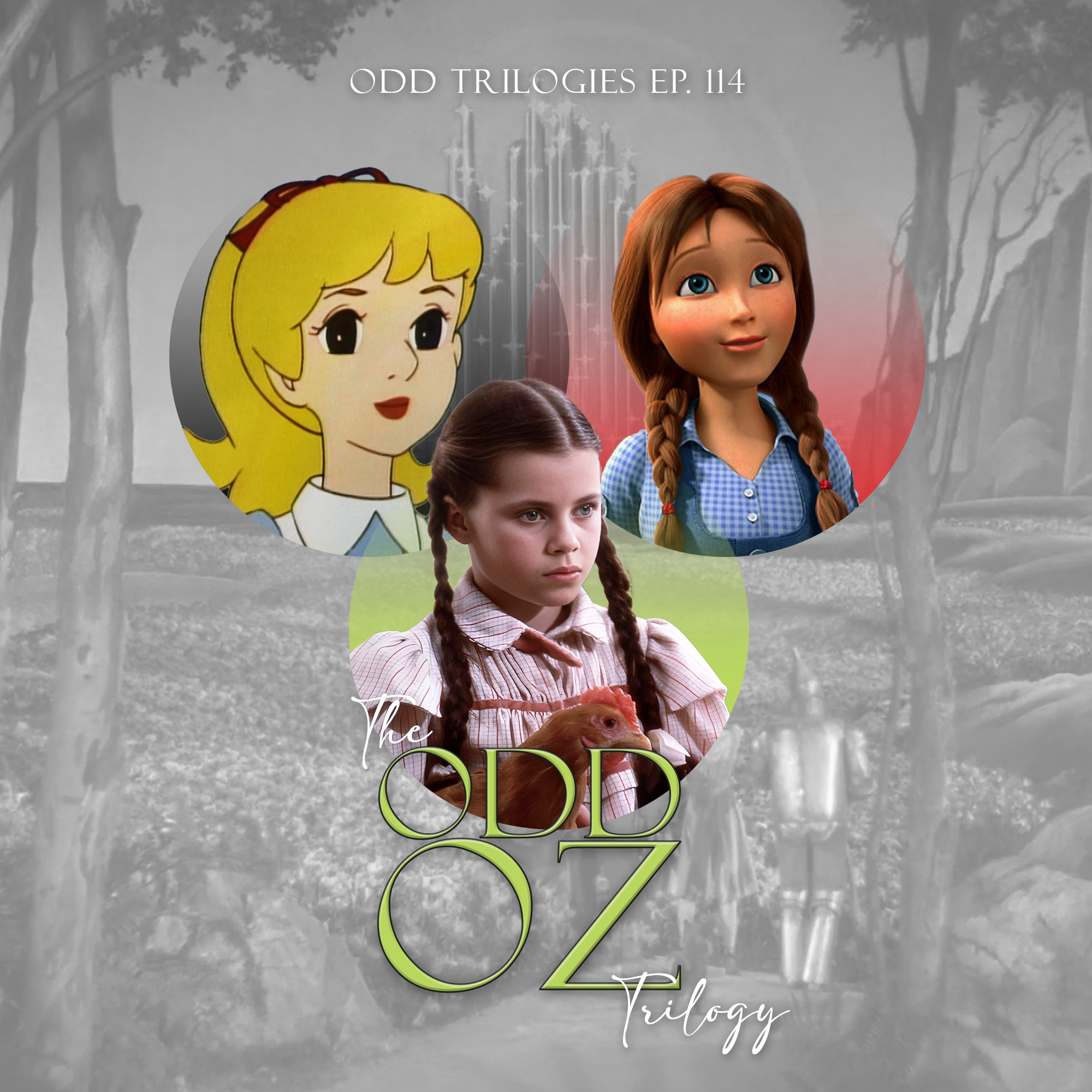
And today, in honor of the release of Wicked for Good for our final November trilogy, we thought it would be interesting to cover something that most people don't really think about. Because the thing about the franchise, I guess, wow, saying franchise makes me feel gross. But it's kind of truly comes to Oz.
[00:01:58] Speaker B: Yeah, it's kind of more of an IP, I guess than a single franchise.
[00:02:02] Speaker A: I feel like I'm cocky the gun when I say Oz as an ip.
[00:02:06] Speaker B: The Oz franchise, the Oz ip.
[00:02:09] Speaker A: But wizard of Oz being a novel series that became an iconic film in 1939.
[00:02:15] Speaker B: Right.
[00:02:15] Speaker A: With the classic Julie Garland film. It is kind of wild to think of it as an IP because for most people it begins and ends usually with the 39 film.
And Wicked because to be completely honest, Oz as a brand really hasn't hit any kind of stride in the last century until now with Wicked.
[00:02:40] Speaker B: I mean.
[00:02:40] Speaker A: Cause Wicked adaptation of a 20 plus year old musical.
[00:02:44] Speaker B: Right. I mean the Wicked was to some degree its own sensation when it was a book, like when the book was published. And then again obviously the Broadway show was a huge hit. But even still, Broadway is kind of its own sphere. Yeah. The music certainly became popular. Defying gravity and things. But yeah. With the release of the film adaptation last year. Was that last year?
[00:03:08] Speaker A: Yeah, the first act.
First act.
[00:03:12] Speaker B: The first that really took the franchise to new heights.
[00:03:17] Speaker A: And here's the thing. I think with both of us, we might have talked about it last year too, when Wicked was coming out in a way, shape or form. But, like, neither one of us expected the popularity, the hit.
[00:03:27] Speaker B: I gotta be honest, I didn't even expect it to be good.
[00:03:30] Speaker A: Me neither.
[00:03:31] Speaker B: I didn't think the trailers made it look very good.
[00:03:33] Speaker A: I wanted it to be, but that doesn't mean it was going to me.
[00:03:36] Speaker B: Well. And I am notoriously a musical hater. But even putting that aside, watching the trailers, I remember last year being like, is this. This isn't gonna be good. Right?
[00:03:48] Speaker A: One of my favorite.
[00:03:49] Speaker B: And then it came out and everybody loved it too.
[00:03:51] Speaker A: One of my favorite Andy stories.
Cause I don't even think he remembers this when you were talking to me. But we were both in college at.
And La La Land had just come and we were talking. You know, we're just texting each other about La La Land. And I'm. I swear to God. Andy texted me at one point, he said, I really liked the movie anytime there wasn't a musical number. And I said, andy, it is a musical.
[00:04:15] Speaker B: Right? Right.
Yeah.
[00:04:17] Speaker A: Did you know what you were getting into?
[00:04:20] Speaker B: I've matured a hair since then. And actually, I still love that movie. I still love that movie. And I love a lot of the music in it.
I think to this day, how I feel about that movie is I like it the less. It is trying to be a traditional show, showy musical, because early in the movie it does a lot of kind of classical show tune style bits and I'm less into those. But then as it goes on, it's more kind of sad.
[00:04:48] Speaker A: And if the entire film was all the numbers, I do think it would be, but it would make the film less magical. But it is, because, again, yeah, the musical numbers are used in that to show, like, you know, the magic of first love, the magic of la, of stardom.
[00:05:05] Speaker B: Yeah. And then you kind of crumble that illusion over the course of the film.
[00:05:08] Speaker A: Yeah. This has nothing to do with what we're talking about today. Today we're talking about. Yeah.
[00:05:13] Speaker B: Which is Wicked, which is wizard of Oz, which is what we're talking about. Yeah.
[00:05:16] Speaker A: La La Land, though.
[00:05:17] Speaker B: Transitive property.
[00:05:18] Speaker A: Yeah. We are discussing today Maybe our first of many, depending on how many more Wicked films come out of. Good.
But this is a.
Our first, maybe last Odd Oz trilogy. Yeah, this is kind of something we haven't done in a little while, probably since Odd Pinocchio.
[00:05:38] Speaker B: Yeah, that was a couple. Few years ago, which is basically.
[00:05:40] Speaker A: We did it. We did years ago. We did something like an odd Nutcracker.
[00:05:43] Speaker B: Yeah.
[00:05:45] Speaker A: And then an Odd Pinocchio, which is basically kind of taking you know, adaptations to a degree of a popular novel and just watching and you know, kind of dissecting. How exactly do you take this, you know, popular or at least an iconic version of this novel, and how do you, like, push it aside to make your own version of it or how do you use it to bounce off to make a different version?
[00:06:11] Speaker B: Yeah. And longtime listeners know we kind of. Not all of our trilogies fit this bill, but like, a lot of our trilogies kind of fall into different sort of veins or categories. You know, we have our rise ofs, which are all about, like, chronicling the early films of certain filmmakers or whatever, and samplers, which kind of piecemeal collaborations between, you know, filmmakers and stuff. And then. Yeah, our odd blank trilogies are just. Yeah, it's just kind of like. Usually it's like an IP or a public domain story that has just stood the test of time and has had countless wildly diverse adaptations over the years. And so we pick three of them. Or in this case, you pick three of them.
[00:06:56] Speaker A: Well, Bomb's novel series, Oz series, is, as of this year, 125 years old. The original wizard of Oz was published in 1900, about 1314 novels between 1900 and 1920, excluding short story compilations. So it's safe to say the wizard of Oz has been around.
[00:07:17] Speaker B: Yeah.
[00:07:18] Speaker A: And it's kind of this funny thing when we discuss wizard of Oz, because it's like there is not a shortage of adaptations of these books. There is, like, if you look at a decade, there's at least one or two attempts.
[00:07:32] Speaker B: Yeah.
[00:07:32] Speaker A: Even before the Judy Garland one, I think the. The early, like 1910, 1915 in the silent film era. And so it's like when we were talking, when I was kind of suggesting to Andy we do something in honor of Wicked for good, making $800 billion possibly by the time this is out.
We thought it would. I thought it'd be interesting to talk about specifically, you know, talk about three films that are. Three different approaches to the Oz IP is the best way to put it. But also using that and talking about, like, just, you know, These aren't three films that are meant to be like, you watch this one first, then you watch this one second, this one third. It is like, with our odd. Our odd Blank trilogy moniker. This is just like a fun.
Let's look at how all these different. These three vastly different types of studios, different types of creatives focus on making these stories.
[00:08:29] Speaker B: Right. And, you know, and also, I think it's worth noting, specifically with Oz, how much the Judy Garland movie informed, like, culturally, has informed our perception of what the story and the world of Oz is like. And so these three are interesting in that they are not doing that version, but they're also, like, not entirely departing from that version. You know, each one of these makes choices that are like, clearly, like, oh, that's how it happened in the book, not the movie.
[00:09:02] Speaker A: Yeah.
[00:09:02] Speaker B: And blah, blah, blah. But then they'll also have like, yeah, pieces from the movie version that get in there just because they're so iconic.
[00:09:11] Speaker A: Yeah, they'll.
[00:09:11] Speaker B: There's.
[00:09:12] Speaker A: Especially with our second film when we talk about today, which, again, just getting Ramble City right now, but the three films we're talking about today is 1982's the wizard of Oz, which is a Japanese anime.
[00:09:24] Speaker B: Yeah.
[00:09:24] Speaker A: It's about less than 80 minutes.
[00:09:26] Speaker B: Right.
[00:09:27] Speaker A: It's directed by the guy who, if you are a longtime listener, we are both huge Gundam nerds.
[00:09:32] Speaker B: Yeah. Fumihiko Takayama, who's known for the guy.
[00:09:35] Speaker A: That did War in the Pocket, which is an OVA series. One of the best Gundam pieces, pieces of Gundam media we've either watched.
So. Yeah, you know, Oz, I guess, is a Gundam show now. Yeah, we're talking about that. We're talking about 1985. Probably the most notable of the three films that most people would know is Return to Oz. It was a Disney's attempt.
[00:09:55] Speaker B: Yeah.
[00:09:56] Speaker A: To basically bounce off of the 30s film, but in a way that is vastly different from the 30s film.
And in a sense that you don't really know what exactly it was trying to do, other than just trying to capitalize on, you know, oh, it's been 40 years.
[00:10:14] Speaker B: Right.
[00:10:14] Speaker A: Let's see if anyone wants to watch this. And then we're gonna watch, I think would probably be the most standard version of what you think a.
An Oz film is in an era of like. I've never heard of that film before. It's Legends of Oz.
[00:10:29] Speaker B: Yeah.
[00:10:29] Speaker A: Dorothy's return from 2013, which is pretty much. Which, when we get to that, once we describe, you know, involved what it's about, you'll understand why? It feels very. Of its era. All three of these films definitely do. But it is funny to think that, like, you bring up the Garland film, like what we're going to constantly bring up, because it's in the 82 film, even though we watched the dub of it, which the dub of that movie has the.
Has the actress who plays Annie in 82's Annie.
[00:11:03] Speaker B: Yeah. God, what's her name?
[00:11:04] Speaker A: Dorothy. Apparently in the Japanese original audio, they had the Japanese actress who apparently did the dub for Judy Garland for the Japanese version of wizard of Oz.
So already there.
[00:11:20] Speaker B: Yeah.
[00:11:20] Speaker A: They're using the woman who already is probably in so many people's heads, Dorothy Gale.
[00:11:25] Speaker B: Right.
[00:11:26] Speaker A: For this anime version. And this. The anime version of wizard of Oz is more of a direct, stronger adaptation of the book. Of the book.
[00:11:35] Speaker B: Yeah.
[00:11:37] Speaker A: It is 30 minutes shorter.
[00:11:40] Speaker B: Yeah. And it also still, it makes the same creative choice to do original musical numbers, although they are obviously not the same ones that are in the movie or in the original movie.
[00:11:52] Speaker A: Yeah. Two of these three films are musicals.
[00:11:55] Speaker B: Yeah. I mean, I think. I guess at this point, culturally, we kind of associate Oz with songs.
[00:12:01] Speaker A: Wicked has not. Has not helped that at all.
[00:12:03] Speaker B: Right, yeah.
[00:12:05] Speaker A: Let's not stop that.
[00:12:06] Speaker B: But, yeah. Interestingly, this 82 version of wizard of Oz, despite being Japanese in origin and done by a Japanese animation group, doesn't look like it. It's very much in a more Western kind of Disney ish style, which was very unusual for the time in Japan.
But I think the idea was appeal to the people who know Oz, which is more the West.
[00:12:37] Speaker A: No, for sure. I think Dorothy's probably the closest. Dorothy kind of looks like a.
[00:12:42] Speaker B: She does look a little bit like.
[00:12:43] Speaker A: An Astro Boy character.
[00:12:44] Speaker B: Early anime. Yeah.
[00:12:46] Speaker A: But the Tin man, the lion, the, you know, the Scarecrow, they all have these very cartoony, very lavish, kind of more. I think the designs of those characters are like, oh, that's cute. They're not trying to evoke the 30s film. They definitely try to do something.
[00:13:03] Speaker B: They're appreciably different. Yeah.
[00:13:07] Speaker A: That being said, the musical numbers are not great.
[00:13:11] Speaker B: No, they're not great. And look, I don't want to pin it all on her because she didn't write the songs. She just sang what she was supposed to. But Aileen Quinn, who voices Dorothy in the English dub and voiced Annie in the. The same year in the Annie film adaptation, who's probably listening now. So, yeah, she.
She's grading in this movie, and that's partly because the songs are just not that great. It's Partly because the recording quality is not very good.
[00:13:43] Speaker A: Depend on how much you love musicals in terms of, like, how this description will be to the listener out there if. But the way that I would describe it to people is that if you've heard someone sing in a way that is like, I am singing. This is a song I like singing. Here's my song.
[00:13:59] Speaker B: Yeah.
[00:14:00] Speaker A: Like that kind of feeling where it's like you. There's no rhyme or reason to the song, but you feel like you have to sing in some way. So you're making it up as you go along.
[00:14:11] Speaker B: Well.
[00:14:11] Speaker A: And also has that energy.
[00:14:13] Speaker B: Yeah. And also that very childlike lack of volume control where you're just cut. You're kind of shout, shout singing. You're kind of forcing it out of the chest.
[00:14:23] Speaker A: She does sing most of these songs. I can't think of what other songs does she. Who else sings in here besides her?
[00:14:32] Speaker B: I only remember her singing, I think so. Yeah. Yeah. I mean, they might have kind of backing vocals from some of the other cast, but it's mostly like they do like, what, four. Yeah, it's like four or so musical numbers. And then they reprise the first one at the end three times.
[00:14:50] Speaker A: They do it in the actual film. And then I think they use it again for the credits.
[00:14:53] Speaker B: Yeah. And she has this. In that. That one that they repeat multiple times. She has this fucking line in it I wrote down, but I can't find.
It was like, tra. She sings like, TRA la la oom papa. And then laughs into the microphone in the middle of the song. And it's the same recording all three times. So you just hear that same laugh into the mic every time. And she's like, what are we. What are we doing?
[00:15:20] Speaker A: Yeah.
[00:15:20] Speaker B: Capturing childlike whimsy. I guess it.
[00:15:23] Speaker A: If you can't already tell, it's not really that good.
[00:15:26] Speaker B: No, it's.
[00:15:27] Speaker A: It's. It is. I can see this being something that is like a tele. I think. I think it was made for TV probably an extent. And it was something that, you know, it's. I can imagine as a child, if you just use. It's one of those films, I feel like, oh, there's bright colors on the screen. I know. Wizard of Oz. I'm going to sit and watch wizard of Oz things.
[00:15:48] Speaker B: Yeah.
[00:15:48] Speaker A: And I mean, to be fair, I guess you can give it props for being more accurate to the novel. There is the one section that is the. I can't remember what the creature is called, but it's like the giant panther.
[00:16:00] Speaker B: Like oh yeah, you know what? And I just. I actually read the book in prep for this just. Cause I never actually read it.
[00:16:09] Speaker A: You actually read wizard of Oz?
[00:16:11] Speaker B: I read the original wizard of Oz. I started Marvelous Land of Oz, which is the second one, which serves as part of the basis for Return to Oz. I did not finish it or get to the third one, which is the other basis for Return to Oz. But I did read the first one.
Yeah, it's like. It's not carrot ed or something. It's like it's. I think it starts with a K or C sound. But yeah, the like wild cat.
[00:16:35] Speaker A: It's like a wild cat creature that shows up that's not in the original film or the original 30s.
[00:16:40] Speaker B: Yeah.
[00:16:41] Speaker A: Film and is kind of like. It's a giant panther tiger thing that is like, you know, chasing after them in the forest.
And this is one of those movies where like, I mean, when we were talking about doing this and I was like, oh my gosh, this is barely 80 minutes, this will be fine. And then we started what. I started watching it and I was like, unfortunately, this is one of those 70 minute films where I kind of wish I was watching the two hour long original. Yeah, yeah, the original Judy Garland film. Because in all honesty, like, it's just, it is the bare bones beat for beat.
You know, most of the story.
You know, she's got a sing about, you know, not wanting to leave home or like losing Toto and then she sucked up and then kills the witch. And.
[00:17:28] Speaker B: Well, and it's, it's funny too because this is. Yeah, like you said, it's obviously trying to be a little bit more accurate or direct adaptation of the book rather than, you know, trying to be the movie.
But it still has to make kind of a lot of the same concessions as the Judy Garland movie in order to fit a reasonable runtime and ends up like structurally basically being exactly the same as the Judy Garland movie. It just kind of plugs in scenes from the book instead of the scenes that they do in the Judy Garland movie. And so like, it really doesn't feel that different except that it's like, oh, I don't remember seeing this character or this monster in the Judy Garland film because it's from the book.
But yeah, it, both the Judy Garland movie and this 82 adaptation really compress the like last act of the book because yeah, we all think of like, okay, Dorothy destroys the witch and then she goes back to Oz and exposes Oz and then, yeah, Glinda shows up and Dorothy clicks her heels and she goes home. In the book, the journey back to Oz is as arduous, if not more arduous than the journey out to go find the Wicked Witch out in the West.
And so it's this really drawn out thing. And then even after they get back to Oz and they expose the wizard, then they can't, they don't know how to get home, so they have to go journey to go find Glinda the Witch of the North. So they go on this journey to go get Glinda and Glinda's like, you didn't have to come all this way. You can just click your heels together.
[00:19:15] Speaker A: Props to the 30s film for finding a way around that.
[00:19:17] Speaker B: Yeah.
[00:19:18] Speaker A: Being like, no, why'd you do that?
[00:19:19] Speaker B: Right? It's, it's. I mean, I think, you know, the books come from an era that, you know, the style of storytelling was different than we're used to. It's almost, you know, kind of like the Lord of the Rings books where like they destroy the ring and then you still have like multiple hundreds of pages left until the story's actually over, which is wild.
[00:19:40] Speaker A: I never would have thought the Oz books would have been like that too. But then again, I do know that the Oz books have a lot of social commentary, even some politics, like political kind of aspects to it later on too. And of the era. But yeah, I mean, it was kind of like an interesting, it was interesting to be like, it's been 30 plus years since the original film.
How is the studio just gonna, you know, do it again? Yeah, and it really is like, it's a mix of. Oh, there's a little bit of difference here. But yeah, we're just gonna do it again.
[00:20:11] Speaker B: Yeah, it's a, it's a respectable exercise to be like. Well, obviously the wizard of Oz, the Judy Garland movie is not like inappropriate for kids. It's pretty kid friendly. But the goal of this movie seems to be let's do the book more faithfully but still make it more palatable for children. I mean, the original book was made for children, but due to cultural changes over time, like a lot of the violence and stuff in the book is cut out in pretty much all movie adaptations.
[00:20:43] Speaker A: It's like a grim fairy tale type of.
[00:20:45] Speaker B: Yeah, it kind of is. Yeah.
And so, yeah, I guess I appreciate it in that sense. It's like, oh, let's do a stripped down faithful adaptation but still make it a very charming kids movie.
And it just, but it, you know, it's just, frankly not that interesting.
[00:21:03] Speaker A: Yeah.
[00:21:03] Speaker B: And, you know, it's clearly not. Probably didn't have that big of a budget. And also, who knows, since we.
We only had access to the dub, you know, maybe watching it in the original language would be better. I don't know.
[00:21:19] Speaker A: Yeah. Maybe the music sounds better in Japanese.
[00:21:21] Speaker B: Yeah.
[00:21:21] Speaker A: But, yeah, I mean, it was. It was a. It was kind of a. Almost like a palate cleanse being like a good idea to start with this one, just to be like. Okay, so we're starting with an adaptation that is just, you know, clearly wanting to do a little bit of its own thing by hearkening back to the books more, but also at the same time with the musical numbers as well as the structure.
Clearly trying to evoke the 30s film without just looking at the camera and winking.
That is not the case with their second film.
[00:21:54] Speaker B: Right.
[00:21:55] Speaker A: Because our second film, while our second film is not an MGM film.
So they do not have the rights to Ruby Slippers. They didn't, you know, they weren't a part of the original film's production.
It's still Disney and wildly enough, despite, you know, 40, nearly 40 years after the. After the 30s film came out, they are making a sequel. Pseudo sequel.
Standalone film.
[00:22:27] Speaker B: Yeah.
[00:22:28] Speaker A: That is like, clearly trying to do a lot, like, with this first film we talked about where it's like, trying to pull more from the book.
[00:22:37] Speaker B: Right.
[00:22:38] Speaker A: But in more in a way that feels like to get around copyright, yet at the same time willing to pay certain amounts of money to get things from the 30s film that aren't even in the book.
[00:22:50] Speaker B: Yeah.
[00:22:50] Speaker A: Because the big thing which. Talk about now, which I think most people know, is that the Ruby Slippers was a Technicolor choice.
[00:22:56] Speaker B: Right.
[00:22:57] Speaker A: It was never in the original book.
[00:22:58] Speaker B: We need something that's gonna pop. Yeah. We need something that's gonna pop on screen. Yeah. Let's do bright red.
[00:23:04] Speaker A: So Ruby Slippers are basically owned by mgm.
[00:23:07] Speaker B: Yeah.
[00:23:08] Speaker A: Like trademark wise. And so anytime you see Ruby Slippers in anything that is hearkening to wizard of Oz basically means MGM has gotten some sense of money.
[00:23:20] Speaker B: Yeah.
[00:23:21] Speaker A: Through that transaction. It's one of the reasons why, you know, we've. Which, to be honest, if we had not already talked about this film years ago, we probably would have put this on this trilogy. But Oz, the Great and the Powerful.
[00:23:33] Speaker B: Yeah.
[00:23:34] Speaker A: I think there's a tease where you see the slippers at a certain point, but it's the Silver slippers.
[00:23:38] Speaker B: Isn't there a sequence at the beginning or end of that movie where the camera's Kind of like zooming through Oz and you sort of see Dorothy and the lion and the Tin man, like, walking down the yellow brick road.
[00:23:51] Speaker A: Wicked.
[00:23:52] Speaker B: Oh, is that Wicked? Okay. Yeah.
[00:23:54] Speaker A: Okay, then that's the end of Wicked.
[00:23:56] Speaker B: Yeah, I think you're right.
[00:23:58] Speaker A: Which Wicked is also doing the Silver slippers.
[00:24:00] Speaker B: Right.
[00:24:00] Speaker A: Because that's. That's in the show. But that's also the classic novel.
But Return to Oz from 85 is doing this thing where they're doing like, they're calling the Tin man the Tin Woodsman.
[00:24:12] Speaker B: The Tin Woodman, which is his book name. Yeah.
[00:24:15] Speaker A: They are doing like more book accurate, like, backgrounds of all these characters.
[00:24:21] Speaker B: Yeah, well, they're not talking about the.
[00:24:23] Speaker A: Scarecrow Wanted a Brain. They're not talking about the Tin Man.
[00:24:26] Speaker B: Right.
[00:24:27] Speaker A: This and that.
[00:24:28] Speaker B: The interesting thing about Return to Oz is that you're right in that it's trying to do something distinctly different and stand on its own. But it also does at times need to rely on the Julie Garland film references to make sense to people. Because it's actually. It says in the opening credits based on the Marvelous Land of Oz and Oz and Ozma of Oz, which are the second and third books.
And Dorothy is not in the second book.
Oh, so what? It really. The. The movie is really an adaptation of the third book and all of the events of the second book happen before Return to Oz.
So, like, I read the beginning, I didn't get done with it, but I started the Land of Marvelous Land of Oz, which is the second book.
And Dorothy's not in that one. But you see the creation of Jack Pumpkinhead and he's a main character in both the book and in this movie Return to Oz. But when we meet him in Return to Oz, he has a history already. He's already existed.
So it's kind of like, well, what if we just only told Dorothy's perspective of these two books.
[00:25:44] Speaker A: Yeah.
[00:25:45] Speaker B: Which is. Dorothy doesn't have a perspective of the second book, so she's finding out stuff when she comes back to Oz.
[00:25:51] Speaker A: Because I guess we technically have had a film on the show that has a similar situation. Like with Tales from Earthsea.
[00:25:58] Speaker B: Yeah.
[00:25:58] Speaker A: When that was like, we. That movie is basically book three or four.
[00:26:02] Speaker B: Yeah.
[00:26:02] Speaker A: And like, you're just jumping in headfirst, being like, I have no context of what these are. And the film doesn't really do a good job of explaining that.
[00:26:10] Speaker B: Yeah.
[00:26:10] Speaker A: Well, I think Return to Oz does a solid job of using Dorothy not understanding what happened to Oz as a way to kind of like.
[00:26:18] Speaker B: Yeah, it's a good audience vessel to exposit what has happened in Oz while she was away.
[00:26:25] Speaker A: The thing, though, that really throws you off immediately and why this film is so notorious is that, you know, Return to Oz has this kind of interesting identity crisis. Seems a little extreme because it clearly has a vision.
[00:26:43] Speaker B: Yeah.
[00:26:44] Speaker A: But in terms of its narrative, there is a bit of an identity crisis in the fact of, like, is this plot point going to be based off of the books or is this gonna be based off of the MGM version of the book? This.
[00:27:00] Speaker B: Yeah.
[00:27:00] Speaker A: And it's like this kind of in between of like, the movie is drab.
The first part of Return to Oz reminds me of James and the giant peach.
[00:27:11] Speaker B: Yeah. I was saying the same thing to our friend Adam.
Yeah. It's kind of grim in an unexpected way. Like, oh, Dorothy's being sent to a mental hospital to fix her delusions about Oz.
[00:27:27] Speaker A: She needs shock therapy to sleep.
[00:27:29] Speaker B: It's Return to Oz is Jacob's ladder to Oz.
[00:27:33] Speaker A: It was just like. It was fucking wild how it was like, because I'm like, in my head, like, because Adam and I were watching this and I was like, I've never actually seen this, so I don't even really know, timeline wise, if they're even trying to pretend like it's involved with the original the 30s film. And they pretty much.
There's ruby slippers.
[00:27:52] Speaker B: Yeah.
[00:27:53] Speaker A: They talk it like, they're clearly, like, trying to be like, this is not a sequel to the 30s film, but if you want it to be.
[00:27:59] Speaker B: Right.
[00:27:59] Speaker A: And it's like. Because, like, they basically go like, it's been six months.
And I'm like, it's only been six months since what? The 30s film kind of talks about what the fuck? And it's like, she can't sleep. Auntie Em and Uncle Henry are trying to rebuild their house because a tornado fucking hit their house in the original story.
[00:28:20] Speaker B: And so like, Auntie Em also being played by Piper Laurie, who is Carrie's mom in the original film. Carrie.
[00:28:27] Speaker A: Yes.
[00:28:28] Speaker B: Yeah.
[00:28:28] Speaker A: They're gonna laugh at you.
[00:28:30] Speaker B: Yeah. So it's. It's in. In. That's an interesting. I don't know if it's necessarily like a deliberate callback, but, like, that through line is interesting because you. You get a sense for a second of that same kind of controlling hostility.
[00:28:43] Speaker A: Yeah.
[00:28:45] Speaker B: Which is not really upheld at the end, but it was weird, like, because I just watched Carrie recently, like, back in October and see her pop up in this. I was like, oh, God, is she gonna torment Dorothy and hate her and.
[00:28:59] Speaker A: Abuse Her Uncle Henry broke his leg at some point while making the house. And now he's in, like, recovery. But also, it's almost implied he has trauma from hurting himself trying to fix the house.
[00:29:10] Speaker B: Yeah.
[00:29:10] Speaker A: He's afraid to do it.
[00:29:12] Speaker B: And there's some, like, resentment from Auntie M, who is kind of mad that he's not doing anything, but also knows that he can't do anything.
[00:29:19] Speaker A: So the first 30 minutes of this movie is like, you going, I everything do not understand how we're going to get to Oz. But I really want to get to Oz.
[00:29:29] Speaker B: Yeah.
[00:29:29] Speaker A: I don't.
[00:29:30] Speaker B: Get me out of here.
[00:29:31] Speaker A: And God, the movie just, like, goes to a point where it's like, Dorothy gets taken to the hospital, she nearly gets shocked. A lightning storm happens that, like.
Like, we find out later, burns the asylum down.
[00:29:45] Speaker B: Yeah. When you get the impression that this asylum that she's in, they're, like, doing experimental, nefarious things to their patients. Like, they're gonna try out something they've never tried before on Dorothy.
[00:29:57] Speaker A: Like some, like. Like some American Horror Story, like, asylum shit. And it's like, why. I know it's the early 1900s, and when I think of medicine and the.
[00:30:06] Speaker B: Medical science is not very.
[00:30:07] Speaker A: That's horrifying.
[00:30:09] Speaker B: Yeah.
[00:30:09] Speaker A: But why is that the choice for this film? And it's like. Cause it's also, like, there's no attempt to do, like, a Technicolor changeover for.
[00:30:20] Speaker B: Going into Oz, because as we find out, Oz is also kind of in a state of desolation.
[00:30:26] Speaker A: Yes. It is this weird kind of situation where it's like, God, the real world sucks.
I want Oz to take me away. And then Oz is like, oz also sucks. Oz also sucks.
[00:30:37] Speaker B: Oz has a bunch of weird punks on rollerblades on all fours.
[00:30:42] Speaker A: Yeah. You find out Return to Oz at the gate goes, when they get to Oz, one Toto is not the animal sidekick anymore. Toto was just left behind.
Even though, let's be honest, as much as the original Toto is cute, I do like the Return to Oz Toto a little bit more. I just like that dog a little cuter. A little cuter. Little scruffy. But he's not a part of it. No. We have a talking chicken, Belinda, who is like, it. Just every time I saw a real chicken being held, I'm like, I couldn't do that for my life. I would not want to do that.
[00:31:21] Speaker B: Yeah.
[00:31:22] Speaker A: That poor little girl who most people would probably know her from the craft.
[00:31:28] Speaker B: The craft. And she's also the Water Boy. That's where I was Adam Sandler's love interest in the Water Boy. Farouza.
[00:31:34] Speaker A: Bulk for the Bulk, you know. Yeah. She was.
[00:31:37] Speaker B: This was her first on screen role.
[00:31:39] Speaker A: Yeah. And I will have to say she is doing a really good job.
[00:31:45] Speaker B: Yeah, she's good at this.
[00:31:45] Speaker A: There is moment. There are moments when AB And I were watching this that I looked at him and said, you just catch that? She just did some little Garland shit. She's just a little bit of Judy Garland.
[00:31:56] Speaker B: Yeah.
[00:31:56] Speaker A: Just right there where it's just like a. Golly gee.
[00:31:58] Speaker B: Yeah. The ability to just like, pepper in little things like that.
[00:32:01] Speaker A: And I'm like, this is a child. She's doing it so easily and she's so, like, emotionally invested.
[00:32:07] Speaker B: Yeah.
[00:32:08] Speaker A: And this poor child is just like holding a chicken for like a hot moment of this movie.
[00:32:13] Speaker B: Yeah. I have to say, though, on the chicken, a note of positivity. Pretty impressive. Animatronic chicken in certain. Or puppet chicken in certain shots.
[00:32:23] Speaker A: Oh, yeah, they mix.
[00:32:24] Speaker B: They do a mix of her carrying a real chicken and her carrying a puppet.
[00:32:28] Speaker A: We should also say, too, this is not a Jim Henson Creature Shop film, per se, but it does have a lot of Henson alums.
[00:32:35] Speaker B: Yeah.
[00:32:35] Speaker A: Including Henson's own son, Brian Henson, who plays the voice of Jack Pumpkinhead.
[00:32:41] Speaker B: Right.
[00:32:42] Speaker A: So, like, a lot of the. The effects in this movie are phenomenal.
[00:32:45] Speaker B: Yeah, they're really fun.
[00:32:47] Speaker A: Unsurprisingly, all the blue screen stuff has aged probably the most. Like.
[00:32:51] Speaker B: Sure.
[00:32:52] Speaker A: But the stop motion, the puppeteering, puppeteering, animatronics. So well done. It is. It was the thing I kept saying when I was watching with Adam is like, every single time a new character, a part of the team, a part of Dorothy's new team. Because the lion, the tin woodsman and the scarecrow are all basically either captured or set in turn to stone.
[00:33:14] Speaker B: Yeah.
[00:33:15] Speaker A: They're not a part of the plot in this film. Really.
Every single new character that is added to Dorothy's team, which is the mechanical soldier, Tick Tock.
[00:33:25] Speaker B: Jack Pumpkinhead.
[00:33:26] Speaker A: Pumpkinhead. Gump.
[00:33:29] Speaker B: Gump. Oh, the horse head or moose.
[00:33:32] Speaker A: Green moose head. Is brought to life with magic.
[00:33:35] Speaker B: He is a Gump. His, like, his species is Gump, but I think. But I think that's his name.
[00:33:40] Speaker A: He doesn't remember who he was.
He just calls him. They all call him Gump.
Every single time a new character is introduced, I turned to Adam and said, it's like every single one of the anime, like, the director, everyone around was trying to make the hardest version of a Fucking character to, like, make it their life a living hell. You have Tick Tock. Who is this?
[00:34:04] Speaker B: Like, he's the tin Woodman, but you have to wind him up.
[00:34:07] Speaker A: Yes. He has three different, like, little keys. One is for thought, one is for movement and one is for speech.
[00:34:14] Speaker B: Yeah.
[00:34:15] Speaker A: He's, again, great designs across the board. Tick Tock is awesome, but he is a fucking copper. R2D2 that is the size of two R2D2s, enormous lengthwise. And he clearly has someone in a suit at times. And, like, you can't. Like, he has to move like he's in a bubble suit.
[00:34:34] Speaker B: Yeah.
[00:34:35] Speaker A: It's like difficult to make it look like he's heavy, but also not trip at every little moment.
[00:34:41] Speaker B: Yeah. It's such an odd. It's a design you would expect to see in animation because he's got a very. His legs are very far apart. He's short and stout. His legs are far apart. His body is almost completely spherical. Yeah, almost. More like. Yeah, like a rugby ball. So it's like, do you have two people in there?
[00:35:01] Speaker A: Yeah.
[00:35:02] Speaker B: Or do you have two very small people?
[00:35:03] Speaker A: It's like. It's like I kept being like. I don't even think you could. Like. I think he's just big enough. A little person would be. It would be cumbersome.
[00:35:11] Speaker B: Yeah.
[00:35:11] Speaker A: You'd have to have a child or like a smaller woman.
[00:35:15] Speaker B: Yeah. Such a bizarre. Yeah, but like, cool. I mean, the fact that they have wide shots of TikTok walking across the room unassisted, I was like, how?
[00:35:28] Speaker A: Then they would hard cut to Belinda, who has a real chicken at times. And also there are moments where there is a fake chicken, an animatronic chicken that sometimes has articulation in the talons.
[00:35:40] Speaker B: Yeah.
[00:35:40] Speaker A: There's a one point where Belinda, like a cartoon character, pulls up its talons and points.
And I'm like. The camera can barely even register because it has to stay in frame. And it's like you built talons that point like people animatronic legs. And then it's like, ok, that's already a lot. And then you're looking at the sets because this is a movie that clearly has so much effort put in. From the set design to the look of it, the costumes. There is an antagonistic force called the Wheelers, where their helmets are horrifying faces.
[00:36:18] Speaker B: Yeah, well, because. So the Wheelers, the way they move around is on all fours, but all four of their extremities, their hands and feet are wheels.
So they move around on all fours. On wheels. So when you first see them, they come riding in and they look like these terrifying humanoid monsters. And then they lift their heads up to talk, and it's like, oh, that was their helmet.
[00:36:40] Speaker A: Yeah.
[00:36:41] Speaker B: With the horrifying face on it.
[00:36:42] Speaker A: And it was. And then it's like, oh, my gosh. They're all, like, basically, like, in one walker formation. Like, their bodies.
[00:36:48] Speaker B: Yeah. They look like ats.
[00:36:50] Speaker A: Yeah, they. They are initially horrifying, and then they become absolutely goofy.
[00:36:55] Speaker B: Just silly. Yeah.
[00:36:56] Speaker A: The silliest things possible, but they're horrifying designs.
When they go to Princess Mom's castle, it's like all mirrors.
[00:37:05] Speaker B: Yeah.
[00:37:06] Speaker A: Just insane to think with all the kind of articulation and, like, the effects.
[00:37:11] Speaker B: Yeah.
[00:37:12] Speaker A: And then when you get the jack pumpkin head, you're like, okay, now we're going from a rotund, just portly, like R2D2 Copperman to literally a stick figure with the biggest fucking head imaginable. And it has to go back and forth. You have to have someone who is slender enough to get away with, like, wearing, like, black sleeves to look like they're twigs.
[00:37:37] Speaker B: Yeah.
[00:37:37] Speaker A: Then also cut to a dummy that clearly has twigs for arms.
[00:37:42] Speaker B: And it's just like, yeah, the.
[00:37:43] Speaker A: How could this get any worse? And then they put a moose head.
[00:37:45] Speaker B: On a couch, and then the couch has to move around.
[00:37:48] Speaker A: And then we see the gnome king and it's like, my God.
[00:37:52] Speaker B: Oh, yeah, the gnome king.
[00:37:54] Speaker A: The gnome king is phenomenal. The gnome king is probably my favorite.
[00:37:57] Speaker B: Part animation, because he's like. He transforms over the course.
[00:38:01] Speaker A: And it's also like the amount of layers of the rock to use to extinguish his nose and, like, his upper lip.
[00:38:09] Speaker B: Yeah.
[00:38:10] Speaker A: And. Well, it makes sense as to why the scarecrow looks like shit.
[00:38:14] Speaker B: Yeah. Scarecrow feels like an afterthought.
[00:38:17] Speaker A: When Scarecrow shows up, it is literally a. They have a version of his face that, up close, can blink and move its mouth. But most of the shots are like mid shot to wide shot. And it's just a giant mask.
[00:38:32] Speaker B: Yeah.
[00:38:33] Speaker A: And the dude has to, like, move his body around all crazy to make it seem like he's talking a lot, but. But his mouth never moves. It is like the shittiest looking out of all the designs. And it's like, yeah, if I spent all my money on everybody else, I guess he's a smaller part of the story.
[00:38:49] Speaker B: Yeah.
[00:38:50] Speaker A: You can get around that. Because the lion looks good.
[00:38:54] Speaker B: Yeah.
[00:38:55] Speaker A: The tin woodsman, when he comes alive, looks fine.
[00:38:57] Speaker B: Yeah.
[00:38:58] Speaker A: But for some reason, Scarecrow just looks like, shit.
[00:39:00] Speaker B: Well, and part of that I think is the design because they do go for a more book accurate version of the scarecrow where like he's not. He doesn't have sewn and structured features in the book. He's just a burlap sack with painted on eyes and mouth, which is basically how he looks the next film.
[00:39:18] Speaker A: I mean, the next film does. Yeah, the next film does it too. So it makes sense.
[00:39:22] Speaker B: Like, it makes sense, but it does in comparison to the other character designs which are wild and elaborate and crazy. He just looks cheap.
[00:39:29] Speaker A: It's just a dude in a suit.
[00:39:31] Speaker B: Yeah.
[00:39:31] Speaker A: And hey, I understand because the amount of other animation like effects that are happening in this movie, this is the type of movie.
And again, it's because of the Jim Henson of it all. But yeah, like, it reminds me a lot of Dark Crystal. Like when I remember seeing that film for the first time, I was just in awe of the design of it in the animatronics and whatnot. But I also was not naive enough to be like, huh, I wonder why this movie didn't make its money back.
[00:40:02] Speaker B: Yeah.
[00:40:02] Speaker A: Like, Return to Oz is just like, I don't understand how any child. Like, I'm at least glad some people like this movie because I can imagine people fucking hated it.
[00:40:12] Speaker B: Yeah.
[00:40:13] Speaker A: Well, because this is not the Oz they were told.
[00:40:16] Speaker B: Yeah. Perusing like letterboxd reviews and stuff. It seems like a lot of people have a. Like, who saw this as kids have a relationship with it of like. This scared the shit out of me as a kid and now I love it because I had this fear of.
[00:40:29] Speaker A: It for so long because Princess Mombi's whole thing is that she was promised by the gnome king 30 heads.
[00:40:35] Speaker B: Yeah.
[00:40:36] Speaker A: She can constantly switch her head.
[00:40:38] Speaker B: I don't know what the advantage of that is.
[00:40:40] Speaker A: And there's this whole. There's a whole.
[00:40:42] Speaker B: What power do you gain by having multiple.
[00:40:45] Speaker A: Don't know. Maybe in the book you'll find out.
[00:40:47] Speaker B: Yeah.
[00:40:47] Speaker A: But there's a whole room of heads and they just fly. Follow Dorothy's eyeline the entire time.
[00:40:54] Speaker B: That seems actually pretty creepy.
[00:40:57] Speaker A: Yeah. And then when she has to get the magic powder and then fucking. And then like the. The main mombie head wakes up and then the body comes up.
[00:41:05] Speaker B: The body's running around the castle. Yeah.
[00:41:08] Speaker A: How the fuck do you think people that like the 30s film is going to watch that and be like, huh? Yeah, that's kind of cool. It's like, no. They'd be like, mom, I just shit myself.
[00:41:17] Speaker B: Can we go home?
[00:41:18] Speaker A: Is the line going to come up at any point? Is he going to make funny jokes?
[00:41:21] Speaker B: Where's the coward?
[00:41:22] Speaker A: What are they gonna sing?
[00:41:24] Speaker B: Yeah.
[00:41:24] Speaker A: Because there's no music. This is the only one that is.
[00:41:26] Speaker B: Not no musical numbers.
[00:41:28] Speaker A: And you know what? I appreciate that. I think it is better for it because with the next film and with our first film, you'll see that just because it's a musical, because the original's musical, doesn't mean it's a good thing.
[00:41:38] Speaker B: Just because you can have musical numbers.
[00:41:40] Speaker A: Doesn'T mean you should. But it is something that like.
Yeah, it just had. It had nightmare fuel for a kid in the 80s written all over it. And I think now finally being able to watch it, I appreciate it a lot. I enjoy aspects of it, I think, in my opinion. Yeah. I think when they get to the Gnome Kings, layer on, that's my favorite shit all the way to the end.
[00:42:07] Speaker B: Yeah.
[00:42:09] Speaker A: But I do think it says a lot to like, at a certain point when you get to the stuff and you're like, how's this going to end?
Because unlike the 30s film, you're kind of invested in her getting back in this movie. You're like, does she really need to go back home?
[00:42:24] Speaker B: Yeah, it sucks back home. And also she's like, she's so invested in fixing what's happening in Oz that it's like, you're not really even compelled to. I don't know. It's also the issue of.
[00:42:38] Speaker A: Well, you have.
[00:42:38] Speaker B: That it repeats kind of the structure of the original story.
[00:42:42] Speaker A: Yes.
[00:42:44] Speaker B: Except from kind of a apocalyptic starting point.
But unlike the original story, there's not like a moral to this movie.
So when you get to the kind of climax which is a similar. It's like an inversion of the wizard of Oz.
Yeah.
This sort of inversion of, you know, confronting the wizard of Oz and him being like, oh, you need.
You don't need a heart. You need. Or you already have your heart, you don't need courage, you already have it. Blah, blah. In this, instead of it being the wizard and learning or teaching each character a lesson, it's just the gnome king sending them into a room full of knickknacks to see if they can guess which knickknack is their friends.
[00:43:29] Speaker A: Yeah. And if you're clever enough.
[00:43:32] Speaker B: Yeah. There's.
It's like the same structure as the original story, but with no metaphor.
[00:43:38] Speaker A: Yeah.
[00:43:39] Speaker B: And it's odd because the film starts out, you know, this kind of grim, dark interpretation of like, oh, well, is Dorothy insane? Do her parents like, you know, not understand. You think, like, maybe that's gonna be. The moral of it is like, oh, the kids should. Or, yeah, parents should let kids be kids. Parents should believe kids when they tell them things.
[00:44:03] Speaker A: Yeah.
[00:44:03] Speaker B: But that.
It doesn't really come back up at the end.
She gets back and her parents are just excited that she's back.
[00:44:11] Speaker A: Auntie and Uncle Henry go, yeah, the asylum burned down. And the doctor who's gonna do the shock therapy. Who. The doctor also plays the gnome king.
[00:44:19] Speaker B: Yeah.
[00:44:19] Speaker A: Because they do the film. They do the 30s film thing where they have actors playing double duty to an extent.
They say, oh, yeah, the doctor just died in the asylum, in the fire. And also the main woman, who really didn't do anything mean to you, but had a mean energy.
[00:44:37] Speaker B: She gets arrested.
[00:44:38] Speaker A: Prison.
[00:44:38] Speaker B: Yeah.
[00:44:39] Speaker A: And I was like, God, could you imagine if the original wizard of Oz film was just like, dorothy, we're so glad you're okay. That mean old woman on the bike earlier just got hit by a sign and died.
Crazy.
[00:44:50] Speaker B: She drowned.
[00:44:52] Speaker A: Wild, right? Anyway, we're okay. We're so glad you're okay.
[00:44:56] Speaker B: Yeah.
[00:44:57] Speaker A: Does the book have the. The mechanic or like, the kind of the idea that the scarecrow looks like the farmhand or the wood Tinsman kind of looks like someone that works for her?
[00:45:08] Speaker B: No, they don't really go into that.
[00:45:10] Speaker A: Yeah, that's because I figured Return Laws was taking that from the movie, because I thought that was the movie thing. And it was just like, that's an. I guess that's cool. You could take someone that's like, you're not going to take an actor who's just going to be in for five minutes and not show up again. Because the gnome king rips.
And that actor is literally the. The shock therapy doctor for, like, two, three scenes.
[00:45:30] Speaker B: Yeah.
[00:45:30] Speaker A: Then doesn't show up for a while.
[00:45:31] Speaker B: And then shows up as the gnome king.
[00:45:33] Speaker A: And he's good. And mom bees the same way. But, like, it just. Yeah, it was.
It's a solid. It's like a solid three out of five.
[00:45:43] Speaker B: Yeah. I enjoy this almost entirely esthetically, like, I was compelled enough by the story, like, what's wrong with Oz? To get through it, but it was more just like, man, these effects are wild, Man. I fucking love Tick Tock. He's like one of my favorite character designs and, like, physical executions of a fantastical character I've seen in a long time.
[00:46:07] Speaker A: He is the classic, how do I make this my next D and D character energy.
[00:46:12] Speaker B: Yeah. He's just.
[00:46:13] Speaker A: Yeah, he's got his whole thing, his.
[00:46:14] Speaker B: Whole dynamic with needing to be wound up all the time is just adds a lot of fun to his.
[00:46:19] Speaker A: And him pretending to be stuff, like to be in motion and be like, I'm just with you. I just wanted you to come in here and help me.
[00:46:26] Speaker B: Yeah. Conserving energy.
[00:46:28] Speaker A: I. So good. Yeah, it's a fun movie. It's good. And there's a lot of love put into the movie, and I think it is worth a watch if you are, you know, an Oz fan of the novels in the classic film and you just want to see an interpretation of it that maybe feels probably closer to the books in a lot of ways, but also is just, you know, kind.
[00:46:48] Speaker B: Of doing its own thing.
[00:46:49] Speaker A: Not as whimsical as what you.
[00:46:50] Speaker B: Well, yeah, it's like property to be dark whimsy. Yeah. It's like, still kind of silly and fluffy and, you know, bubbly, but in a way that's also like, everybody's sad.
[00:47:02] Speaker A: Yeah. If. If we had, like, a Jim Henson whimsical dark scale and like, one side is Labyrinth and the other side is Dark Crystal, Return to Oz is kind of like in the middle.
[00:47:12] Speaker B: Yeah.
[00:47:14] Speaker A: Leaning towards Dark Crystal more than anything, but, yeah, it's. It's solid. It was. It was a solid watch and it was definitely the best of the three.
[00:47:23] Speaker B: Yeah. And I mean, I think it's. Yeah, I think it's genuinely worth watching if you have any investment in just. Yeah. The Oz world and the cultural impact of it. Because it is.
It was not a terribly successful film at the time, but I think has rightfully gotten a little bit more of a second look over the years and a little more appreciation for at least the. The. The technical and kind of conceptual aspects of it. Even if it's not the most inventive story.
[00:47:57] Speaker A: No, not at all. But hey, it's an Oz. It's an Oz story. There's only so much you can do in that.
[00:48:02] Speaker B: Yeah.
[00:48:03] Speaker A: But now we've talked about how in 82, they handled, you know, the wizard of Oz. In 85, how do you handle kind of, you know, returning back to Oz?
[00:48:12] Speaker B: Yeah.
[00:48:13] Speaker A: Building off of the 30s film. Now we're going to take a huge gap about nearly 30 years from return to Oz to talk about an era where the Wicked book comes out, the Wicked Broadway musical comes out. Yeah. You know, the idea of coming back to Oz at this point is now more of a direct to video fair.
You know, there's plenty of other types of interpretations that try to build off it or you know, parodies of this and that.
[00:48:40] Speaker B: Right.
[00:48:41] Speaker A: But in the late 2000s, early 2010s in that area, there's, you know, the popularity of Wicked.
There's also rumors that Disney is, like, looking to try to make a big budget Oz film to really capitalize on the fact that it's public domain and, you know, MGM's not really doing anything with the property.
You know, it makes people think maybe it's the time. Maybe it's time to get in there, get some, you know, actors that, you know, everyone knows and loves and just try their best to make another shot in the Oz universe.
And maybe we'll just make it fully animated and, you know, kids will love it. Fully cg Definitely gonna be in theaters.
[00:49:27] Speaker B: Oh, yeah.
All star cast.
[00:49:32] Speaker A: And we are talking about final film in our trilogy, which is 2013's Legends of Oz, Dorothy's Return, a film that is of its era, I would say, even more so than the other.
[00:49:46] Speaker B: Yeah.
[00:49:47] Speaker A: Which you have Lea Michelle of the. At the time, Glee fame.
[00:49:51] Speaker B: Yeah.
[00:49:52] Speaker A: As Dorothy Gale.
You have Dan Aykroyd as the Scarecrow. Jim Belushi as the lion. Kelsey Kramer as the Tin Man.
[00:50:01] Speaker B: Yep.
[00:50:02] Speaker A: And then on top of that, you have Martin Short as the main villain of the film, which is the Wicked Witch's brother, the jester.
[00:50:11] Speaker B: Yeah.
[00:50:12] Speaker A: Who gets the Wicked Witch's broom and ends up just wreaking havoc in Oz.
And then you also have Oliver Platt, Hugh Dancy, Megan Hilty and a bunch of other voices. Bernadette Peters.
[00:50:24] Speaker B: Oh, yeah.
[00:50:25] Speaker A: Who's Glinda?
It's a movie that basically felt like, you know, it is no surprise that it exists in a sense of it being like, you know, direct to video or like, you know, VHS to direct to video. Kind of like slop or like kids fair.
[00:50:44] Speaker B: Yeah.
[00:50:44] Speaker A: Is it is a bread and butter that will last until I think modern civilization corrupt, like, just kind of erupts.
It is an easy thing where, like, especially in the streaming era where you just like your child, if you give your child the remote, they are. They are going to pick the first thing that is going to pop up in their heads. And it's not usually it could be K Pop Demon hunters. And other times it could just be, how the hell was this made? And why are we watching this?
[00:51:11] Speaker B: Yeah.
[00:51:12] Speaker A: Kind of like, you know, versions of like, you know, Frankenstein or something like that. Like just something very, like, Right. Cutesy and just like low effort.
[00:51:23] Speaker B: Yeah. And, you know, just pretty colors on screen. Yeah.
[00:51:27] Speaker A: And we've talked about films like that. Like, we talked about With Pinocchio, a.
[00:51:30] Speaker B: Little bit where we.
[00:51:31] Speaker A: We talked about the Pauly Shore, the. Tori. Yes, Father. When will I become a little boy? Or the.
It could be, I guess, very controversial to say, but the. The Barbie Nutcracker.
[00:51:44] Speaker B: Oh, yes. Barbie Nutcracker. Yeah. Be careful about that.
[00:51:47] Speaker A: I know. I understand why it's iconic, but I will say it's. It is. It is of its era and there's a reason why it was not in theaters.
[00:51:55] Speaker B: Yeah. Notably, though, and I didn't know this until after watching it, despite how it would seem, this actually did get a theatrical release.
Made about $20 million.
Yeah.
Weird to think when you see the film, just like, who thought this was going to do numbers?
[00:52:19] Speaker A: It looks.
It's right in between Hoodwinked and Food Fight.
[00:52:27] Speaker B: Oh, God. Yeah.
[00:52:28] Speaker A: A little bit of Dougal in there. You remember Dougal?
Everyone remembers Dougal. Yeah, but there's that era where it's just like. It feels like, oh, my God, CGI animation. It is. It makes money.
[00:52:40] Speaker B: Yeah.
[00:52:41] Speaker A: It just. It practically prints money. We just have to make something cg.
[00:52:45] Speaker B: Yeah, well, and it's one of those, like, kind of.
It's the unfortunate downside of, like, the democratization of technology to where, like, oh, it's quote, unquote, anybody can make a CG animated movie now.
[00:52:59] Speaker A: You can do a Pixar movie with.
[00:53:00] Speaker B: Any amount of money because you can do it on your laptop or whatever. And, yeah, you just get really, really poorly done.
[00:53:08] Speaker A: I believe the movie. If it got money in the. It must have come out the same. It must have come out in theaters the same year as Oz the great and powerful 13.
[00:53:16] Speaker B: Yeah.
[00:53:17] Speaker A: So it must have just been capitalizing on hilariously not being. Being a Disney film. Disney doing what they do with mgm. It's like, hilariously not being tied to that, but just being like, oh, you want more Oz?
But yeah, it is. The story is basically. It's now been, I think, similar to Return to Oz. It's been months since the, you know, they. They're playing off the idea that, like, oh, you've seen the 30s film.
[00:53:44] Speaker B: Yeah.
[00:53:44] Speaker A: So it's been months since the wizard of Oz kind of story.
The Scarecrow calls for help with Dorothy because the Jester is taking over Oz in the real world due to the effects of the tornado. Because apparently, I imagine now that I've watched these two films, all 13 books are about how Auntie Em and Uncle Henry are trying to fix the house after the tornado. Because these two films are just basically about the after effects of the tornado. Yeah. And Martin.
Martin Short does double duty as this sleazy kind of salesman who is buying up all the destroyed houses in her small town in Kansas and are trying to just push people out.
And she's like, no, this is our home. We can build it. And then I was like, you're a kid. Shut up. And she has a song of her own, of course. And of course she does. And again, Lee, Michelle, I will say, I think here's the funniest thing. When I was watching Legends of Oz by myself at, like, 11pm because that was the only time I could really get a chance to watch it. I was just sitting there watching it, and my roommate Ray walks in, and I think I said out loud, you know what? I thought I'd hate the music more.
And then Ray walks in and is like, are you saying this is good?
And.
Because they're listening and they're like, this is not good. And I'm like, well, here's the thing.
I don't like it.
[00:55:11] Speaker B: Right.
[00:55:11] Speaker A: But it's not horrible. It's just.
[00:55:13] Speaker B: Yeah, it's.
[00:55:15] Speaker A: It's.
[00:55:15] Speaker B: It's competent, I guess.
[00:55:17] Speaker A: Faux Broadway.
[00:55:18] Speaker B: Yeah.
[00:55:18] Speaker A: It's trying to be just like a.
[00:55:19] Speaker B: It's very much an imitation of a recognizable style of music.
[00:55:23] Speaker A: And of course, you get fucking Megan Hilty, who is a Broadway star. You've got Lea Michele, who's been on Broadway before, and he always on Glee. And then Megan Hilty also, at the time had a show, an NBC show, called Smash, which is about Broadway. And just like you have. You have actual talent surrounding it, like, it's gonna sound pretty solid already. And they're not children. Like, in the first film we talked about, where it's like, they have some vocal range.
[00:55:47] Speaker B: Yeah.
[00:55:47] Speaker A: They can kind of hold back if need to. And the music is written in a way where it's not like how that first movie talked about, where it's like writing the lyrics as they're going.
[00:55:56] Speaker B: Right.
[00:55:57] Speaker A: Like, the music is done by Bryan Adams.
It's weird to say that out loud, but at least there's a consistency with the narrative, like, with the music that. It's like, if you think the first song is fine, the rest of them, you'll probably just be like, yeah, whatever.
[00:56:11] Speaker B: Yeah, they're forgettable. At worst, I would. I would, like, annoying.
[00:56:16] Speaker A: I would question your taste of music if I looked at your Spotify and saw that you were listening to the soundtrack. But at the same time, I understand if this is not, like, the worst thing, because it wasn't the worst thing.
[00:56:27] Speaker B: No, it's not like a pollen.
[00:56:30] Speaker A: It is kind of one of those things, too, where it's like, hilariously, with Oz stories, where I think it's probably like, the. The easiest choice I think you can make, if you make an Oz film post, you know, the 30s, is just like, get Dorothy and then just get a new crew. People around.
[00:56:46] Speaker B: Yeah, that seems to be the.
[00:56:48] Speaker A: And you what? It's kind of fine. Like, I like. I like with Return to Oz. I like, like. I agree with you. I like Tick Tock. I like Pumpkin Head. Belinda could do without.
[00:56:57] Speaker B: Yeah, but you're a big gump head, though, Gump head.
[00:57:00] Speaker A: I mean, Gump was funny because Gump was basically just being like, listen, man, I don't know how much longer I had to be alive. I don't know how much powder you put on me, but I'm ahead.
[00:57:08] Speaker B: Yeah. I don't know how I'm moving, but I'm doing.
[00:57:11] Speaker A: I'm here.
[00:57:11] Speaker B: Yeah.
[00:57:12] Speaker A: And in this, you have a fat owl played by Oliver Platt.
[00:57:17] Speaker B: Yes.
[00:57:18] Speaker A: Who is an owl who is. Will not stop talking.
[00:57:21] Speaker B: Yeah, he's just kind of a motor mouth.
[00:57:23] Speaker A: He's a motor mouth. You have Hugh Dancy, who at the time was in Hannibal.
[00:57:27] Speaker B: Yeah.
[00:57:28] Speaker A: He's playing Marshall Mallow.
[00:57:30] Speaker B: Marshall Mallow. I kept calling him Major Marshmallow.
[00:57:34] Speaker A: It's close.
[00:57:35] Speaker B: Yeah.
[00:57:35] Speaker A: That sounds like the Captain Crunch version of that character.
You have Megan Hilty as the China Princess.
[00:57:42] Speaker B: Right.
[00:57:43] Speaker A: And that's the four.
[00:57:44] Speaker B: Yeah.
[00:57:45] Speaker A: And to be honest, out of the three of these films, it's the most unique of the. The of them, to a degree. Because it's like. No, actually, no, fuck that. Because Gump.
No, because, like, it's. But I will give it for Return and Legends, they are unique. Different build ups where, like, with Return, it's like a fucking moose head.
[00:58:03] Speaker B: Yeah.
[00:58:04] Speaker A: And Tick Tock and Jack the Pumpkin and. Well, it's like in this one, it's like a fat owl that can't fly.
A marshmallow man who has to. Who respects orders, doesn't really have a thought for himself. And the smallest, most porcelain woman possible.
Pristine woman who can't do anything without being cracked.
[00:58:25] Speaker B: Yeah. It's, I guess, a little more creative, at least in concept, because in Return, those three supporting characters are basically filling in slots for the Scarecrow, the Tin man, and the Lion.
[00:58:38] Speaker A: And Classic. Just like Return to Oz, they basically. Even though we get a little bit more of the OG3 of scarecrow, lion and Tin man, they get captured.
[00:58:48] Speaker B: Yeah.
The main.
The previous Dorothy's Previous compatriots are barely in the movie.
Notably the three biggest names in the cast.
Barely in the movie.
[00:59:03] Speaker A: If you have a big Jim Belushi fan around your kids, unfortunately, he's not a big cowardly. He's not a part of the cowardly line.
[00:59:11] Speaker B: Yeah, well, I guess I shouldn't put Jim Belushi as a bigger name than Martin Short. That's. That's unjust.
[00:59:17] Speaker A: But man, Martin Short is a man.
[00:59:20] Speaker B: Who still to advertise the film as Dan Aykroyd, Kelsey Grammer, Jim Belushi. And then they're not. They're barely there.
[00:59:28] Speaker A: Lea Michele.
[00:59:30] Speaker B: Yeah.
[00:59:30] Speaker A: Yeah, I was there for Hugh Dancing.
No. Martin Short, a man that we have talked about on this podcast before, he was very much his. His jester performance was very akin to his Jack Frost performance from Santa, from the Escape Clause.
[00:59:46] Speaker B: Yeah. It's him doing. I mean, he's. He's doing Martin Short in kind of the most basic way.
[00:59:51] Speaker A: Yeah.
[00:59:52] Speaker B: He's not.
[00:59:52] Speaker A: He's like.
[00:59:53] Speaker B: Martin Short scripted is never quite as good as Martin Short.
Free balling. Yeah.
[01:00:00] Speaker A: Or only murder.
[01:00:00] Speaker B: Unless it's a joke that Martin Short wrote.
[01:00:03] Speaker A: Yeah, well, yeah. As long if he's not next to Steve Martin.
It is. It is. It could go either way. And he's here and he's, he's built. He is. His design out the gate is just screams animation outside the States.
Yeah. Because it is. It's an animation studio. That's not. Is it an American studio?
[01:00:26] Speaker B: I don't think so.
[01:00:27] Speaker A: I think it is.
[01:00:27] Speaker B: It's.
[01:00:28] Speaker A: It's. It's American produced. I think it's like a, It's a co production, but.
[01:00:32] Speaker B: Right.
Because Prana Studios, which is.
Oh, it's Los Angeles.
[01:00:39] Speaker A: Okay, never mind. It must actually be American studio. It just has the energy like we talked about, like the Pauly Schwarz Pinocchio where it's like.
There was a moment when I was watching the movie initially before I realized, oh, the lip flaps are meeting the vocals. It clearly was made and it was clearly made with the intention of being in English.
[01:00:59] Speaker B: Yeah.
[01:00:59] Speaker A: But at a certain point I was worried. I was curious. I was like, is this, is this like a. Just a big cast over like a French Oz film that no one saw and.
Yeah, this is, you know, we're now getting to the point where I feel like we, we age two years when we say certain kind of versions of like movies that this, you know, feels like to us. Like I would say, like if with Andy and I in a closed room, this is like a Bargain bin at Walmart film.
[01:01:29] Speaker B: Yeah.
[01:01:30] Speaker A: Now, I guess if you're listening out there and you don't want to be like, that's an old thing to say. It's like you see it on Tubi.
[01:01:36] Speaker B: Yeah.
[01:01:36] Speaker A: It's like you're just. Yeah. You're just being like, oh, what is like, what does to be have? And they're like, oh, we have so many things. We have this horror film you've never heard about.
[01:01:45] Speaker B: Yeah.
[01:01:46] Speaker A: This Hallmark rom com that we have.
[01:01:48] Speaker B: A bunch of things that are named similarly to stuff, you know, but they're not. Not the things that, you know.
[01:01:52] Speaker A: Legends of Oz, Dorothy's Return. And it's like, it just has that energy of.
I don't know how you would be looking at this film unless you are just a Die Hard Oz fan and you just really want to watch everything.
[01:02:06] Speaker B: Yeah. Or you just have weird curiosities about things. Like we do.
[01:02:09] Speaker A: I. I enjoyed it about as much as I enjoyed the 82. 82.
[01:02:15] Speaker B: Yeah. I mean, it's in the same vein of like, this isn't good. It's not memorable.
It doesn't do anything that really strikes a chord. But it's also never offensively bad or it's not dog shit terribly grating or anything. No, it was very much just kind of exists.
[01:02:34] Speaker A: It has a romance in the movie between a marshmallow man and the smallest woman imaginable. And it sells it.
[01:02:41] Speaker B: It does sell it. I was a little concerned about the fact that Marshmallow man glued the broken China princess back together.
His marshmallow flesh, his melted marshmallow goo.
And I don't know why I expected this, but I expected a scene at the end where she gets like fixed back up with real material.
But no, she's just left to stay together with rotting marshmallow glue.
[01:03:09] Speaker A: Yeah.
[01:03:10] Speaker B: You would think like, oh, we do the thing like the Japanese technique where we put gold in between her cracks or whatever to make sure she's solid. But no, she's just gonna. She's been live out her days as a partly marshmallow woman.
[01:03:24] Speaker A: Now she's really Marshall's woman.
[01:03:26] Speaker B: Yeah.
[01:03:26] Speaker A: Because she's full of Marshall.
[01:03:28] Speaker B: She's full of his goo.
[01:03:29] Speaker A: She's been marshaled.
[01:03:30] Speaker B: She got marshalled.
[01:03:32] Speaker A: It really does have that energy of like if you went over to a friend's house, like, you know, growing up and there was just like a bunch of VHS's or DVDs because like for the longest time it was like. It was almost like if you went to a friend's house. You were like, oh, how many fucking DVDs, VHS do you have? Because, like, my house was just, like, too many. My parents.
[01:03:55] Speaker B: What's your collection?
[01:03:56] Speaker A: Yeah, especially if you have siblings. There's just, like, a big mass of, like, this is my movie. This is my sister's movie, my brother's movie. And, like, this movie just has the energy of, like, you go over to a friend's house and you're like, legends of Oz. What the fuck is this? Yeah, it's like, oh, my sister likes that.
[01:04:11] Speaker B: Right?
[01:04:12] Speaker A: Like, it is one of those. Like, it is. I.
I guess it's more geared toward girls. Like, it's trying to maybe hit the Barbie.
[01:04:23] Speaker B: Yeah. But not. Not, like, as overtly as you might think.
[01:04:28] Speaker A: Because I think Lea Michele of it all. Like, the Glee aspect. I think it's like, younger girls who are probably watching Glee, which, I'm. To be honest. No, watch. Think about Glee now. I don't think younger girls should have been watching Glee, if that's what you're trying to sell people on at that time. But.
[01:04:42] Speaker B: Well, but, I mean, in general, I feel like most iterations on the Oz brand, ip, whatever, over the years have been a little bit more, like, feminine oriented. I mean, part of it's. The main character is a girl, and, you know. Yeah. And it's whimsical and silly and charming and not too many, you know, tough, grim, violent things happen, which are generally more geared toward boys. So.
[01:05:09] Speaker A: Got a love interest.
[01:05:11] Speaker B: Yeah.
[01:05:13] Speaker A: Marshall Mallow's a cuck.
No, he's.
Yeah, just.
[01:05:18] Speaker B: I don't know. The fat owl learns to fly.
[01:05:20] Speaker A: He does learn how to fly. And he also goes. I'm speechless. For the first time in my life. I don't know why I pulled out a Force Whitaker from Rogue One. A Soul Soul Guerrero for a second.
[01:05:31] Speaker B: For the.
[01:05:31] Speaker A: For the Owl.
[01:05:32] Speaker B: Yeah. Oh, we forgot about Dorothy's fourth companion. Borgullet.
[01:05:35] Speaker A: Borgar Gullet. Oh, man.
Yeah, that's.
[01:05:41] Speaker B: Yeah, there's really.
We can't really pour over this one anymore.
There's not a lot to pull apart from.
[01:05:48] Speaker A: It's like. It's like we're. It's like we're about to tell our audience we're about to have a divorce. The way you said, we can't pretend anymore.
It was. It was. This was probably one of our most unhinged choices this year because it was just like kind of a collection, a trio of Oz adaptions that were kind of just different vibes that we thought would be fun just to kind of Talk about and just be like, wow, this is where we were literally 12 years ago, where Legends of Oz. This is like, what was considered, like, oh, my gosh, Oz is back.
Oz the Great and powerful is going to lead to so many more movies, and we're going to do this and that. And it's like. Like, no, no, no, no, no. Mila Kunis was green, and that was it. We're not gonna do.
[01:06:32] Speaker B: That's true. She was green.
[01:06:33] Speaker A: She was green and she was the witch.
[01:06:36] Speaker B: I guess we could have done the Wiz.
[01:06:38] Speaker A: Well, this thing there's.
[01:06:39] Speaker B: But then the Wiz is like, that's a stage adaptation.
[01:06:42] Speaker A: You know, every time we both, I think, have looked up other Oz adaptations, the. The pool gets bigger, right?
[01:06:48] Speaker B: It's like, so for some reason. And then there's another wizard of Oz anime in the 80s. It's an actual series, like, episodic.
[01:06:55] Speaker A: There's a 90s, I think, American show, too. Yeah, there's like, Oz is, like, very. I think. I think it has more than, like, Alice in Wonderland, but it does have that energy of, like, wow, what the fuck? Why are there.
[01:07:07] Speaker B: So. Why did everybody get to make an Oz?
[01:07:10] Speaker A: There's even, like, a Mickey Rooney Scarecrow one where, like, I think it was made by Filmation. Liza Minnelli is Dorothy.
Where, like, Filmation basically made it until they had no money and they did other projects, made that money, and then finished it. So it was, like, on the shelf for several years. Like, there are. And then there's even Muppets of Oz. Yeah, there's the Muppet Oz. Like, there's.
[01:07:33] Speaker B: There's.
[01:07:33] Speaker A: There's even, like.
[01:07:34] Speaker B: You know, Oz is an endless treasure trove of strange cinematic oddities. It's.
[01:07:39] Speaker A: It's one of those weird things where it's like, in the 2010s, we saw this with John Carter around that time, too, where it's like in Tarzan. People's obsession with Tarzan every so often is like these I. These, like, IPs and these ideas that were like these classic novels literally a century ago being, like, how. Why were they so captivating back then and how do we use them now? And with Oz, it's like, yeah, it's fantasy. It's got these wild, goofy kind of interpretations of things that are just like, if you. If, like, Wicked now, if you hit in the right area, people are invested and are down for.
But, you know, unless we're gonna get another wicked film, which, in case you don't know, Wicked as a book series, there's like, three Four, maybe five books.
[01:08:29] Speaker B: We.
[01:08:29] Speaker A: We have. We have fuel for the fire. We want to do more odd. Odd stuff. But it is. It was something that I thought would just be fun to kind of do a little palate cleanser. Especially after Lanthimos.
[01:08:39] Speaker B: Yeah.
[01:08:40] Speaker A: Lathamos was a. Was like a solid time, but also it was very dark.
[01:08:44] Speaker B: Yeah.
[01:08:45] Speaker A: So it was a good in between to watch all these goofy ass forgettable movies.
But especially when we get into our final two trilogies of this year and. Oh man, I'm excited. I. You need to have. You're gonna have to refresh me on. This is our scary one first.
[01:09:08] Speaker B: No, we were gonna do the friendly one.
[01:09:11] Speaker A: That's what I thought. Oh my gosh. Because both of them I'm genuinely excited to have conversations about because, you know, the last. I think it's been a year or two since we've done a prominent Christmas trilogy.
[01:09:25] Speaker B: Right.
[01:09:25] Speaker A: And so I thought it would be fun for this year to make up for last year not really having one because last year we did egg.
[01:09:32] Speaker B: Yeah.
[01:09:33] Speaker A: We have two Christmas trilogies.
[01:09:36] Speaker B: Yeah.
[01:09:37] Speaker A: The first one is trilogy that thankfully, I think for Andy's case, it's not all three Christmas films.
[01:09:47] Speaker B: Yeah. It's kind of, I guess incidentally a Christmas trilogy. Rather than the entire trilogy being centered.
[01:09:54] Speaker A: Around Christmas, it has two iconic Christmas stories in different ways. And then the middle one is not Christmas. A truly odd fits in here where there is a prominent American auteur who is known for classic films throughout his entire career. In the 2000s, he starts to have this kind of obsession with making films that are entirely CG.
[01:10:16] Speaker B: Yeah. Across the board, 3D animated, but pseudo photorealistic rather than like stylish in the Disney sense or you know.
[01:10:26] Speaker A: And so from 2004 all the way to about 2012, 2013, I believe we have three films where Robert Zemeckis made the first ever fully, I think, cgi.
Fully motion captured, fully motion captured film all the way until his final, final film of that we are going to be talking about his CGI trilogy, which is 2004's Polar Express, Beowulf 2007, and then 2012's the Christmas Carol.
[01:11:03] Speaker B: Yeah. Which is the Jim Carrey one, if you remember that.
[01:11:07] Speaker A: Who could forget? Yeah, who could forget?
[01:11:09] Speaker B: Well, and yeah, Beowulf, notably not a Christmas movie. It's a. Like a Norse mythology, like a Viking mythology brought to life.
[01:11:18] Speaker A: There's probably a Christmas tree in there somewhere.
[01:11:20] Speaker B: Yeah. But I mean. Yeah, all three of those movies.
Yeah. I mean, Zemeckis CGI era has Been kind of, you know, much laughed about over the years for, you know, kind of this uncanny valley that it exists in age.
[01:11:38] Speaker A: So. Well, yeah, I just watched Polar Express the other day.
[01:11:42] Speaker B: The dangers of being ahead of your time, I guess, with technology and the. The ambitions you have and how to use it.
[01:11:49] Speaker A: So it was so fascinating too. And we'll talk about it with the three films. But it has a through line of one specific question, which is, who is going to spearhead this specific project?
And all three of these movies, I believe, have an answer to it. And they all vary in terms of the execution or the result of said thing.
And I'm excited because, I mean, to be honest, you know, it's good to have the Christmas.
Try to have the Christmas spirit in like a classical sense. Because our second trilogy, in case we haven't already talked about it, is Silent Night. Deadly Night. Yes, we will be. In honor of the season itself, we are talking a Christmas slasher trilogy, which.
[01:12:37] Speaker B: Those of you slasher heads out there might be thinking. But wait, there's five of them? Well, the first three are all about the same characters, so they're all connected in that sense.
Yeah.
[01:12:48] Speaker A: The fourth film is, I believe, Witches. And the fifth film is Killer Toys.
[01:12:51] Speaker B: Yeah. Yeah.
[01:12:52] Speaker A: And then it just stops.
[01:12:54] Speaker B: Yeah.
[01:12:55] Speaker A: But yeah, we actually have a guest.
[01:12:57] Speaker B: We do.
[01:12:58] Speaker A: Final episode of the year, we have.
[01:13:00] Speaker B: A guest, our good friend, another writer for Midwest Film Journal. We have had Nick Rogers and Evan Dossey on. On.
As well as Sam Watermeyer, too. Yes. We are adding to our catalog, like our collection of Midwest Film Journal guests in the form of Mitch Ringenberg.
[01:13:23] Speaker A: I'm excited.
[01:13:24] Speaker B: He's first episode, not yet been on, but he's a big horror guy and a big like 80s throwback, weird shit type of guy. Depraved. He loves depraved shit. Absolutely.
He. He has seen all of these movies, I think, at least once.
[01:13:43] Speaker A: Fantastic.
[01:13:43] Speaker B: But he's excited to be joining us for that one and we're excited to have him.
[01:13:46] Speaker A: Yeah, I'm. My goal is to watch all of them.
[01:13:49] Speaker B: Oh, yeah, yeah.
[01:13:51] Speaker A: Will I watch both remakes? Because that's the thing too, is we came up with this when I was like, we should do this because this would be fun.
I did not know there was going to be another remake coming out this year. And they're very similar to the Toxic Avenger remake. When we talked about it, they're pushing the terrifier angle because I guess the production company.
Yeah, there is another Silent Night, Deadly Night remake out this year.
I don't know if it'll actually get released around us, but.
[01:14:21] Speaker B: I have to do a dual free quel both of.
[01:14:24] Speaker A: Those with both of them. Yeah. Because I.
But yeah, it's gonna be. I'm excited. I'm excited for our December releases. I'm. I'm excited to go from straight from Zemeckis to just Christmas Slasher.
[01:14:36] Speaker B: Yeah. Yeah. I mean, the. The Black Christmas trilogy was a lot of fun. At least. At least the original Black Christmas was fun to get to experience.
Yeah.
And Mitch is also a huge fan of that movie.
So the. The heritage of Christmas slashers runs deep around here.
[01:14:54] Speaker A: Perfect. And I'm. We are so excited for more. So, yeah, tune in for our next episode where we talk about Zemeckis CGI trilogy. But until then, I'm Logan Soosh.
[01:15:04] Speaker B: And I'm Andy Carr.
[01:15:05] Speaker A: Thank you so much for listening.
[01:15:07] Speaker B: Bye.