Episode Transcript
[00:00:00] Speaker A: Foreign.
[00:00:18] Speaker B: Hello, everyone. Welcome to Odd Trilogies with Logan and Andy. I'm Logan Solwash.
[00:00:23] Speaker A: And I'm Andy Carr.
[00:00:24] Speaker B: In Odd Odd Trilogies, we take a trio of films, whether tied by cast and crew, thematic elements or just numerical orders, and discuss the good, the bad and the weird surrounding each film.
And today, in honor of, in honor of Lee Cronin's the Mummy, a film that we didn't even realize was actually getting a full release this year until December of last year, we decided in honor of that new mummy film after how many years since the Tom Cruise film? Like five?
No, it's been way more than that.
[00:00:55] Speaker A: No, like seven.
[00:00:56] Speaker B: Seven or eight.
[00:00:57] Speaker A: Yeah. I don't know.
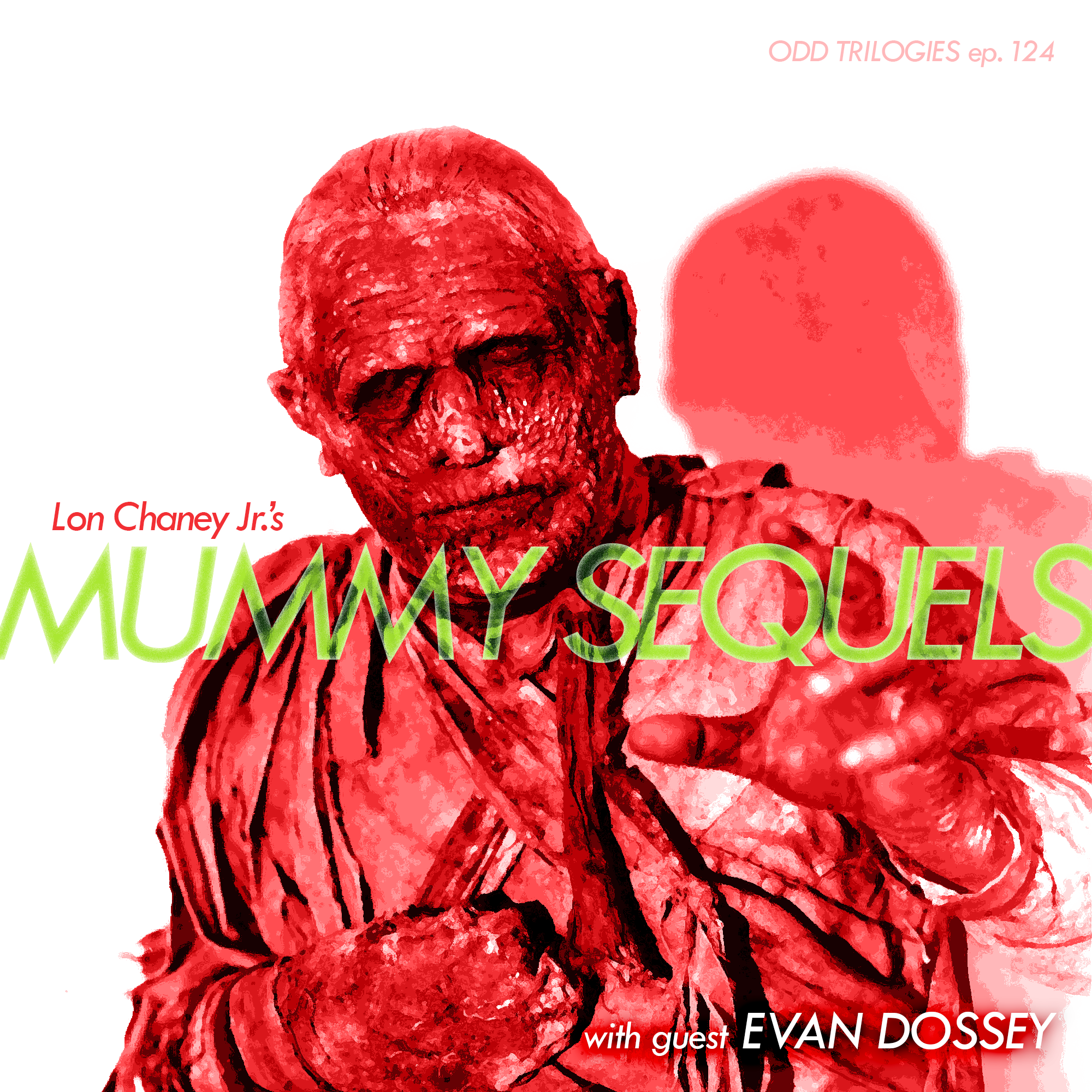
[00:00:59] Speaker B: In honor of, I guess another chance to possibly reboot this iconic Universal franchise, we thought we would tackle a truly odd trio of films pertaining to a classic Universal star being attached to the final three films of the five film classic Universal mummy franchise that we are calling Lon Chaney jr's Mummy Sequels.
It's a mouthful and it is. And you know what, with a mouthful like that and just so much lore and so much film to tackle today, we just couldn't do it by ourselves, now could we, Andy?
[00:01:39] Speaker A: That's right. Yeah. We are honestly, we're grateful to have an extra voice on this one.
We've got with us an Odd Trilogies veteran whom you may have heard a couple years ago extolling the virtues of symbiotic relationships on the Venom trilogy, or you may have heard him last week or last episode on our on our Zeta Gundam trilogy weebing out with us. He's a lover of classic monster cinema and schlocky horror the world over.
He's co founder of and prolific writer for Midwest Film Journal and a fellow member of the Indiana Film Journalists Association.
He's number one Ananka fan, Evan Dossey. Evan, thank you for being here.
[00:02:27] Speaker C: Thanks for having me here for this stellar trilogy of Universal classics.
I was excited that this was the trilogy you were handling because when you think about the Universal classic monsters, you have to look at all of those movies and you have to say, are these some of the best ones they ever made?
[00:02:47] Speaker A: The answer is no.
[00:02:49] Speaker C: You have to wonder, are these important for any reason? Also no.
[00:02:54] Speaker B: Yeah, yeah, yeah.
[00:02:55] Speaker C: Like these are truly like B movies and they stayed B movies for almost 100 years. They're movies nobody needs to watch.
[00:03:06] Speaker B: I forgot to introduce the trilogy itself in terms of the three films we are talking about today. I mean, to be honest, we are going to be probably talking about the entirety of the franchise, because one specific film in particular basically lays the groundwork for the. This entire trilogy. But the trilogy, yeah, we're mostly focusing on with Lon Chaney Jr's involvement, in a way, is 1940s the Mummy's Tune and the 1942. No, 1942's the Mummy's Tune and the 1944's the Mummy's Ghost and the Mummy's Curse. I gotta say, when I was trying to watch all these movies, it was really confusing initially to figure out which one was coming next.
[00:03:48] Speaker A: Right.
[00:03:49] Speaker B: Especially the. The last two being both 44.
[00:03:52] Speaker C: I'll be honest.
[00:03:53] Speaker A: Yeah.
[00:03:54] Speaker C: It's been a while since I rewatched all of these. And when I started watching Tomb, because so much of that movie is just the Mummy's hand redone, I was genuinely confused. I thought that I had put in the wrong movie.
[00:04:10] Speaker A: Yeah, I mean, honestly, there was a lot of that for me throughout the whole trilogy. I was like, wait, wasn't this. Didn't this happen in the last movie? Or am I rewatching the same movie?
[00:04:22] Speaker B: So, yeah, I mean, for some groundwork. 1932 is the classic the Mummy, the best of these five films.
Boris Karloff plays the titular Mummy.
When you think of the Mummy, you think of Imhotep. You think of the love interest of the lead being a reincarnation of Imhotep's old lost love.
You think of mummies, you think of curses, you think of cults.
You would probably also think of action in Brendan Fraser. That is not what we are talking about today in any way, shape or form. We've talked about that years ago.
[00:04:56] Speaker A: Already covered.
[00:04:57] Speaker B: Already covered. But we're talking about the classic film that I think Evan has, you know, put it best is the. It's Dracula, but racist.
It's basically what he described.
[00:05:10] Speaker C: Let's not let Dracula off the hook.
[00:05:12] Speaker B: No, no, no, no. I think you said more racist. I think is what you described it.
Because I will be honest, this movie's always been on my list of Universal monster movies to watch, but I had not seen any of these in full until doing this.
[00:05:28] Speaker A: I was a virgin as well.
[00:05:30] Speaker B: Yeah.
[00:05:31] Speaker C: As a monster super fan, I rewatched the big 30s Universal movies, which. It's important for historic context that the first, the classic Universal monsters were produced. When Carl Lamel and his son ran Universal Studios, they founded the studios. They lost the studio in the late 30s, at which point was around the time that the monsters became interesting to audiences again and the new owners started pumping out all of the sequels that we think of sort of when we think of these being B movies.
[00:06:06] Speaker B: Yeah.
[00:06:06] Speaker C: There are a couple sequels. Like Bride of Frankenstein was under the original ownership, and that's of quality. But aside from the Wolf man and much later, the Creature from the Black Lagoon, like the people who made movies like the Mummy's Tomb and the Mummy's Curse, that's. That's not the same people at all. From the people who made.
[00:06:25] Speaker A: Right.
[00:06:26] Speaker C: The classic Mummy.
[00:06:27] Speaker B: I'm shocked to hear that the eight year gap between the original Boris Karloff film and the sequel to it, that has nothing to do with evo death.
[00:06:37] Speaker C: Yeah.
[00:06:38] Speaker B: It's a different creative team entirely. But.
Yeah. So 1932 is the mummy. Eight years later is where we get our first sequel, the Mummy's Hand, which has Tom Tyler as the Mummy in that. Is it Taylor or Tyler?
[00:06:54] Speaker C: I think it's Tyler. It's Tyler.
[00:06:56] Speaker A: Yeah.
[00:06:57] Speaker B: So, yeah, they decide we're not gonna bring emo tip back. We're not gonna try and constantly bring back the same mummy. Instead, we're gonna make an entirely new mummy that is totally not Imhotep in any way, shape or form. We're just gonna reuse footage from the Boris Karloff film just to fill the gaps.
And we have a new mummy named Karras who is in love with Anaka. And Anaka is the new princess that now is a reincarnation in certain versions of these films.
[00:07:25] Speaker A: And, yeah, she was kind of like his. His tragic lover from their original life who he's trying to reunite with, or people are trying to reunite them in the modern day.
[00:07:39] Speaker C: Yeah. And it very much is a. It. This is where you get the Mummy who's just a lumbering beast. Yeah, for the most part.
[00:07:45] Speaker A: Yeah.
[00:07:45] Speaker B: Yeah. And it's also where, like, clearly, like, is the Karloff design is iconic in a lot of ways. And definitely, because when you first see Karloff in the makeup is how well they do the wrapping tied to his face, like how, like the flesh and wrap is really melted well together. And then clearly that is something no one wants to ever do again. Including the actor that has to play the Mummy.
[00:08:10] Speaker C: Yeah.
[00:08:11] Speaker B: So it's more of a mask, if anything, when he.
[00:08:14] Speaker A: Even in that movie, they're pretty scant with how much they use.
[00:08:17] Speaker B: Yes.
[00:08:18] Speaker A: The makeup look. Or that makeup in particular.
[00:08:21] Speaker B: Yeah, it's.
[00:08:21] Speaker A: And kind of soften it as the movie goes.
[00:08:24] Speaker B: Yeah. And even in that, like, gosh, there's like one shot in the Mummy's Hand where Karras looks genuinely terrifying, I think, in a really well Done way.
[00:08:33] Speaker A: Yeah.
[00:08:33] Speaker B: And then.
[00:08:33] Speaker A: Yeah.
[00:08:34] Speaker B: And then every time you see him afterwards, they rotoscoping black eyes onto Tyler. It's the most jarring.
[00:08:41] Speaker C: Which though honestly, like the rotoscope black eyes look much cooler than almost anything Lon Chaney gets to play with. Yes.
[00:08:50] Speaker A: Yeah. Like, yeah.
[00:08:52] Speaker B: So, yeah. And I've also, if you're listening to this and you're like, who the fuck is Lawn Chaney Jr. You actually, if you've listened to the podcast for a while, which. Thank you for doing so, you would know that about a little over a year ago we did the Odd Wolfman trilogy where we discussed different iterations of the classic Wolfman films. And the Original Wolfman from 1941 is a Lon Cheney Jr. Picture. And he's great in that film. I really like the original.
[00:09:20] Speaker C: Yeah.
[00:09:22] Speaker A: Which is why I was knowing nothing about these movies. Very interested to do. To do them because it felt like he brought something to the Wolf man. Like, yeah, you know, this kind of desperate humanity to that. And you know, I knew Boris Karloff was, was well loved for his performance as the Mummy in the original, so I was like, okay, well, I wonder Cheney jr's got some edge to bring to this and unfortunately he doesn't get to do much.
[00:09:51] Speaker B: Let me bite the bullet early. This was my trilogy choice.
I thought this would be kind of fun because both Andy and I, I think we've talked about in the past, you know, the universal monsters. There are certain aspects that are blind spots and so we thought that cool to go through a trilogy in hell, even five films where they're like 60 minutes each, which is crazy. And thank God they are towards the end of the series and honestly, by the end of the films, it's. Most of those 60 minutes are just reshot footage or just.
It's right. I, I thought like, like Andy, I thought Lon Chaney Jr. Would add something very fascinating to these three films.
[00:10:33] Speaker C: I'd like to say Lon Chaney Jr. As the Wolfman is an all time horror performance.
[00:10:40] Speaker B: Yeah.
[00:10:40] Speaker C: Lon Chaney Jr. Is literally any of the universal monsters. Is the only man to play all of the major universal monsters.
Awful. His Dracula movie, Son of Dracula, one of the worst movies ever made. It's so bad that I would suggest years from now you do a universal Dracula trilogy.
[00:10:58] Speaker B: Okay.
[00:10:59] Speaker C: Only because I want to hear your reactions to Lon Tony Jr trying to play Dracula, because that's.
[00:11:04] Speaker B: The Son of Dracula is the one where Alucard's originally introduced and that also has the scene it's Because I've seen one scene from that where it's like Alucard's name is in a mirror and someone goes, D, R, A. Like they spell Dracula.
[00:11:19] Speaker C: Yes, yes. And.
And like, with. What is it? How is. I still can't keep the Mummy trilogy straight. It's Cursed, the last one, which is inexplicably in the south. Son of Dracula, also inexplicably on the south, using some of the same sets as they were made very close to each other.
[00:11:38] Speaker B: Yeah.
[00:11:39] Speaker A: The crazy.
[00:11:40] Speaker B: The craziest thing I would have never expected from these films because the crazy thing about the first film in this trilogy, the Mummy's Tomb, is that while this is a. It's a genuine sequel to the Mummy's Hand, it also is such a time jump from the Mummy's Hand and spends so much time recapping the Mummy's Hand that technically you could skip 1 and 2 and get to 3 and kind of just get the Mummy's Hand that you needed. Yeah. And then just watch the films as a trilogy. It wouldn't be a fun trilogy, but it's kind of funny how like two years after the Mummy's Hand, they just go, all right, we're doing a 30 year gap.
Protagonists Steve Banning and Babe Jensen, I think is his name.
The two Americans in mummy's hand are now 30 years older. It's chronologically 1970, I think, like, because it's like 30 years after 1940, which is when Mummy's Hand takes place and comes out. They kind of keep with that up until Tomb.
And then there's like a little bit of a time gap in Mummy's Ghost. And then Mummy's curse is a 25 year gap.
So it goes from like the 70s technically, to like the mid 90s. Yeah, technically.
[00:12:57] Speaker C: It's like Comic book time, though. It really is Spider man for five years.
[00:13:02] Speaker B: For seven years, it's Comic book time where like, yeah, they're gonna still say moxie in 95.
They're still gonna.
They're still gonna have a transatlantic accent.
[00:13:14] Speaker A: Well, and. And Evan, you were kind of mentioning the other day, obviously these movies were all new to Logan and I, but as our listeners could probably infer, you're obviously not new at all to you. And you were telling me the other day that it sounds like almost you. You grew up more on these movies than on the original, I think, anyone.
[00:13:37] Speaker C: So. I mean, I'm only a little older than you guys, but in the mid-1990s was when Universal started to put out the VHS line of Universal classic monsters, which was like the most recent resurgence for the characters. So when we'd go to the library or we would go to Blockbuster, you would have a whole rack of different Universal monsters. And they really aren't delineated by like, which ones are good and actually classic. It's no different than what you see now with like Marvel releasing all of their movies with similar packaging to flatten the curve. Like, my son's going to get a Marvel movie. If they didn't have Ally and I introducing them, they might run Brave New World and it might be the same to them as Winter Soldier.
[00:14:22] Speaker B: Yeah, yeah. So.
[00:14:23] Speaker C: So like, that's kind of how the Mummy stuff and a lot of the Universal stuff was for us. I mean, my dad guided us to most of the classics, but once we were on our own, it was kind of like, this might be cool.
[00:14:35] Speaker B: Yeah. Because there's no way a Blockbuster is going to have classic Universal films over here and then just have like an
[00:14:42] Speaker C: assigned dog Universal right next to really even generations older. Like, one of the reasons why the Universal movies are so popular and have been so influential for so long is that they got sold as packages for like Svengoolie style television in the 50s and 60s.
[00:14:59] Speaker A: So.
[00:15:00] Speaker C: And he wasn't curating like, hey everyone, we're going to watch the classic Boris Karloff the Mummy. He was just like, here's the Mummy's ghost. Buy some Alka Seltzer.
[00:15:09] Speaker B: Like,
[00:15:11] Speaker C: so it's, you know. But rewatching them as an adult, which I've now done for several years. I mean, I've seen these three movies more than anyone ever should.
I mean, they're, they're, they're difficult to sit through.
[00:15:26] Speaker A: Sure.
[00:15:27] Speaker B: I mean, it is because, like, it also because I had to constantly remind myself too, especially with starting with Tomb, the fact that like, even though Hand is two years prior, it's like this Hands not been on reruns on television for two years between 1940 and 1942. Like, clearly with Tomb, they have to be like, okay, if we're gonna do a time jump, we're literally just gonna show you Hand again.
[00:15:50] Speaker C: Yeah.
Watching it all in a row is not even something that was possible for the first 50 years. These movies exist.
[00:15:59] Speaker B: Which, honestly, that's fine, I think. But I also get it, why the 90s. It's such a big deal to have them all in a box set.
[00:16:06] Speaker C: It kind of makes the, the level of continuity. It's arbitrary that they even bothered doing it. It kind of makes. Right, yeah, like they really flow into. In the dumbest ways possible. But like.
[00:16:17] Speaker B: Oh yeah, yeah.
[00:16:19] Speaker A: But that they were committed to carrying through that story in an era when people weren't really going to be able to keep it fresh in their minds.
[00:16:28] Speaker C: Yeah.
So I was thinking, are you guys capable, since we've all established that none of us really enjoyed these movies that much, we all capable of saying one nice thing about each movie?
[00:16:40] Speaker A: Oh yeah, I think I wrote down a positive about all of them.
[00:16:44] Speaker B: I. Yeah, I could probably say because. Yeah. Cuz we were talking right before off Mike with this or like off. Yeah, we were like summarizing all three of these movies is pretty simple because with the original Mummy and with Mummy's Hand it has this idea of basically there are new excavators who are coming in who are trying to find bones in a, in a, in a desolate land and hopefully they'll bring it back to a museum and they'll be famous. And in the process of finding the, the mummies or the, the artifacts, they have a cult that is dedicated to making sure no one finds said mummy or said artifacts. And the mummy's tomb is basically that. But in Massachusetts the mummy's ghost is like that. But in Massachusetts a few years later. And then the mummy's curse is the same thing, but 25 years later in I guess the Louisiana bayou, but it's pretty much the same thing across the word, there's a new cult member who's using Karras. Well, actually originally they don't use karus. They just are like, just you can maybe do something with karus, but don't like abuse it. And then by Mummy's Curse they're like, he's your toy, just fucking use him. Just kill people that you don't like. With the Mummy he'll do it because they also. Mummy's hand introduces we losing Logan the leaves because.
Because in the Karloff film the leaves don't really exist because they use, they use. In the Karloff film they have like. The scroll is a big deal in the Karloff film, the scroll that can like resurrect people if you use the ritual. They use that footage of the scroll from the Boris Karloff film in the Mummy's Hand. But instead of it being a scroll in the box, it is a bunch of leaves because it introduces the idea of if you use three leaves, he'll listen to everything you do. In a full moon, if you burn nine leaves, he'll go batshit chorus crazy, I guess.
[00:18:45] Speaker C: Yeah.
[00:18:46] Speaker B: And by the time you get to the Mummy's Curse, I think they lose track of how many leaves they burn on a given basis.
[00:18:52] Speaker C: I actually had to rewind to see if it was consistent, and it is surprisingly consistent.
They even trying to get the funniest
[00:19:01] Speaker B: part in the the second. And the second film of this trilogy with the Mummy's ghost is all the professors being like, well, let's try it. One leaf to leave three. And then the guy gets choked out.
I mean, if. To start with the Mummy's Tomb, I guess if, like, the one nice thing I could say about the Mummy's Tomb, and I'm not saying it succeeds on this really, but I was really surprised when watching the Mummy's Hand, how fucking goofy that movie is. Like, it is entertaining. It's kooky. It's just vastly different from how the Karloff film is in a way that threw me off that when we get to Mummy's Tomb, the fact that we're in, like, a rural Massachusetts town and the film takes itself super seriously.
Like, it's a film that is basically like, this is a film about a mummy killing a bloodline because of what happened in the previous film.
[00:19:53] Speaker C: Yeah.
[00:19:54] Speaker B: And it's in, like, a small town that looks like something out of, like, It's a Wonderful Life.
[00:19:59] Speaker A: Right.
[00:19:59] Speaker B: And they. It's so grounded in a weird way until, like, someone starts talking about the Mummy, and then it becomes batshit insane when they talk about, like, the college professor in this film is just like. Well, you have to understand, the mold on this implies that it has to be a real mummy and it's walking around.
[00:20:16] Speaker C: I love the mold thing. I love that they wrote that to rationalize the whole story. Like, he's leaving gray dust and mold and they're, like, dating it.
[00:20:26] Speaker B: Yeah. Like.
[00:20:26] Speaker A: Yeah.
[00:20:27] Speaker B: The fact that Babe.
Babe Jensen from the second film, who pushes the cult member down the stairs to death after shooting him, has, like, a genuine.
Like, it's not really horrifying, but, like, he, like, gets choked down in an alleyway by a movie so wild.
And it's like they commit hard with the lighting to that.
[00:20:50] Speaker C: Like, Cars is like an early version of, like, a. I mean, like, obviously a serial killer, but even, like a Jason style. Just like.
[00:20:59] Speaker A: Sure.
[00:20:59] Speaker C: Slasher.
[00:21:01] Speaker B: Yeah.
[00:21:02] Speaker A: Yeah.
[00:21:02] Speaker C: No thanks to Lon Chaney Jr. Who's completely unrecognizable. And makeup that isn't even. I mean, it's not by Jack Pierce, who. Who made all the classic monsters. You can tell, but.
[00:21:13] Speaker B: Oh, you could definitely tell.
What is your favorite?
[00:21:17] Speaker A: Yeah.
[00:21:18] Speaker C: Oh, go Ahead.
[00:21:19] Speaker B: No, I was gonna ask you two, what is your favorite thing about the mummies too, or one nice thing?
[00:21:22] Speaker A: Well, I guess just jumping off of. You know what we were just saying with the kind of goofy makeup, it is obviously like a clear step down. But I feel like at least in this first. The first of this trilogy, it still comes across as kind of creepy in certain scenes because of the lighting that's like really dramatic lighting. And I think some of the swells in the music and like the ways they have Karus move on people like as he's getting ready to strike still carries some little bit of creep factor to it in a way that the two following this are just kind of like broad daylight shenanigans.
[00:22:06] Speaker C: Yeah.
[00:22:07] Speaker B: Yeah.
[00:22:07] Speaker A: That I appreciated in this one.
[00:22:09] Speaker C: In this one, they still attempt the classic shadow of the mummy on the wall approaching the sleeping woman. He has his hand outstretched like Dracula. Like they're trying still.
I will say one thing that you guys. I agree with everything you guys said. I do appreciate that in this one, the actor who plays the. The bad guy who's part of the cult, Turin Bay is not just a white man in brown face.
[00:22:34] Speaker B: Yes. 100%.
[00:22:36] Speaker C: It's worth commending this movie for at least that not being a market. Yeah. Given what comes later.
[00:22:43] Speaker B: Getting non. Getting non white speaking characters in this series is a true Monkey's Paul wish.
[00:22:49] Speaker C: Yeah.
[00:22:50] Speaker B: Which we will talk about later.
Mommy's Curse has like a speaking role for a black man in a series that has little black people in it. And his character is his name and
[00:23:02] Speaker C: his character and a heaven. This movie. I see. I wrote his name down now. I feel.
[00:23:06] Speaker B: Yeah.
But he's good. Yeah. I mean, for Mummy's Tomb, I think. Yeah. The. The cult member.
Yeah. He definitely.
Especially when you can see at a certain point that the plot becomes.
His whole thing becomes less about killing the bloodline and more about weirdly falling in love with Steve Banning son's fiance.
[00:23:27] Speaker C: Yeah.
[00:23:28] Speaker B: Which to be fair, nearly every single Mummy sequel after the Karloff film basically has to be like, well, you one, somebody has to be horny.
[00:23:37] Speaker C: Yeah.
I like when Andahab says that it's now a mission of life rather than death. And like he just wants the mummy to kidnap a lady.
[00:23:45] Speaker B: Yeah.
There is kind of a fascination with how at a certain point in this film when it becomes Steve Banning's son, who has now realized that Babe was right, there is a mummy that is not only killing his family members, but also kill Babe, that he has to get this small town to rally behind him, to take off. Take on a mummy.
[00:24:13] Speaker C: Which is the ending of the original Frankenstein.
[00:24:16] Speaker B: Yes.
[00:24:17] Speaker C: Like they corner the creature and they burn him. Which if I recall correctly is the end of the mummy's hand too. Right. Like they think they burned him.
[00:24:30] Speaker B: They go to the Anaka's kind of tomb because they find like the secret entrance.
Then they fight. Yeah, they fight chorus and they technically burn him off screen. Like Steve Banning drops like a lamp on him.
[00:24:42] Speaker C: Yeah.
[00:24:43] Speaker B: And implies he's burned to death. And then at the start of the mummy's tomb, it just says he's fine.
[00:24:47] Speaker C: Yeah. And in this one they're like, we're gonna try it again.
[00:24:50] Speaker B: Yeah, yeah. The, the, like the, the Forrest Gump esque house burning down is actually kind of fascinating because that's like the most I think you get out of Cheney in the performance because of his like rabid trying to come and reach and lunge at people that are trying to get off the burning house. And we should also mention at least a little bit I looked beforehand of just being curious about, because I didn't expect there'd be a lot of lore or conversations production wise about these films, at least from an initial glance. But I thought if there be anything, it'd be about Chaney's involvement because. Because again, the Mummy's tomb is like a year after the Wolf Man. Like it's a year after his iconic performance. So it's like clearly there was something involved in this. And then it just. If you look up, literally if you look up the Mummy's Tomb wiki, it just says in 1941, after the Wolf Man, Lon Geni Jr. Renewed his contract with Universal, production started and it's like that kind of was it like it's. This is. It does have energy, especially going on with the series. There is a for hire feeling to it because he could do it.
[00:26:02] Speaker C: That's what's interesting when you go read about really any of any, any classic Hollywood stuff is that so many actors who have these roles that are of historic importance also have. For every role like that, they have like a dozen roles they were mandated to do by a studio contract in like the lousiest shit you've ever seen. Like with some exceptions, but for the most part, like, like guys like Lon Chaney were just working guys.
[00:26:28] Speaker B: Yeah.
[00:26:28] Speaker C: Like he was apparently a real terror on the lot. Like he had horrible alcoholism problems.
[00:26:32] Speaker B: Yeah.
[00:26:33] Speaker C: He hated being in these movies because of the makeup.
Like these are not movies he would have ever been proud of having starred in either.
[00:26:41] Speaker B: Mm.
Which is good for him because even though they use his name all big in letters in the Mummy's Tomb credits, they get rid of it for the Mummy's ghosts and then kind of put it smaller in the Mummy's Curse.
[00:26:55] Speaker C: Can you imagine, though? I mean, if your first impression is that, okay, these movies have Lon Chaney Jr. Surely he's going to do something besides Mummy. Can you imagine what that would have looked like, though, if they had had a flashback to Lon Chaney and Brown Face as human?
Like, it's almost fortunate that, you know.
[00:27:13] Speaker B: Yeah.
[00:27:14] Speaker C: In the long run that Lon Chaney was not put in that position. Like.
[00:27:17] Speaker A: Yeah.
[00:27:18] Speaker B: Yeah. But it also. It's kind of wild to think that the majority of, like, being such an emotive, expressive figure face.
[00:27:25] Speaker C: Yeah.
[00:27:26] Speaker B: And doing such a phenomenal job with the Wolfman the year prior, the most you see of his face is his left eye. Like, because it's the only thing that is poking out from the mask behind the whole kind of wrap around him.
And it leads to him to have to be a very physical actor, more so than he already is, but, like, has to really just. If he wants to show any character, if he wants to, it's gonna have to be in his waddle.
[00:27:53] Speaker A: Yeah.
[00:27:54] Speaker C: And unfortunately, he. I mean, Lon Chaney is. He.
He's a. He's a big guy.
[00:27:59] Speaker A: Yeah.
[00:27:59] Speaker C: Big mummy. And as the movies go on, he becomes a bigger guy. And the movie scene Mummy seems to be even bigger. Like, he's a chunky mummy by the end there.
[00:28:08] Speaker B: Yeah. By the curve by Curse. Yeah.
[00:28:10] Speaker C: Yeah. Although I do think he looks better in Curse than he looks in Ghost. Like, I think Ghost is the Nader of.
Of these.
[00:28:19] Speaker A: Yeah.
[00:28:20] Speaker B: Is that your least favorite of the three?
[00:28:23] Speaker C: Easily, I think.
[00:28:24] Speaker B: Okay.
[00:28:25] Speaker C: Yeah. Do you want to move on to Ghost?
[00:28:28] Speaker B: We could talk about, like, I guess. Yeah. Because I thought we'd. Yeah. I mean, when it comes to Ghost, I think. Because I don't really. I don't like Ghosts and I don't really like Curse at all. But I think Ghost, the thing that I was kind of the most surprised with is it's the most out of his performance as Chorus, I think comes out in Ghost.
[00:28:46] Speaker C: Yeah.
[00:28:47] Speaker B: Mainly because it is the most that chorus has tied to the actual plot in terms of, like, the Anaka stuff.
[00:28:54] Speaker C: Sure.
[00:28:55] Speaker B: There's. There's, like, one scene where he seems like Karus is supposed to be mad. It is like, smashing things.
[00:29:01] Speaker C: Yeah.
[00:29:02] Speaker B: And is like, that is actually seems like the most, like, emotional Thing he's done so far in like two films, like showing like this kind of hesitation because I think it's when they show him Anaka's tomb and then like the woman that's in it or the, the bandages that are in it just become empty because he's trying to show him that like a knock is resurrected through this half Egyptian woman so far goes to this college in Massachusetts that so far is the reincarnation of Anaka. Yeah, yeah. When he sees like her disappear from like, he starts like getting really rabid and it's like, oh, that's kind of cool. But no point.
I mean with Ghost it is kind of like. Yeah, it's cuz Tomb ends on a happy ending.
[00:29:45] Speaker C: Yeah.
[00:29:46] Speaker B: And then it's just like Ghost comes back. Yeah, Ghost comes back and is like, oh, he's still here.
He's here.
[00:29:54] Speaker C: Ghost, which is ostensibly Massachusetts, has the most obviously Southern California sets though. Like oh my God, Seven Jackals is literally just a backlot hill. Like and it's clearly California like at the climax is set in that mill which is like clearly in the desert.
[00:30:15] Speaker B: Yes, yes.
[00:30:17] Speaker C: John Carradine, also a universal man, also a horrible Dracula. Although a Dracula I'll defend to some extent. Like he's, he's hanging out here.
The, the little dog whose name sounds like penis.
[00:30:32] Speaker B: Yes, yes, yes, I do. Like when the, the girlfriend is being, you know, like we were talking about Egypt in class today and when she said that like her, her face like gets really intense and almost starts shaking like ah, Egypt, my homeland. It's like, oh my God, settle down.
Yeah. I mean, again with like. I guess another thing I can give to Ghost maybe is more stronger than my initial example is the ending of Ghost because it is kind of.
[00:31:05] Speaker A: Yeah.
[00:31:06] Speaker B: Saddest ending of the three. It's kind of, I guess the boldest per se because it just lets Karas leave.
[00:31:13] Speaker C: It's surprising how dark the ending that movie is.
[00:31:17] Speaker A: Yeah.
[00:31:21] Speaker C: What do you think, Andy?
[00:31:24] Speaker A: Sorry, Yeah, I mean the ending when he walks into the swamp, I think the imagery of God, what's her name? Amina.
Basically like aging super fast as they're like descending into the water. Like that's actually kind of unsettling and appreciably dark for such a you schlocky movie amidst two other schlocky movies.
Yeah, it is, it's kind of a, it's a big swing of an ending for what's otherwise just kind of here's more suburban mummy shenanigans kind of movie. So appreciated that,
[00:32:12] Speaker C: Yeah, I had forgotten. I had actually forgotten that that's how that movie ended. So when I was re watching it again, like these movies, they just don't stick in your brain. Yeah, I was surprised. I. I don't like that. So Lon Chaney's makeup job in this movie, this is the one where he first has the slicked backed hair because they didn't want to wrap his head. And it's like in gray clayish paint and the way that his. I'm not gonna say I was looking at the mummy's ass, but like it is weird that like the lower part of his costume looks like he has like a jock strap on out of. Out of Mummy. It's just a terror. It's a terrible costume and it looks bad like. And it's not the case in Curse. I think in Curse he looks pretty good comparatively. But you know, those are my not nice things to say about the mummy's ghost.
[00:33:06] Speaker A: Yeah, I mean in this one it really looks like the, the costume feels like, like just a thin veneer over something else, you know, whereas in kind of the previous ones and even Curse, it feels a little bit more like a fully fleshed out, you know, made piece by beast costume rather than just like something draped over something else.
[00:33:31] Speaker C: Yeah.
[00:33:34] Speaker B: All right now. Mommy's curse. Curse. Nice things.
[00:33:37] Speaker C: My favorite of the three.
[00:33:39] Speaker B: Is your favorite.
[00:33:40] Speaker A: Oh really?
[00:33:40] Speaker C: Of the three of these three. Because it's so like when I think about these movies and the reason you return to them is because at least like, like I said, can you say one nice thing? But there's always one image in each movie that has stuck with me and makes me want to re watch it. And I think when I don't remember her human name, but when Virginia Christine, who's now playing Princess Ananka, when she comes, when she emerges from the mud and she's covered and caked in mud, I think that's such a dynamic and interesting scene that feels like it belongs in a movie. Has a lot more vision than the rest of this movie. Yeah, she's, she's gorgeous and she's so good throughout this movie.
I mean it's, it's just a shame it's in this movie, right?
[00:34:26] Speaker A: Yeah, it's wrapped up in the turd that that is.
[00:34:29] Speaker B: This, that was probably be my mind. One nice thing is I think the whole aspect of Anaka with the dual personalities and you know, everyone, everyone around her being like, oh, you seem weird, but you know, it's fine. I mean you seem also like you're super chill. And everyone who's probably seen the last film walking into this being like, it's actually kind of cool that I'm aware that this woman is not okay.
[00:34:56] Speaker C: Yeah.
[00:34:56] Speaker B: We don't know what's gonna happen to her.
Yeah. Tomb actually is my personal favorite. What's yours, Andy? Of the three.
[00:35:04] Speaker A: Of the three, Probably Tomb as well.
Although, you know, I think it's noteworthy that neither of your positives for Curse were Gooby.
[00:35:17] Speaker C: Oh, yeah. Who can forget Gooby?
[00:35:20] Speaker A: I like that.
[00:35:22] Speaker B: Yeah. I like. On our.
[00:35:23] Speaker A: On our.
[00:35:24] Speaker B: On the Google Meet, Evan froze when you said gooby on my screen.
[00:35:29] Speaker A: Like, what am I gonna do?
[00:35:31] Speaker C: I can't deny Curse is the first one that just dips wholeheartedly into racial and ethnic stereotypes.
[00:35:37] Speaker B: Yeah.
[00:35:38] Speaker C: For supporting, there's also Cajun Joe.
[00:35:41] Speaker B: Cajun Joe.
[00:35:42] Speaker C: He speaks in a Creole accent that's completely inexplicable.
[00:35:45] Speaker B: Yes. Yes.
[00:35:48] Speaker C: Yeah. And then obviously, Gooby, who doesn't really do a whole lot throughout the movie,
[00:35:51] Speaker A: he just shows up and he just bumbles.
[00:35:54] Speaker B: Yeah. You know, he says massa a lot.
[00:35:58] Speaker C: Yeah, he does.
[00:35:58] Speaker A: Yeah.
[00:35:59] Speaker B: A lot. It is. Because I want to. I want to clarify something here, because I don't know if I ever got full clarification, but when I was watching all the films, the Nubian in the original film is just a white man in black face, Correct?
[00:36:12] Speaker C: Yeah.
[00:36:13] Speaker B: Okay. Because that was like. When I saw Gooby and Curse, I went, oh, my gosh.
Like representation, finally.
It's like. It's like they don't have to feel like they have to paint a white man in a horrible stereotype. And then Gooby started talking, and I went, oh, no. Oh, like, oh, is this worse?
[00:36:31] Speaker C: Yeah, yeah, it's. It's the first.
It's close to the end of World War II, and they made this too, which makes it feel worse in a way. Like, it opens with a musical number.
[00:36:43] Speaker B: God, it does. Yeah.
[00:36:44] Speaker C: Yeah.
[00:36:44] Speaker A: Which is gonna.
[00:36:45] Speaker C: Had a little bit of energy to the beginning of the movie. Right. The Mummy is just a simp throughout the movie.
[00:36:51] Speaker A: Yeah.
[00:36:52] Speaker C: It's a big difference. He has a little bit more of himself in there.
Yeah. And they have another couple white guys and fezzes for some reason.
[00:37:02] Speaker B: But it was kind of funny how deal with Tomb and Ghost that they had.
I don't know the actor off the top of my head, but the same old, very old decrepit white man as the head of the cult.
And it would be like, here's your task.
Go do this. And then I think Curse is the first Time where they don't have him. Be like, here's your task. Go be a part of the cult. Like the cult members already entrenched in the Southern Engineer Company or whatever, the architectural thing.
And just to be like, you don't. You don't need it again. You don't need a third, like, four times in a row. What this is like, the guy with the fez is probably a part of the cult.
[00:37:46] Speaker A: Yeah.
[00:37:47] Speaker B: He probably has cars with him.
[00:37:51] Speaker C: Yeah.
[00:37:51] Speaker B: These. These movies. I mean, this was kind of like, you know, going into this as blind as I did, like in, you know, getting Andy on board with it and then having you get involved with this evidence. Thank God you're here, because I was, like, going through this. And, like, even after the Karloff film, I was like, well, I feel like I've just now watched the one that everyone talks about.
[00:38:14] Speaker C: Yeah.
[00:38:14] Speaker B: I feel like if it's all like, naturally, it should just go downhill from here.
And it really does.
[00:38:23] Speaker A: Sure does.
[00:38:23] Speaker B: It sure does.
[00:38:25] Speaker C: I expressed. I expressed guilt in a conversation we had a few days ago that, like, for you guys, this is like your first big exploration of the classic Universal stuff.
[00:38:36] Speaker A: Sure.
[00:38:38] Speaker C: But you've now seen, like, you've seen what happened to them. I mean, what they became at the tail end of them being relics after the. Even during World War II. I mean, the reason these were B movies is that audiences didn't want horror movies anymore. Wolfman's really the last great horror movie Universal made. They kept bringing these out to be the B movie at double features. Cheapos that could just play for an hour after the A picture, which is usually like a war picture or a musical or something.
You've kind of seen where it goes. I mean, I would be, like I said earlier, curious if you ever covered a good trilogy of Universal monster movies.
[00:39:21] Speaker A: Yeah.
[00:39:22] Speaker B: But I mean, yeah, it's. As somebody who has gone way too deep dive into, like, serial killer, like slasher horror films, like the 80s, like the 70s and 80s. Like, the amount of Halloween films I've seen all those and all the Friday the 13th. I am very well versed in the. Well, this is definitely not going to keep this momentum, if there is any momentum. Like, it has to go down at some point.
[00:39:49] Speaker C: And in a way, in a way, I mean, historically, the Mummy series of.
Of all of those Universal series is the one that feels the most prescient for what came later in horror franchises. Like you were saying, like, Halloween has a lot more in common ultimately, with what happened here than like, although pretty much all of Them ended up becoming B movies in the end. It's just some of them had better be movies movies. And the others, like Frankenstein has significantly more movies, but none of them are as bad as the Mummy movies get.
[00:40:23] Speaker B: And technically, even though this is the last canonical Mummy film, this wasn't the last Universal Mummy film, because I think a few years after this, wasn't it, Abbott and Costello was.
[00:40:32] Speaker C: Yeah.
[00:40:32] Speaker B: So, like, that's technically, I think, the last Mummy film they did of the original 40, 30 40s.
[00:40:39] Speaker A: Yeah.
[00:40:40] Speaker C: Like, and Karus is in that.
But it's. It's not. It's not either of the actors, not Tom Tyler or Lon Chaney.
[00:40:48] Speaker B: They brought back Boris Karloff came back for having Acosta.
[00:40:52] Speaker C: That would be.
I do not. As someone who has seen Abbott and Costello Meet the Mummy and owned the VHS tape of that movie, I don't recommend watching that movie and how much.
[00:41:03] Speaker A: There's one of them you really like, though, right? Is that the Wolfman?
[00:41:07] Speaker C: No, Abbott. Well, the Wolfman's in it. Abbott and Costello meets Frankenstein is. Oh, incredible.
[00:41:12] Speaker B: That's an OG. That's. That is a classic. That is. There's some great gags in that.
[00:41:17] Speaker C: Yeah. That movie we. We watched that in just after we got married and Ally was like, I now understand your entire sense of humor.
It's all. It's all from that movie. Yeah.
[00:41:30] Speaker B: And how much time is between the end of these movies and Hammer? Is that like a decade?
[00:41:35] Speaker C: No, no.
[00:41:36] Speaker B: So.
[00:41:36] Speaker C: Well, the end of these movies, about a decade. Abbott and Costello Meet the Mummy came in the early 50s, I think.
[00:41:43] Speaker A: Yeah.
[00:41:43] Speaker C: Oh, no, in the mid. It came in 55. So if you consider that the end of the Universal Mummy movies, then it was not as much time. But Hammer did.
[00:41:51] Speaker A: Right.
[00:41:52] Speaker C: It co produced with Universal the Christopher Lee Frankenstein movie in 59, which is also boring as shit.
[00:42:01] Speaker B: So.
But, like, it's. It's because Lee is the mummy in the Hammer films, too.
[00:42:06] Speaker C: Is it Cushing Lee is the Mummy. Almost. Almost. In every case, Lee is the monster. Cushing is the human foil when they're teamed up.
[00:42:15] Speaker B: Yeah, makes sense.
[00:42:16] Speaker C: Except in Cushing's Frankenstein movies, Frankenstein is the monster. And not in the, you know, every other Frankenstein way. Like, he's literally.
He's the.
Cushing's Frankenstein is like the bad guy in all of the movies, and each time he creates a different kind of creature.
So, yeah, yeah.
[00:42:36] Speaker B: I mean, it's. It's just wild again. Yeah. Just nearly. Nearly a century from these films. And to, like, get to a point, like, because it Was. It was fascinating because, again, it's also, like, at a weird time when we're talking about this, it is to be a Mummy fan, it's got to be a fascinating in between because we now have, you know, radio Silence announcing that they're doing Mummy four with Fraser and Rachel Weisz coming back, as well as Lee Cronin's the Mummy finally getting a trailer coming out this year.
Being this fascinating, like, this looks nothing like what anyone could have anticipated from this. And again, it could be.
As we're recording, none of us have seen it.
There is. There's been advanced screenings that say there's some horrifying shit in the film. There's other people that say movie isn't good. Like, it feels like it is doing a very.
A huge departure from what you'd expect a Mummy film to be in a studio sense.
So it's kind of fascinating how, like, a century later, the Mummy still lives on in a wild way.
[00:43:42] Speaker C: It's.
[00:43:43] Speaker A: It's.
[00:43:43] Speaker C: Yeah. And it's interesting that really, of the universal monsters, the Mummy is the only one. It took a long time. I think it was like.
It was like Monster Squad before the Mummy, actually.
[00:43:55] Speaker A: Yeah.
[00:43:56] Speaker B: Yeah.
[00:43:56] Speaker C: Because all of the other universal monster characters interacted together in a movie, but the Mummy was like the odd man out in a. In a big way for a long
[00:44:04] Speaker B: time, which is fair because it's basically taking just funeral. Funeral practices and turn it into, like, a. All the other. A monster.
[00:44:15] Speaker C: Yeah.
[00:44:17] Speaker B: The fun Monster Squad. Fun fact. Andy, who's the wolf man in Monster Squad?
[00:44:25] Speaker A: Fuck, I don't know.
[00:44:26] Speaker B: Uncle Rico.
Oh, John Grease. John Grease is in that era. He's also in Fright Night 2 as a vampire. He was. He was a monster a lot in the 80s,
[00:44:36] Speaker A: and he was a monster
[00:44:37] Speaker B: in Napoleon Dynamite, an iconic monster.
Oh, man.
Is there anything else you want to talk about with this trilogy?
[00:44:49] Speaker A: That might be it.
[00:44:50] Speaker B: Here's the thing to find out of the two trilogies of the month of Dawsey, the fact that, you know, Zeta, we expected to be 10 hours long to have it be this one. Be just an hour is fine with me.
[00:45:06] Speaker C: I'm frankly proud we got an hour out of it.
[00:45:09] Speaker A: Yeah.
[00:45:09] Speaker C: It's a podcast episode the same length as those movies.
[00:45:13] Speaker A: I mean, appropriate.
[00:45:14] Speaker B: Yeah. It really is just like.
It is. It is a morbid curiosity to go through all these movies, and I'm. I don't regret watching all of them, but I don't like the last two. But, like, at the same time, it is kind of like, really Cool to just do a deep dive and see how the Karloff film becomes so iconic in a way that it warrants at least four more films kind of sequels to that in the Universal.
[00:45:40] Speaker A: Yeah.
[00:45:41] Speaker B: And have led to the Hammer interpretations decades later. The Mummy, the 90s Mummy films, as well as the fact that while it's not a good movie, it's an absolute mess. The fact that they even thought the Tom Cruise Mummy movie would be even worth, like, using the Mummy as the introduction to a dark universe for Universal is so wild.
[00:46:05] Speaker C: I have always been perplexed by what attracted Tom Cruise in particular, out of all of those properties, to want to
[00:46:13] Speaker B: do the Mummy, especially to have Alex Kurtzman write and direct that film.
[00:46:18] Speaker C: Those are. Those are Alex Kurtzman coming on is even a step down the line from where the most bizarre decisions with that movie.
Why have all of these. I mean, I guess you could say that Tom Cruise is mostly inspired by the 90s mummy movie, which is so much more adventure oriented.
Like, he saw himself doing that, but like, what a disaster, right?
[00:46:40] Speaker B: But it was crazy that Jake Johnson played Gooby in that film. It was great.
I was talking to.
Because I was telling a friend of the pod, as well as my roommate Adam about doing these movies, and he's seen the Hammer film, loves the Hammer film, and has seen the Carlo film and likes it. I think he's. He's. I think like most of us, it's just like Karloff is the reason for that film. Everything around it is either mid or you probably don't like it that much. But like Karloff is.
His stare makes that movie and his intensity. But he was. We were talking about just kind of like the downhill slope of this. And he even watched Mummy's Curse with me, which was a wild choice to see him go from only seeing the Karloff film to go into Mummy's Curse. And I'm like, here's the lore.
Here's everything you've missed from this. But it was. It just. He, like a few months ago, I think, watched the Tom Cruise Mummy film out of morbid curiosity. And he was talking to me. He's like, have you seen this? And I said, to be completely honest, when I watched this movie, I took a shit at the last 30 minutes of the film. And I came back and I couldn't care less what happened in those 30 minutes. So that's kind of the process of that film. That's that film in my mind.
[00:47:58] Speaker C: I've never. That movie. I mean, 2017, as a film critic, was the year the first year I was with the IJA for a full year. The first year I was using letterboxd.
It was the year Nick and I really became friends and partners before we launched Midwest Film Journal.
[00:48:15] Speaker B: Oh, nice.
[00:48:16] Speaker C: And we used to actually get press screenings that we could go to almost every week. And the Mummy is the press screening of that year. Of everything that I remember the most vividly because it was such a piece of shit. Allie was with us is at Landmark Glendale. She was getting pissed off as the movie went on, which is rare for her. Like, that was such an awful experience for every single person in the theater.
[00:48:40] Speaker B: Just.
[00:48:40] Speaker A: Yeah.
[00:48:41] Speaker B: The fact that that was gonna be the launching pad for Javier Bardem, Frankenstein's monster.
[00:48:48] Speaker C: Yeah.
[00:48:49] Speaker B: Johnny Depp, Invisible Man.
And the fact in the fact that the mummy film itself takes time out of its own film to establish an organization led by Dr. Jekyll.
[00:49:01] Speaker C: Yeah.
[00:49:02] Speaker B: Played by Russell Crowe. So that at least has like an. A shield.
[00:49:05] Speaker C: Yeah.
Every franchise was getting a shield at that time.
[00:49:10] Speaker B: And to think how funny that is and how it's like they. They tried so much effort to do that. And then like literally two years ago, the first thing Gun really does in his new DC is just fucking creature commandos, which is just Suicide Squad, the Universal monsters.
And it's like that's all you kind of really had. I don't know why you had to force so much into a Mummy movie with Tom Cruise.
Oh, man. I can't imagine being in that room with like, if you had mummy swag just sitting there just like, oh, no. Hey. If anything, the. The mov. That movie led to a. A video game adaptation that was tied to. That's actually really great.
Yeah. So that movie.
There's a Metroidvania kind of Castlevania esque mummy game based off of the Tom Cruise.
A great. A great score. Like a great Chiptune score. And is like basically just a Metroid game in that movie. It's so wild.
I have it. And it was actually a lot of fun. That was like the only. Only plus of that movie besides the trailer fuck up where they released it without it being fully done.
I could never forget about it. That's like the best.
But yeah, that is Lon Chaney Junior's Mummy sequels. That is.
[00:50:34] Speaker A: Yeah.
Evan, thank you for lending some substance to this episode.
[00:50:38] Speaker C: Thanks for having me on.
[00:50:39] Speaker A: I was exc.
[00:50:40] Speaker C: To jump at it and it was. It was. Even though they are all terrible, it was still a rewarding opportunity to revisit talk.
[00:50:48] Speaker B: Yeah, absolutely.
And hey, you got Zeta and Then you got Mummy, you got. You got a nice little mix of both this month. And that's right. I know you're really going to be jealous about our next episode, but, Andy, do you want to tell everyone how we're starting off May?
[00:51:06] Speaker C: Yeah.
[00:51:06] Speaker A: We're kicking off May with three different renditions of one iconic story.
A fable of fascism, if you will. Maybe one of the most iconic fables of fascism that has been adapted exactly three different times in feature film format. We're talking about Animal Farm.
[00:51:29] Speaker B: We're talking about the Odd Animal Farm trilogy. We haven't done a trilogy like this in a while, but literally, almost in the same breath in conversation that Andy and I had while talking about the Lon Chaney Mummy movies, Adam walked in on us talking about what we were gonna do this year and pitched us Animal Farm.
[00:51:47] Speaker C: Good luck, guys.
[00:51:49] Speaker B: And so the least we could do is not only do all three of those movies in honor of the notorious new version, the Andy Serkis. Is this still directed by Andy Serkis?
[00:52:01] Speaker A: Yeah, yeah.
[00:52:03] Speaker B: The Andy. The animated Andy Serkis film that's coming out this year starring Seth Rogen as
[00:52:07] Speaker A: the big pig from Angel Pictures. Angel film.
[00:52:13] Speaker B: Yeah, we thought it would. We couldn't do this without Adam as a guest on the episode to talk about the original animated version of the film or of the story, the live action crazy, like, 90s adaptation.
And then of course, the 2026 adaptation of the George Orwell classic.
Right. Truly a wild way to start May and I couldn't. It's this year is so many bangers and I can't wait to see what that comes up.
[00:52:44] Speaker A: Yep.
[00:52:46] Speaker B: Oh, man. But yeah, tune in in May when we start off the month with the Odd Animal Farm trilogy. Evan, thank you so much again. Thanks again, as always. I'm Logan Sowash.
[00:53:01] Speaker A: And I'm Andy Carr.
[00:53:02] Speaker B: Thank you so much for listening. Bye.