Episode Transcript
[00:00:20] Speaker A: Oh, he iced us out.
[00:00:22] Speaker B: I didn't mean to ice you out.
It was more just thinking about, like, God, what if we actually listened to the radio dramas?
[00:00:30] Speaker A: Yeah, because.
[00:00:32] Speaker B: Yeah, because the radio dramas are literally a year before the first movie we're talking about today. Or is it?
[00:00:37] Speaker A: Yeah, well, the same year, I think.
[00:00:38] Speaker B: Oh, same year, yeah.
Gosh. Did you expect.
Did you expect when you pitched this trilogy to me, that you were going to have a film.
You're going to hate one of these films so much.
You are genuinely, I think, off, you were a bit of the minority, I think, when we talk about the second film where you're at.
[00:01:02] Speaker A: Yeah.
[00:01:03] Speaker B: Which I think is fascinating because that honestly made the second film much more of, like, interesting to me to watch because I heard your review and I read it.
[00:01:11] Speaker A: Yeah. No, I.
Yeah, well, we'll certainly get to it. But I wouldn't say I hated it. I do think it's a bad movie, I will say. And I don't think Oshi knew what he was doing, much to the contradiction of what everybody on letterboxd loves to say about that movie.
[00:01:28] Speaker B: Oh, I still have. Have not dabbled into the actual reviews of those movies. I just know that for certain people, if you're looking, because I was. It was funny because I was looking up on like, what the. The chronolog, the chronology, what was released and stuff. I have it up here. But, like, Wikipedia describes it as a tokusatsu film. Right. Which I think is.
[00:01:48] Speaker A: I think it describes the first one. Yeah. As a tokusatsu film.
[00:01:51] Speaker B: I think, honestly, the first film doesn't deserve that moniker any more than the second one.
[00:01:56] Speaker A: Yeah, yeah.
[00:01:58] Speaker B: Even with the one scene.
[00:02:00] Speaker A: Right.
[00:02:02] Speaker B: But yeah. Hello, everyone. Welcome to Odd Trilogies with Logan and Andy. I'm Logan, so.
[00:02:07] Speaker A: And I'm Andy Carr.
[00:02:08] Speaker B: And not Odd Trilogies. We take a trio of films, whether tied by cast and crew, thematic elements or just numerical order, and we discuss the good, the bad, the weird surrounding each film.
And boy, we picked a weird one. This is genuinely, again, I've said this, I think, in 8,000 times in the amount of episodes we've done for this pod. But, like, truly, this is one of the reasons why I'm like, ah, this is why we still keep doing this, in a way, because this is a trilogy that for the longest time this trilogy is known, I think, popularity wise, for its final film.
[00:02:41] Speaker A: Yeah.
[00:02:42] Speaker B: Because its final film is kind of like almost to a lot of people, like an undiscovered gem of 90s animation. Because it's like literally the tail end of the 90s when it comes out.
And it got to a point where, like, we were aware of it, but we had never seen it. And then I think when you were dabbling more into Jinro, which is the third film in this trilogy, you realized that it was a trilogy. And so you pitched it to me and I went, holy shit. We did Patlabor last year.
[00:03:07] Speaker A: Right. Also Oshii.
[00:03:09] Speaker B: Oshii. And so we thought, why not talk more about legendary anime director Mamoru Oshii and discuss the Kerberos trilogy, a wild saga franchise. Multimedia franchise that has radio dramas, mangas, I believe, Ova, possibly live action films, hybrid live action animation films, fully introduced
[00:03:33] Speaker A: episodes of other TV shows and a
[00:03:36] Speaker B: full blown spin off that seems like it has nothing to do with anything that is in the mainline series other than just one aspect that is discussed in the first movie today, which is our trilogy is 1987's the Red Spectacles, 1991's Stray Dogs, Kerberos, Panzer Cops. I kept calling it Panzer Corps for a while.
[00:03:59] Speaker A: I thought it was that for the longest time too.
[00:04:01] Speaker B: And then 1999's the Wolf Brigade.
And these are three films that are truly, I cannot stress enough, vastly different from one another in a way where it's almost kind of surprising that Mamor Oshi, again, who, when we talked about him in the Patlabor episode, he is, you know, he was one of the creators of Pat labor of Headgear, the collective that created Patlabor the world. And around the same time they were doing Pat labor, he was doing this shit.
[00:04:33] Speaker A: Doing this shit in his basement or whatever.
[00:04:35] Speaker B: Yeah. Which is Kerberos is basically in a very nutshell.
Too long, didn't read aspect. It is like an alternate historical sci fi drama action series in some ways.
[00:04:48] Speaker A: Yeah.
[00:04:48] Speaker B: In a world where Germany won World War II, Japan, in hopes of trying to keep their own independence during this post Nazi Germany Win, basically militarizes the police and also tries to like, basically have the same boom that real life Japan had.
[00:05:09] Speaker A: Yeah.
[00:05:09] Speaker B: When it was trying to recover after the war.
[00:05:11] Speaker A: Right, right.
[00:05:13] Speaker B: And then ultimately in that process creates a special military police unit that is separate from standard police called the Kerberos Unit.
[00:05:23] Speaker A: Yeah. And also the Capitol Police, I think is their official designation.
[00:05:29] Speaker B: The cpo, I think is the case.
[00:05:30] Speaker A: Yeah. The Capitol Police organization which then kind of gets named the Kerberos.
[00:05:34] Speaker B: Yes. Which they are most notably known for their protective unit or protective gear. Yeah, Protect gear, which is basically
[00:05:44] Speaker A: the kill zone armor.
[00:05:45] Speaker B: Yeah, Kill zone Armor. It is. It is based off of actual German armor. German kind of outfits and armor from World War II.
They look horrifying but also rad because of course, when you have legendary animators, you have a legendary anime kind of auteur involved in a lot of classic actual veterans involved in these projects. They're gonna do some rad ass designs for some horrible people.
[00:06:13] Speaker A: Yeah, well. And to be honest, the design of that armor is so iconic that you might recognize it even if you haven't seen any of these movies.
It's been influential on video games, like we said Killzone and other films and animation.
Yeah, it's very much styled after like.
[00:06:37] Speaker B: Is the Wehrmacht? Is that what it's called?
[00:06:39] Speaker A: I can't remember in Killzone.
[00:06:41] Speaker B: No, what the original, what the German inspiration was for?
[00:06:44] Speaker A: Oh yeah, it's something like that.
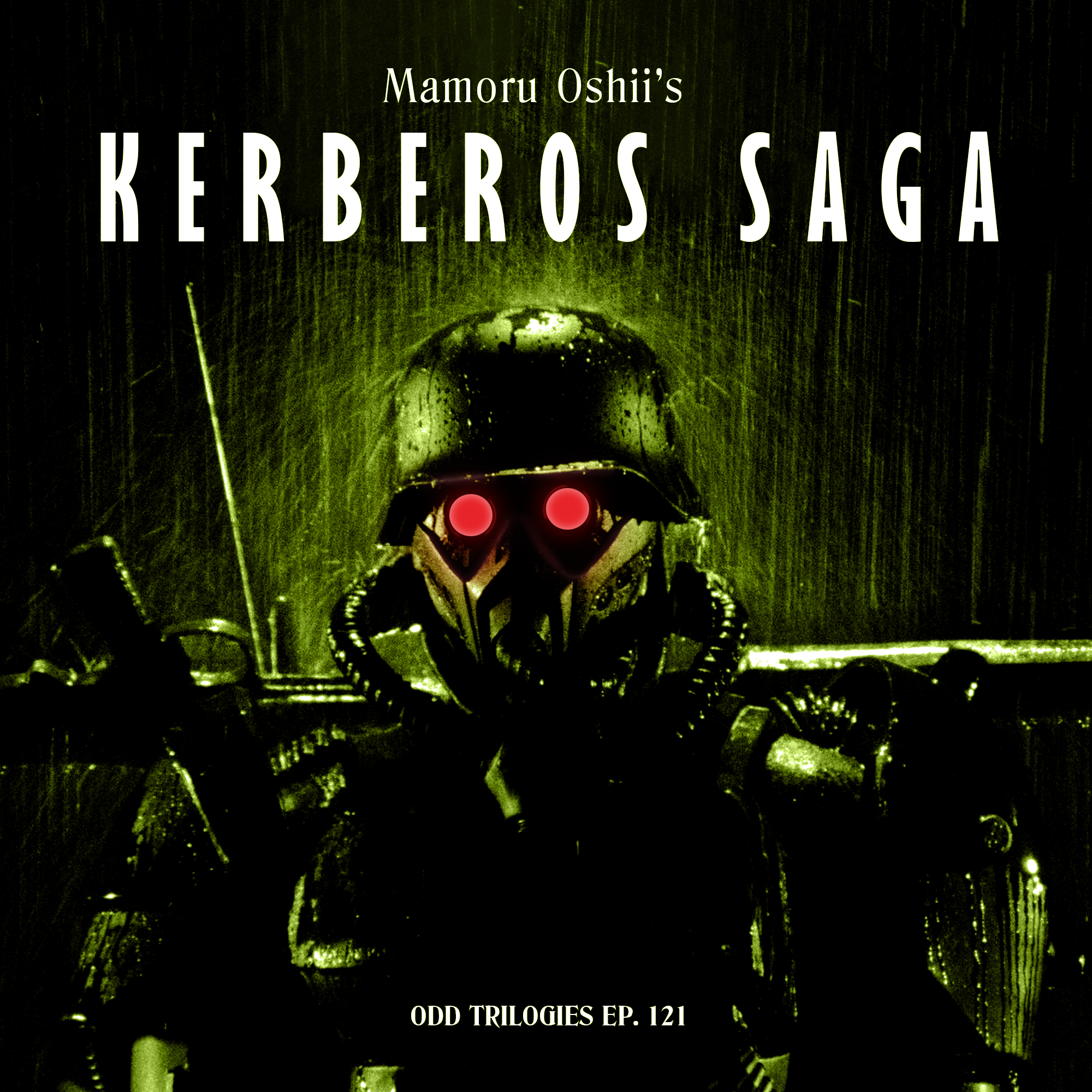
But it's very Darth Vader esque. It's hulking, black, mechanical, with bright red eyes. Kind of looks like an old gas mask.
And yeah, these soldiers are just these very imposing titans they carry around giant. These giant machine belt fed machine guns.
[00:07:05] Speaker B: Yeah.
[00:07:05] Speaker A: And so, yeah, if you look up the Panzer Cops or the Kerberos Saga or whatever, that's the first thing you'll see. And you might instantly recognize it.
But just know that that's from this, this very eclectic and far reaching, yet still incredibly niche franchise, as it were.
All from Oshii's own head. Gosh.
[00:07:30] Speaker B: Which is just fascinating. Again, he.
Even though we talk about his animated works more than anything of Pat Ladybird, because of his direction with 1995's Ghost in the Shell.
[00:07:43] Speaker A: Yeah.
[00:07:43] Speaker B: And ultimately that film redefines cyberpunk or introduces people to dystopian cyberpunk in a way that they probably never knew and leads to things like the Matrix and the late 90s early 2.
The love of leather, even though no one's wearing any kind of leather, not a lot of leather in the original Ghost in the Shell.
[00:08:02] Speaker A: Right.
[00:08:03] Speaker B: You kind of see the vibe in that.
Around the same time this is happening. And at the same time Pat labor is also happening.
Mamoru Oshii creates this world.
And in the process of doing that, the same year that the, the original, I think you said radio drama came out, kind of specifying the world, the war torn times of, I think when World War II, like right after Germany wins and how it's like building into the protect gear and kind of what we know as the CPO and the public security, like the public sector and whatnot, we get the first movie yes. Which is the Red Spectacles, which doesn't deal with any of that, really.
Because another thing you should probably know too is I think we talked about a little bit at the end of the Silent Hill episode. But these films are released while Red Spectacles is the first film of this trilogy. Chronologically, it is the last film in the timeline.
[00:09:07] Speaker A: Yeah. These movies take place in. Or they release. They're in reverse chronological order, basically.
[00:09:15] Speaker B: Yeah. Red Spectacles takes place in this alternate timeline in the 90s. In the mid to late 90s.
The second film, Stray Dogs, takes place in the early 90s.
Well, pseudo kind of like right before Bread Spectacles. But it takes certain aspects from the 90s. And then Jinro, the Wolf Brigade, I think is the 60s.
[00:09:36] Speaker A: Yeah.
Ginro is really one of the many fascinating things about this trilogy is that only the last film, Jinro, really takes place in the midst of any of this like world building historical context that Oshii created for this.
[00:09:58] Speaker B: Yes.
[00:09:59] Speaker A: Red Spectacles and Stray Dog make the, you know, interesting choice to establish all of this lore and then set the story way after all of that is
[00:10:10] Speaker B: kind of over is basically.
[00:10:12] Speaker A: This is very. These are very small personal films.
[00:10:15] Speaker B: Yeah. In a very fascinating way, which I think a lot. It also has to do with budget. It has the fact to do with just the range of scope of what they were discussing and doing. I think they probably the bigger, more headier lore, probably sci fi aspects are more close to the manga, which there are several different manga series in the Kerberos franchise. These first two films in particular very much feel like we are going to do the best we can to really evoke the era, the sci fi aspect a little bit. But we're going to treat it as grounded as possible.
Or in the case of the Red Spectacles, we're going to be very surreal about it intentionally.
[00:10:58] Speaker A: Yeah.
[00:10:59] Speaker B: Because another thing that's so crazy about this trilogy, which honestly makes it.
Of all the positive aspects, I guess I can give. As a trilogy as a whole, these three films are vastly different genres.
[00:11:10] Speaker A: Yeah. Yeah.
You would almost never think they were related if it weren't for the consistent appearance of the Panzer Cop armor.
[00:11:21] Speaker B: You have Red Spectacles being a dark comedy, surreal sci fi noir film.
[00:11:29] Speaker A: Yeah.
[00:11:31] Speaker B: And then you have Stray Dog. Is it Stray Dog or Stray Dogs? Stray.
[00:11:34] Speaker A: I think it's Stray Dog. Singular.
[00:11:36] Speaker B: Okay. Stray Dog. It makes sense.
Stray Dog is a slice of life drama that starts and ends with sci fi aspects pertaining to the Kerberos team.
Because of flashbacks, because of the armor itself, because we get to see the armor in live action.
[00:11:57] Speaker A: Yeah.
[00:11:58] Speaker B: Which is funny because it does have that energy of like, don't worry, guys. If you just wait long enough, you'll get to see the armor. And then you get to the third film, which I think is, unsurprisingly, since it's animated the most, I would say complete dedication to the height of what this franchise, I think has appeal wise.
[00:12:18] Speaker A: Yeah. It's the most immersed in the world,
[00:12:21] Speaker B: which makes sense considering, like Andy said, it's like right off the heels of post World War II and is at this, like, which we'll talk about more like a turning point kind of pressure point area of where the Kerberos kind of team could go. The unit could be post in a time of peace.
[00:12:39] Speaker A: Yeah.
[00:12:40] Speaker B: Where could that be? And in the red spectacles, it has already been, you know, the time peace has already happened. There is no indication that there have been other wars since World War II.
[00:12:51] Speaker A: Yeah.
[00:12:52] Speaker B: The thing about the red spectacles and what it kind of ends up being, the inciting incident in terms of what we are told, because we don't really see this, is that in the red spectacles, they talk about the Kerberos team, the unit, basically, once wartime stopped, they got pretty much power hungry in a way and started really butting heads with local police, started butting heads with local governments, and then ultimately led to a battle between, I think, the military, the actual military police, and the Kerberos.
And Kerberos lost.
And most of the teams, most of the soldiers in the Kerberos unit were either killed or given choices to go to prison or to do this or that, or if you were lucky, I guess, you get away.
[00:13:45] Speaker A: Yeah.
[00:13:45] Speaker B: And this first film is about one of the most iconic, I guess, in the lore, Kerberos soldiers to ever exist, which I believe his name is Koichi Tadome.
[00:13:56] Speaker A: Yeah.
[00:13:57] Speaker B: Who is, I think Koichi. The last blow, I think, is what they call him.
[00:14:00] Speaker A: Yeah.
[00:14:02] Speaker B: Basically, Red Spectacles is about in the early 90s when the Kerberos are being dissolved because they are losing the war.
Three of the head, I think notable Kerberos commanders are running away and then they get ambushed and basically two out of three of them get injured and tell Koichi to go come back for us. So Koluchy leaves, he gets away on a helicopter. And then we cut to three years later, and now he has come back to a very different, very dreamlike, very odd Tokyo that he's not aware of. The world has changed so much since he's left. And to also clarify when the film starts, it is full color. It is shot in a sense, and I mean this in a loving way. Kind of shot like Power Rangers. Yeah, because in Tokusatsu, it's shot like a Sentai, a little with blood.
Cause we open up with this wild, crazy, but a good time action sequence where like 20 people die in the span of 10 seconds.
[00:15:04] Speaker A: Yeah, it's this really violent warehouse shootout.
[00:15:07] Speaker B: Because it's really trying to clearly, like Mamoru's trying to show you just how dangerous three of these Kerberos soldiers are versus just normal people with guns or even just cops.
And from that scene, you basically have a warehouse that is riddled with bullets on every wall. Because they're just shooting through the walls. They're shooting everybody. And then Koichi gets away, comes back. And now we have, despite this bombastic opening and also text heavy. I also want to clarify that because this is the first film in a alternate history sci fi Diesel, like dystopian Diesel punk series.
We get a lot of title card, like descriptions of Koichi, his backstory, his two friends, and what they're known for, their. Their code names. And then ultimately what, him leaving and him coming back. And then the film is ultimately him trying to find his friends.
And it is so fucking weird. It's such a weird movie. And that's not a bad thing. I don't think it's a bad thing at all for this movie. I like this movie. I think we're both on the same page.
[00:16:19] Speaker A: Okay. Yeah.
[00:16:21] Speaker B: I think we both like this movie, but at the same time, this movie. To say that this movie juggles genres and juggles tone, I think would be an understatement. I think it throws tones in the air, accidentally shoots itself in the foot and catches most of them at times.
[00:16:38] Speaker A: Yeah.
[00:16:38] Speaker B: But occasionally drops the ball here and there.
[00:16:41] Speaker A: I think it would be very fair to describe this film as an experimental film.
[00:16:46] Speaker B: Yes, absolutely.
[00:16:48] Speaker A: Because it does, like, from one scene to the next, change genres, change visual styles change. Like its treatment of space and time.
[00:17:01] Speaker B: Very Lynchian in a lot of ways.
[00:17:03] Speaker A: Yeah, it's Lynchian, but it's even more like divorced from reality, I think, than most Lynches.
But it's also, I think, worth stating that we could sit here and tell you all of these details about not just the world of the Kerbero saga, but of the plot of this story. And it won't really depict for you the experience of watching the film, because the film is very.
Not plot driven.
It's very experiential. It's very. You are living through the psychological roller coaster that this character is on. And almost very few scenes in the film feel literal to me. Like, feel like we are seeing exactly what's happening. It's like we are seeing what this character is seeing in their heads.
[00:17:59] Speaker B: Yeah, it is hilariously.
And not saying it fails in this aspect, I think it actually does succeed at times, especially with the actor who plays Koichi's performance as well as Mamoru. Mamoru clearly knowing what he wants out of it and doing his best to kind of get it across.
But it's a character piece. It's kind of fascinatingly a character piece about basically a soldier of war who is so iconic in a way that it is fascinating to see him come back and not be that soldier anymore. Basically, like all he's known for is wearing that protect gear and being this cool. Like we were the final. I mean, it's in the. One of the posters. But one of the most iconic shots I believe from this movie is the protect gear in the rain. Standing there looking at him and it's like you see that protect and think of that being the first time anyone had seen that gear. That is really fucking rad. And why I'm not surprised they would push that heavily in kind of advertising the movie. But what's crazy is that gear really has very little to do with what's going on. Except for the fact that like, people assume that Koichi has come back in town with the set of armor because people believe that Koichi. You know, it's a film about legends. It's a film about expectation. It's a film about personal struggles and past mistakes and just regret and guilt all while mixed up in some kooky ass set pieces.
[00:19:33] Speaker A: Yeah.
[00:19:33] Speaker B: Acting that is so over the top. Saying it chooses scenery, it devours full sets at times. There's even a scene where you watch Koichi destroy an actual set.
Like it is. It is so bombastic and weird and out there, but clearly it is trying to have the discussion about the idea of like the people we. People that get idolized and how at the end of the day, we are all human. We are fallible, we are vulnerable, we are mortal.
[00:20:05] Speaker A: Yeah.
[00:20:06] Speaker B: And at the end, like the ultimate ending of it shows that like, regardless of how many people you've killed or how cool you are with a gun or how you use a gun, we all. We all go out the same way. If it doesn't go.
[00:20:18] Speaker A: Yeah, yeah. It's also. It's the warrior without a war story or the warrior after the war story where, you know, they come home and they just don't know how to act. Or in Koichi's particular case, he didn't have a home that he could go to, so he disappeared for a while. And when he finally does get to come back, he's so out of place, so out of time.
[00:20:38] Speaker B: Oh, my gosh. Yeah.
[00:20:39] Speaker A: The world has changed. He's not a normal guy to begin with, and now he is this far removed from reality and he has nowhere to escape except his own brain.
[00:20:51] Speaker B: Yeah.
[00:20:52] Speaker A: Which is apparently a very scary place.
[00:20:54] Speaker B: Yeah.
[00:20:55] Speaker A: Based on the events of this film.
[00:20:57] Speaker B: So I will do a disclaimer before we get farther into this because I think it'll be a good way to kind of make a good set piece for a good foundation for how both of us approach our conversations about these films. Because I didn't tell Andy this. This is a last minute decision for on my part. But since it's reverse, like chronological order, I watch these films in reverse. It's the first time I've done this. When we've done the episode. Like, usually how a film is released in time, like, in terms of, like our time, in terms of Red Spectacle, Stray Dog and Ginro, I would probably just watch it that way. However, there was a part of me that was curious about the fact that Ginro being at the earliest in the timeline, as well as the fact that
[00:21:39] Speaker A: most people is the most known, most iconic.
[00:21:42] Speaker B: But also, if there are people out there who are fans of Kerberos as a saga, I have a strange feeling most of those fans probably started with Ginro and went backwards.
So I thought it would be interesting to go Ginro backwards. And I gotta say, doing it that way, Red Spectacles was one of the wildest ways you could end trilogy in that way. And clearly was not the intention. Like, clearly when they made Red Spectacles, it wasn't like Oshi's like, okay, if I make other films that come before this, it's gonna really make Red Spectacles pop that much more. Yeah, no, Red Spectacles pops on its own and honestly pops at its best when you don't think about it in the overarching kind of narrative built in this world.
[00:22:28] Speaker A: Yeah.
[00:22:29] Speaker B: Because in all honesty, it really doesn't have much to talk about about Tokyo in this, you know, post Germany winning World War II era without the fact that it's like food stalls that you stand up at don't exist anymore.
Gangsters clearly have full reign of the police and, you know, there's surveillance everywhere. Very much hardcore Cold War energy throughout the film.
Like it very much. Besides those little things, you don't get anyone who sits down and goes like, this is the big events in Tokyo you've missed since you've been gone for three years. Like, clearly they just go.
Yeah. Since Kerberos was disbanded, like, things really haven't gotten any better. They just. They've just kind of stayed the same in terms of severity, but it's not great either.
[00:23:21] Speaker A: Yeah. I mean, I think this movie would make a great stage play. Yeah.
Which makes sense that it's, you know, I mean, the. The While waiting for the red spectacles, which is the radio drama.
[00:23:35] Speaker B: Yeah.
[00:23:36] Speaker A: I believe large chunks of that are essentially ported over into this film. Which makes sense that it's covering a lot of the same ground in terms of dealing with this. Police officers, soldiers, psyche and breakdown and things. But like, it would. It would lend itself to a very stripped back stage production. Really? Well.
[00:23:57] Speaker B: Oh, absolutely.
[00:23:58] Speaker A: Because you're very much.
It's not literally a one room show, but it kind of feels like it where it's like, okay, you're just stuck with this one guy and then occasionally another character will kind of pop in and out and have a conversation with him. But you're really not like walking through the world experiencing this world. You're just experiencing this guy's experience.
[00:24:19] Speaker B: Yeah.
[00:24:20] Speaker A: And it's very limited.
[00:24:21] Speaker B: Yeah. And limited is a great way to put it because that seems very intentional. Limited in what we're seeing through his eyes. Limited in the spaces that we get. We don't get a lot of huge open areas in the majority of the film. We get an open area at the beginning when they mow down all these civilians trying to hunt them down.
But once Koichi comes back and there's a whole sequence where he, you know, gets rid of a tail that's following him and then he goes to a hotel and whatnot. From the hotel onward, most the sets are pretty small.
[00:24:51] Speaker A: Small rooms, medium sized hallways.
[00:24:53] Speaker B: Even the movie theater. While it feels like it's the biggest thing you see at that point, room wise, it's still. Everything does have that noir energy from the cinematography, the color choices. Yeah. As well as like the set design. It doesn't feel like. It does feel like very different sets. That when you kind of realize, oh, there's this is all supposed to be in the same building. I don't necessarily believe that, but it's kind of cool to think of it like that.
It has. It evokes in a way, it does have the energy that Koichi internally sees himself, even when he's outside of the armor, as some sort of like gumshoe kind of person that everyone wants to keep away from. Good. It goes to the top situation and then ultimately leaves him. Yes. And like some Maltese Falcon Bogart. And really the funniest stuff that comes from that is the fact that, like, when he is so confident in himself is when some of the sillier scenes, if not when his downfall becomes his vulnerability with the food stalls. Or specifically one food.
[00:26:01] Speaker A: Yeah.
[00:26:02] Speaker B: There's a whole running bit that he has to shit constantly because they keep poisoning his food.
And there's. It is the whole extended sequence of him, you know, contemplating whether or not he wants to shit in a urinal.
[00:26:16] Speaker A: Right.
[00:26:17] Speaker B: And it's like, this is the same. This is in the same universe as Jinro, the Wolf Brigade.
[00:26:21] Speaker A: Yeah.
[00:26:22] Speaker B: And it's funny to think because, like, it makes sense in terms of the fact that, like, it's. It's seeing the perception of ourselves. It makes sense that, like, you're watching someone who is contemplating so many different things and he's using kind of the format of a detective noir story to really help them feel like they're on a mission that they are on. They're on the cusp of finding the truth, of finding his two friends. And ultimately when he finds his two friends, they'll get back together and everything will be fine. And guess what? What a surprise. Life happens. Time has passed and things are not the same as what he remembers.
[00:27:02] Speaker A: Right. He's pinning all his hopes on this kind of grand scheme and it's like, dude.
[00:27:07] Speaker B: And then it makes the boldest claim, I think after.
After multiple instances of him being on the right path and then he fucks up and then he gets captured and then he gets out of there and then he does it again and then he gets fucked up. It ultimately makes, I think one of the biggest swings a film like this could really do in terms of an audience engagement and involvement aspect. Which is basically, it was all a dream twist.
[00:27:33] Speaker A: Yeah.
[00:27:33] Speaker B: The. Hilariously, one of the only other aspects that are like. Is very action packed fully is when he gets to his hotel. There's like 87 guys that he kills. And it's like, oh, this is okay. Again, this is trying to show that, like, this guy is a danger, he's dangerous. And you know, him being back in Tokyo, he could. He could swing the tides in any way. He could turn the tides in a way that like, maybe Tokyo could be better. And then you find out no, he never left that hotel.
[00:28:03] Speaker A: No, he's been in the shower succumbing to the effects of poison dying on the floor.
[00:28:09] Speaker B: Hilariously being called, I think, Koichi the Last Blow. The entire film is him recollecting and contemplating the last blow on him as he was shot in the back of the head in the shower.
And then the title comes from the fact that there's a big old suitcase that people think he's got his protect gear in. And they open it and it's just a full suitcase of rose colored glasses, red spectacles, which is fucking. Which is great. Yes, it's a fun movie. It's fun. I do think it drags at a certain point, once you see what it's trying to do. Whether you catch on to the I don't think he's alive thing or like, this is all a dream. Yeah, they do constantly keep going. Like, don't worry, the next time you find a friend, it'll go differently.
[00:28:53] Speaker A: Yeah, it's definitely a little repetitive, paced very slowly. I do think. I think it's funny that the film, despite being described as a Tokusatsu film, all of the action, as it were, in the film is kind of done like vaudeville. Yeah, it's very surreal at the camera. Like highly comedic. Not realistic physical spacing or anything like that. It's almost dance like, or cartoony.
[00:29:28] Speaker B: He, at a certain point in the movie, he's looking for a guy that either who usually eats at a specific food stall, but since they're all like, kind of illegal, they've changed places and whatnot. When he's at a movie theater, he sees a random guy he thinks knows this person. And so he takes him into a bathroom, beats the shit out of him, and then strips him naked in the most, like Andy said, vaudevillian way possible. Like three stooges, like ripping his clothes to tatters. He's just fully butt naked in the. In the bathroom being like, where is this man?
And after all that, he just goes, okay, here's who it is. And it's like, why did you tell him when you were getting your ass beat? Yeah, it's a fun time. Like, I do.
[00:30:14] Speaker A: Yeah. And I mean, it's.
[00:30:15] Speaker B: How'd it feel for you being like the first into this trilogy? Being like, oh, so this is the baseline for me. Yeah, this is the baseline movie.
[00:30:24] Speaker A: I mean, I had. I can't remember, maybe something I'd read about this series or about this film in particular, had kind of clued me into the notion that like this movie is not going to be what you would expect it to be based on the poster, based on the.
The franchise that has spawned from it. It is not that.
So I kind of knew going in to expect something else, but I didn't.
I did not see like full on experimental noir film coming. Experimental comedy noir. Yeah.
And the whole kind of quote unquote, like one room show of it either is like the very claustrophobic nature of it. I didn't expect. So, yeah, it definitely kind of threw me for a loop. And I was also like, well, I know this ends up at Ginro.
Where are we going from here? Because I watched Ginro for the first time last year.
[00:31:21] Speaker B: You did? Yeah.
[00:31:21] Speaker A: And that was kind of what spurred me on to want to do this as a trilogy. It was like, okay, this is an interesting world. Especially that this one guy put all of these entries into it because he was that interested in it. So to see kind of where it all started and the fact that it's such a bizarre beginning was pretty striking.
[00:31:43] Speaker B: Yeah. And also coming from a man that, from what we've talked about in the podcast, both with films that are part of a trilogy, as well as just acknowledging his other past works, to just know him from Patlabor 2 and from Ghost in the Shell, which are both very heady, philosophical, very serious, wordy, serious films to kind of get to a point where the philosophical aspects of Red Spectacles is very dreamlike, as well as the fact that a lot of the conversations are just like. Feels like people are talking again. Dream, dream, logic.
Talking around each other about some wild things that don't make any sense. Or quoting Shakespeare, like the taxi driver that's constantly quoting Shakespeare. And then Koichi has this whole thing about, I think what tries to kind of keep him stable in this whole kind of dreamlike situation is like he has this whole like running thing of like, it was a hot summer day, it burnt the rubber off our shoes or something. Like talking about what happened.
[00:32:41] Speaker A: Yeah.
[00:32:42] Speaker B: And then, and then they constantly. People are second guessing that because they're like, didn't it rain that day? And then it constantly shows the difference between perspective, reality, the perspectives, the fantasy reality of it all. And it shows that even though that like Oshi. I mean, this is not the last live action film this man makes at all. Like, he. I mean, this is literally the next film is also him.
[00:33:03] Speaker A: Yeah.
[00:33:03] Speaker B: As well as, you know, hell, he made a live action patlabor film like 10 years ago.
[00:33:08] Speaker A: Yeah, I was gonna say, haven't the last decade or so been mostly live
[00:33:11] Speaker B: action stuff from him. I think after Ghost in the Shell 2, I think there might be one or two more animated films. And then it's mostly kind of been like, animated shorts and. Or full live action films. Yeah, I think he even did. I think he even did like, a short film for Halo Legends. You remember when they did. Yes, he did the Animatrix, but Halo. Yeah, I think it's the Duel is him.
[00:33:36] Speaker A: Yeah, that sounds right.
[00:33:38] Speaker B: But, yeah, the Red Spectacles starting off in this trilogy, it does start off in at least a unique, intriguing way.
[00:33:45] Speaker A: Yeah.
[00:33:46] Speaker B: And unfortunately, Stray Dog doesn't keep that momentum because weirdly enough, four years later in 91, so now we're like two years before Pat Leaver two. Four years before Ghost in the show, before Oshi just, like, has like, one, one, two punch. That is just, like, kind of crazy.
[00:34:05] Speaker A: Right.
[00:34:07] Speaker B: He comes out with a prequel to the Red Spectacles.
And by prequel, it's not a few years. It is a few months before the events of the Red Spectacles, where we follow a soldier who was under Koichi during the kind of pan. During the Kerberos kind of revolt and riot.
[00:34:28] Speaker A: Well, it's really. I mean, it's the two others that didn't escape. Right.
[00:34:35] Speaker B: Is it the two other.
[00:34:37] Speaker A: I don't know if they're named the same across the films, but to me, the implication was Koichi got away just like he did in Red Spectacles. Those two were survived, but were left behind and then had to.
[00:34:50] Speaker B: Are you saying the little girl, too?
[00:34:52] Speaker A: No, sorry, not the little girl, but Inui is one of the two.
[00:34:55] Speaker B: Okay, okay. Yeah, maybe. Yeah. I mean, it's. Because to me, it was just.
I just took it at face value because I. Again, at that point, I hadn't seen Red Spectacles because.
[00:35:04] Speaker A: Right, yeah.
[00:35:05] Speaker B: And I tell you, Ginro to Stray Dog, like a fucking slap to the face. It was like a culture shock in a way that was like. I mean, it was cool seeing the. You see a little bit in the first in Red Spectacles, but seeing the Kerberos armor is rad. And live action, arguably, I think one of the best aspects of this film is how it looks in live action and how they use it.
Because even in live action, even though I ultimately looks the best in animation, when we talk about general, it still has a threatening aura in live Action, but we see this character named Inui who gets left behind and gets arrested during the point where the, like, the. The government has finally taken over Kerberos.
[00:35:47] Speaker A: Yeah, the.
When the Kerberos uprising is quelled.
[00:35:51] Speaker B: And it's like 92. 90. Yeah, I think it's like 91. 92. And now it's 94.95 Inuit out on parole. And I was being tasked by.
It's not private sector, is it public security? Is that.
[00:36:06] Speaker A: I think so. I think it's police investigators. Yeah.
[00:36:11] Speaker B: Public security basically going, hey, we believe that Koichi is in Taiwan, and if you can grab him, we will clean you, clear your slate. Even though you've gone to prison and you've done your time, we will basically stop bothering you if you go find Koichi and if you kill him.
Okay, yeah. But like, you know. And so the film basically is this ex soldier who is now trying to find, like an old, you know, war buddy commander who scorned him. Because you basically see at the beginning that you see Koichi get on a helicopter, right, to get away, while the military, like the. While the government's coming in and just mowing them all down because they're all just fucking. Just hurt and tired and doing this uprising for way too long.
What happens, what follows is like, Stray Dog is a slice of life drama and has a lot of. I think there are similar ideas in Red Spectacles of terms of just being introspection.
Talking about what it means to be, like Andy said, a soldier without a war.
And ultimately what you do in a response when you run into somebody, you have this guilt you have this vengeance you have. And then what happens when you kind of, you know, you see the person that has scorned you and they are just in them themselves, Just a person.
[00:37:32] Speaker A: Yeah.
[00:37:33] Speaker B: And wondering, can you even live a life after living the kind of life that they have? And it sounds a lot better than how it's actually implemented. But it is like aspect of the movie. Like, it is.
[00:37:44] Speaker A: Yeah.
[00:37:44] Speaker B: It is the shortest of the three films, which I really much give mercy for. Mercifully.
[00:37:50] Speaker A: Yeah.
[00:37:50] Speaker B: But it ultimately is just.
It is ennui. Meeting a little girl.
How old is she supposed to be?
[00:38:00] Speaker A: I think she's maybe high school age.
[00:38:02] Speaker B: I would say. Yes. 17, 18.
[00:38:03] Speaker A: I think they say at one point she's 17.
[00:38:06] Speaker B: I think she's 17. Because there's a joke, the 90s later on where there's an implication that Koichi and this girl have had sex. They have not.
There's no.
She has never said anything.
[00:38:20] Speaker A: No.
[00:38:20] Speaker B: Basically, Inui finds an apartment that's supposed to be in Koichi's name. He finds this girl instead and says, yeah, he left me here too. And there's no really conversation. Whether that means, like, there was any kind of relationship. I got it. Hope not.
[00:38:33] Speaker A: I mean, the implication I got was, yeah, that he hung around her for a while, they shared an apartment and then he moved on.
[00:38:42] Speaker B: Yeah, she helped him, probably. He helped.
[00:38:44] Speaker A: And then when Inui came across her, she was like, oh, yeah, I know that guy. Yeah, I'll help you find him. And.
[00:38:51] Speaker B: Yeah. And so they go. And when they find Koichi, at one point, Inui, I think, yells, at least in the translation Lolita complex, which is like, damn, dude. And it's like a goofy ass scene where, like, they're rolling down hills and stuff. And I'm like, good Lord.
[00:39:06] Speaker A: Yeah.
[00:39:07] Speaker B: But it becomes this introspective film that ultimately has a dreamlike nature to it. To Red Spectacles. Not as interesting at all as Red Spectacles is gonna dream. Like, it feels a lot of. I think I'm assuming the benefit to a lot of people, the positive of this film for so many people, is the fact that it has this energy of like, walking through a town you've never been to before and just getting lost in it.
Because a lot of the film is just Inui and this girl going to some places in Taiwan they've never been. And then just like, literally just getting lost in the process of trying to find Koichi, but also, like, embracing the culture with each new place. And yeah, there's one of the best shots in the movie. I would say it goes on a little too long, but at least it's a shot where they're going down a very long.
Like a long single take shot of them going down alleyways. And then it's like kind of dissolved into, dissolve in and out of the hallway sequence in the beginning of the film where it's all the Kerberos soldiers injured. And it's kind of Inui thinking about just like the last time he's in kind of a situation like this, it was more dire and now it's kind of more peaceful and not knowing how to handle that. And like, will I ever be. Will ever be free of this?
Like, how Red Spectacles is hard to really describe without seeing it with your own eyes, because it's just truly a fascinating watch.
In similar vein to that Stray Dog sounds a lot better than what I'm. How I'm saying that it actually is an execution.
[00:40:38] Speaker A: I mean, I think the. The kind or, like, generous way to describe what this film is doing and I guess to some extent doing effectively, is like, vibes cinema.
Yeah. There's not the story is very loose and tenuous and kind of meandering. The characters are kind of thin in one note but it is just kind of like you said, it feels like you're wandering around an unfamiliar city because that's what the characters are doing and that's what Oshii spends a lot of time shooting. It's a lot of street photography and landscape photography and just kind of really low key kind of chill vibes. It's atmosphere and it's. It's thankfully underscored by Kenji Kawaii. So at least it sounds good.
[00:41:31] Speaker B: Yeah. Honestly a lot of the film and
[00:41:33] Speaker A: it's a pretty looking movie. Movie.
[00:41:34] Speaker B: Yeah. I mean it's really solid. I think it is a film that I think probably looks the scrappiest of the three.
[00:41:40] Speaker A: Yeah.
[00:41:41] Speaker B: Vibes are a great way to describe it. It does feel like if. If I ever just was like putting something like. If I put like a jazz fusion like two hour film in the background on. It's all just like intercut with different films.
[00:41:53] Speaker A: Yeah.
[00:41:53] Speaker B: I could just see so many clips from this film.
[00:41:56] Speaker A: Absolutely.
[00:41:57] Speaker B: Just like watching them walk around because it has this energy of. It's in the. It's shot in I would assume 89, 90.
But everything looks full blown 80s still. It is that transition between every decade where it's like yes, it's a new decade but the 80s are holding on in the look in the feel like literally going for again going reverse chronological order going from the third film to the second. Stray Dog was a culture shock to me because for some reason my brain thought we were going to go to the 70s. Maybe I was like, maybe there's a bit of a gap, I don't know. And then I'm just seeing people. This is all 80s as hell. Where the hell. When the hell does this take place? Because Straight Dog also doesn't really.
The thing about Red Spectacles and Stray Dog is like dates give. Maybe they either give you a date once or they just imply when it could have happened.
[00:42:49] Speaker A: Yeah. I mean yeah. Just from my watching alone I couldn't have told you. No, it may have said. But yeah, I did not retain that because it's not like a major part of the film.
[00:43:00] Speaker B: Yeah. Cuz Jen Road does a phenomenal job of being like.
Even if you aren't listening to what they're talking about, the, the buildings, the costumes, the way that people talk. It's very clearly very close to the end of World War II.
[00:43:16] Speaker A: Yeah. It's that post war mid century.
[00:43:19] Speaker B: Yeah, we, we're We're. The business is booming. We're going up.
And then in this, it just has that energy of just like, yeah, we're just. We're just chilling. We're just chilling here in Taiwan. I don't know who this Koichi guy is. And every so often between these Vibes moments, the movie goes, oh, shit, that's right.
We do narrative. And so they'll just throw in a scene that is like, yeah, let's be contemplative about this. Could you really be a dog in a world where you don't have a master? Like that type of shit? And then you'll go back to doing Vibes for a while. It's a very meandering film. And if you dig that, awesome. Again, it's. It is vibes as hell. And I think very much shows that the film is very relaxing at times if you're not paying attention to the fact that, like, there hasn't been any plot for 10 minutes.
[00:44:04] Speaker A: Yeah.
[00:44:04] Speaker B: But once the plot kicks in, you're just like, okay, okay.
[00:44:08] Speaker A: Yeah. Well, the plot is.
I think that's where it gets frustrating.
[00:44:13] Speaker B: Yeah.
[00:44:14] Speaker A: In that it's like, it's fine to have Vibes movies. There's a place for that. But it's.
When this is bothering to have any sort of story, it's kind of just rehashing stuff from Red Spectacles.
[00:44:28] Speaker B: Yeah.
[00:44:28] Speaker A: Which we talked about this a little bit when you were watching Stray Dog, and you were like, oh, yeah, I see why you hated this movie.
And what's funny is, I think it hits worse coming off of Red Spectacles because they're thematically doing so many similar things, and Red Spectacles is just doing it in a way more interesting and in your face way. And Stray Dog is just kind of like, yeah, what would it be like if you were out of the war, you're out of prison, and you went to live with your old war buddy, and you just ate shrimps and laid on the ground in the sun?
[00:45:11] Speaker B: Is funny that you say that, because I go. And I'd say going Ginro to Stray Dog.
[00:45:15] Speaker A: I'm sure that was a jarring.
[00:45:17] Speaker B: Well, the biggest jarring jump there is the fact that I just. You kind of had the energy after General. You go, well, clearly the next two. Hopefully the next two films really dabble into, like, timeline wise, historically. Like, what's the world feeling like?
[00:45:32] Speaker A: Yeah.
[00:45:33] Speaker B: And no Red Spectacles and Straightaw couldn't really give a. What's going on with the wall. The. Like, the world itself.
[00:45:40] Speaker A: Yeah.
[00:45:40] Speaker B: And which is fine. Because it's like, you don't have to. It just was fascinating to be like, we will talk about it more. But the way that Jinro shows us how Tokyo and how Japan looks in that era and talks about where it's going to go and being like, oh, I'd be curious to see where it goes. And then you get to Stray Dog and it's been like, hey, it's been like 30 years.
Kerberos doesn't exist anymore. But we're chilling.
[00:46:07] Speaker A: Yeah.
[00:46:08] Speaker B: And it's like, oh, it's funny because it makes sense. It makes sense in a way where it's like, when it comes to budget, clearly both these films have to play with their budgets. So that if they're going to do. If they're going to commit to having the protect gear show up at some point and even have an action sequence, dare I say crazy, in these films, those are gonna probably be the most costly moments.
And if they have a small budget, they really have to make it more of an. You know, it just create introspective, very philosophical at times, you know, character study.
But the problem ends up being, especially if you go backwards, is that Jinro is all those things, but also has, like, great historical kind of backdrop, has fantastic action. And going from that to this and being like, I guess it makes sense. They're just not. They're not going to be like.
They're not gonna be like, God, I wonder how Taiwan's dealing with a world where Nazis won. Like, they don't care.
[00:47:09] Speaker A: Yeah.
[00:47:10] Speaker B: And it's fine. Like, it genuinely. It's.
I know if. I know there's probably people. Yeah. If you're out there and you're an actual Kerberos Saga fan, welcome for finding this episode. But I assume you could be out there and you're like, well, just read the manga. There's probably so many mangas out there that really kind of dabble into that more.
[00:47:27] Speaker A: Yeah.
[00:47:27] Speaker B: And I have no doubt.
[00:47:29] Speaker A: Yeah.
[00:47:29] Speaker B: But in terms of these three films, I think it is just kind of like. It is kind of hilarious that whether you watch it going one to three, going the first film to general or general backwards, like I did it, ultimately you're gonna have to come to the realization of, oh, this cool thing. I kind of thought I might be getting more of. I really am not gonna get that. I'm getting something vastly different at a certain point.
And Stray Dog, unfortunately, is just the film in the middle. That is the rude awakening.
[00:47:59] Speaker A: Yeah.
[00:47:59] Speaker B: Because, yeah, it is kind of like, yeah, Andy's. He Literally is a certain point. The second act of the film is basically, they find Koichi. They don't kill Koichi, they end up living with him. And then, like, the little girl and Inui, they don't have, like, a romantic relationship, but there does seem to be kind of, you know, he clearly cares about her. He clearly cares about Koichi. And then he's basically given from the public security guy, like, the ultimatum of, listen, we know where he's at. We know where you're at. We know you're not doing your job. So, like, tell him to bring the armor back to me. Yeah, bring him with me. Bring him to me, and then you and that girl will be fine. And then Inui decides to make his own decision and take Koichi's armor from him. After a unbearably long fight sequence, it's almost they live ask, but not as fun.
They take the armor, he puts on the armor, and then the final act is just him going ham on. I guess the public security team, which I guess in the live action films, the public security team is covered in white face and are goofy. Yeah.
[00:49:11] Speaker A: Which is a weird kind of carryover from a scene in red spectacles because they kind of wear, like, mime gear.
[00:49:18] Speaker B: That made me feel less crazy seeing that red spectacles because, like, seeing that in Stray Dog, I was like, what?
Yeah, because none of that's in general. Not even a lick of general.
Everyone's normal general, which is wild.
[00:49:31] Speaker A: Never quite put my finger on what the mime makeup was supposed to signify.
[00:49:37] Speaker B: He. He. There's clearly the reason why. And I'd have to look up. I'd have to look up. Oh, she. Please tell me.
[00:49:44] Speaker A: Yeah, yeah. It's kind of a strange bookend, like, you know, to have this slice of life film and bookended by these violent action sequences that feel very disconnected from the rest of it, but are no less appreciated because they breathe some life into this film.
[00:50:04] Speaker B: And to end the movie, basically, going, koichi goes back to Tokyo, insert red spectacles now is like, okay, so this
[00:50:11] Speaker A: is just like, Koichi will return.
[00:50:13] Speaker B: Koichi will return in a movie that you've already either seen, or you're like
[00:50:17] Speaker A: me, or you're just now hearing about.
[00:50:19] Speaker B: You're like, what the fuck?
[00:50:20] Speaker A: Yeah. Because, I mean, Red Spectacles was not like, a massive hit.
[00:50:23] Speaker B: No.
[00:50:24] Speaker A: Like, it came out and suddenly there were fans clamoring for a sequel or a prequel.
[00:50:29] Speaker B: There's a reason.
[00:50:30] Speaker A: She just liked these ideas.
[00:50:32] Speaker B: There's a reason why most people know about Jinro, but not the other two. Because the other two are very much like a.
All right.
If you start with these, it's a bold start.
[00:50:42] Speaker A: Yeah.
[00:50:43] Speaker B: I have no doubt that there's. Especially in Japan, I assume in Japan, there were probably a lot of fans of the manga or, like, you know, a cult classic aspect of those mangas. And they probably watch Red Spectacles or Stray Dog, and they're like, what the fuck is this?
Yeah, these are the characters I've been reading about. Because I think Koichi is in some of the manga. I thought.
[00:51:00] Speaker A: Yeah, he is. Yeah.
[00:51:01] Speaker B: I assume Inui maybe pops in and out, but straight. Yeah. Stray Dog is like. It's. I don't hate it. And I thought Andy hated it, which I'm glad he does.
[00:51:16] Speaker A: I wouldn't say I hate it. I think it's a bad movie.
[00:51:18] Speaker B: Here's the thing.
[00:51:19] Speaker A: But I didn't hate it.
[00:51:20] Speaker B: Here's. Here's.
[00:51:21] Speaker A: I disliked it.
[00:51:21] Speaker B: One of the funny. One of the most fun things about us doing the show together is that when one of us is ahead of watching things over someone else, usually Andy's ahead of me.
He usually does his litter box reviews. It feels like the day Yovi watches his movies while I do, like, litter box bombs, like, right. Two weeks later.
I do, like, eight films in a day. But, yeah, it's like after two weeks of worth of shit.
And so, like, with these movies, I wanted to keep it hidden because I didn't want it to imply that I'd watched it in reverse order. But I had been curious about how he felt about the other ones. And he gave this, like, a one and a half.
[00:51:58] Speaker A: I thought. I gave it two.
[00:51:59] Speaker B: I thought it was a one and
[00:52:00] Speaker A: a half, maybe, because I give this a two.
[00:52:03] Speaker B: Like, I don't hate this, but I don't really like it. Yeah, it's there.
[00:52:06] Speaker A: It's.
[00:52:08] Speaker B: The COVID art is cool. That's my.
[00:52:10] Speaker A: Sure. Yeah.
[00:52:11] Speaker B: And I wish the movie.
Honest to God, I feel like the movie.
If the movie was just in the three hallways we see at the beginning, but it's like talking to, like, all the soldiers are being contemplative about the uprising.
That might have been more interesting than what we really get. Because, again, we just go from, this is a soldier of War. This is a bit of a character study about how he feels about himself and his introspections about it. And then here's another soldier of war and how he looks into himself and really has to deal with the character of his actions. And it's like, is this what the movies Are. This is what we're getting from this point forward. And ultimately, and thankfully that's not the case. Like, we do get character study, but I think it's the best aspect of. It's the best case scenario in that regard. Because five.
No, nine years. Eight years after eight years.
[00:53:07] Speaker A: Yeah.
[00:53:08] Speaker B: Again after Stray Dog goes right into Pat Labor 2 and then Ghost in the Shell. And then there's a bit of a gap between Ghost in the shell 95 and our last film tonight, which is Jin Row the Wolf Brigade, the film that caps off the 90s in terms of big budget Japanese animated films that are fucking.
[00:53:29] Speaker A: This is.
[00:53:30] Speaker B: It's a wild movie, this movie.
I knew going into this trilogy, just like sometimes you get vibes when you get. Not like stray dog vibes, but just like general first impressions just from seeing what people are talking about a trilogy or what I'm seeing of posters or whatnot.
I had a feeling going in that I was gonna like Jindero the most.
Mainly because, you know, that's the one that everyone talks about. I've already seen clips of Ginro before. We watched it. And you know, I am a sucker for Oshi's animated works. We talked about it constantly with Pat Laver, too. How there is just. That movie, I think is a hidden banger in so many ways, and how it's written and how they shoot it in places. And to go into Ginro and be like, this is not Oshi directing. No, it's Hiroyuki, last name Okiura. Yeah, Okita, who is now.
He has a Gundam tie.
He worked on most recently Gundam Hathaway 2 and worked on the original Hathaway, but he's worked on Akira as much of other things. Key animator, a big designer, has only directed two feature films. I'm curious about the other one and hasn't done it in a bit.
But we're going into the only film in this trilogy that isn't Oshi and
[00:54:53] Speaker A: still written by Oshii.
[00:54:54] Speaker B: It's still written by Oshi. Yeah, It's Oshi's story, it's Oshi's script. But still to kind of have that, you know, kind of anticipation having Oshi's name on it, but not being the director of it.
[00:55:06] Speaker A: Yeah.
[00:55:07] Speaker B: And being a part of a world that he's created and you having to be kind of the spearhead of it.
Hiroyuki fucking nails it. I love. I love Ginro, the woman.
I love the movie has stuck in my brain since watching it. And I will say too, to add to the reverse chronological order aspect of it, I think you've already noticed. I watched all three of these movies in a day.
[00:55:32] Speaker A: I saw from your plex activity, when you go to watch something, it says, how dare you.
[00:55:40] Speaker B: Keep in mind.
Yeah, well, it just kind of like it happened like that. My goal was to kind of watch a movie a night. That's usually my go to is like I try to get if I know the time frame when we're recording. I like to kind of have a day or so in between.
[00:55:54] Speaker A: Yeah.
[00:55:55] Speaker B: Viewings. But these last few weeks have been busy. And while I kept trying to watch Ginro, every time I tried. It is so general is so fucking dense, especially compared to both Red Spectacles and Stray Dog. General is so fucking dense with its shot composition, its editing, its philosophical discussions. The amount of times I tried to watch it. And then I. I literally look away for a second and I miss something fucking insane.
[00:56:22] Speaker A: Yeah.
[00:56:23] Speaker B: I went, I can't not be fully involved. I need to watch this when I have a day off.
And if I have to watch the other two, you know, back to back another day, so be it. And then so I got to Ginro and I fucking love Ginro so much. I watched Stray Dog, was perplexed and was contemplating red spectacles. And then I went, might as well. I got into red spectacles. And because Jinro is just like, unsurprisingly considering it's the most popular of the three films, feel like it's the perfect encapsulation of like what Oshi's vision of this world at its heyday looks like.
[00:57:01] Speaker A: Yeah.
[00:57:01] Speaker B: In the best way in terms of just like, this is a sad, depressing sci fi action drama that literally just goes hard in the paint from the fucking get go. Gives you these rad, like, you know, stills of. Literally opens with a title, like a title opener. Kind of like a little description of like a. Like a poem, I think it is.
[00:57:28] Speaker A: Yeah.
[00:57:28] Speaker B: And then it goes right into the atom bomb and it goes right into post World War II Japan. And then discussing what this world is like in a world where the Nazis have won. And they don't ever even say that Nazi Germany has won. You can just tell by the uniforms, by the tank design.
By talking about the prosperity of everything. It is fascinating how the movie gets across all these ideas that Oshi's trying to get historically already in this franchise that has existed at this point for a decade.
[00:58:00] Speaker A: Yeah, right.
[00:58:01] Speaker B: And getting it so, you know, just so encapsulated in an original story. Because I think Jinro is an original. It's not in any of the manga. I think it's like.
[00:58:10] Speaker A: I think there are manga after it that expand upon it.
[00:58:14] Speaker B: But it's.
[00:58:16] Speaker A: As of the time of its creation it's a new story.
[00:58:19] Speaker B: Yeah. Because the story is, I mean phenomenal. It starts off pretty straightforward where it's about a Kerberos soldier named Fuse.
I think it's Kyoko Fuse or it's.
[00:58:33] Speaker A: They just refer to him as Fuse the whole time.
[00:58:35] Speaker B: Yeah.
Basically they get. He works for Kerberos. They get intel that these revolutionaries called the Section have been distributing bombs as well as like these nitro jelly infused Molotov cocktails for riots.
And so they find out a place where they're hiding out in the sewers. They go to the sewers. This terrifyingly rad scene goes out where you start to see why the Kerberos unit is a threat in every way, shape and form.
[00:59:11] Speaker A: Yeah.
[00:59:12] Speaker B: Why anyone would be down to fund these guys in terms of like if you have the power and the authority to do so. But also how they can ultimately become the type of soldiers that could become an issue if becoming power hungry.
Because they basically have 50 cal miniguns with him at all times. And they turn people into ribbons.
[00:59:34] Speaker A: Yeah. And they're basically bulletproof.
[00:59:36] Speaker B: Yeah. And it's crazy too is they're bulletproof but not in like an Iron man way where it's like the armor is all over their body. Literally it's all front facing.
[00:59:45] Speaker A: Yeah.
[00:59:45] Speaker B: And which it's fantastic. Cause you actually in the most I think Oshi esque kind of feeling too with in terms of the description and the kind of complexity of it. You actually watch them put on the armor at a certain point and it's fun to watch the piece by piece come on. And it's like fuck.
And then you just start to realize like God, I'm getting way too excited seeing this fascist armor just pop up everywhere.
And so Fousey in his team and the multiple teams successfully stop most of the terrorists. But one of them gets away and that one of them becomes a little girl who's actually just a citizen, who's actually a courier for them which they call a Red Riding Hood because she basically. They basically give her guns or bombs to give to other people.
She has a bomb on her. Fouse has a gun on her and tells her not to do anything. And then she blows herself up in front of him. And he's unscathed really physically.
But mentally my man's not doing well.
[01:00:47] Speaker A: Yeah.
[01:00:48] Speaker B: In fact the Rest of the film is basically a shell shocked fascist soldier trying to reconsider being a part of a fascist regime just a little bit.
[01:01:00] Speaker A: Yeah.
[01:01:02] Speaker B: A man who's basically being told he's done everything right up until this point.
And then the one time he decides to have a shred of humanity, he watches a little girl blow herself up.
And it leads to, I think, some of the, you know, just some phenomenal hallucination scenes. Great kind of dreamlike sequences.
One of those dreamlike sequences is fucking frightening. It's horrifying in the way that they. Again, shows the benefits of animation where there is a shot that is literally him looking away for a second and coming back. And then there's a two second cut to a wolf eating somebody. And then it just cuts back to him and then it cuts into the dream. And I swear to God, Andy, every time, the first time it happened, I missed it, but I knew something happened and so I reversed it. And then I watched it and then for a second I got a text. Like, my phone vibrated and I was like, oh, I wonder. I thought it was you texting me. And then I took it and then it happened again. And I had to be like, I
[01:02:06] Speaker A: have to not lock in.
[01:02:07] Speaker B: I cannot close my eyes.
[01:02:09] Speaker A: It's like Pazuzu in the Exorcist.
[01:02:11] Speaker B: Really? Yeah.
I don't think I've ever expected you to bring back Pazuzu in any way, let alone a Kerberos suck. But to see that scene and to get to a point where it's mostly a narrative about a fascist soldier kind of dealing with PTSD in an era which would have probably called it shell shocked, maybe.
[01:02:33] Speaker A: Yeah.
[01:02:33] Speaker B: Not in a fascist regime. In a fascist regime, they probably would have just said, he's fuck up and you shouldn't be doing anything. Yeah, but he's weak. He's weak. But in the process of him kind of dealing with that, he. He really wants to make amends and, you know, pay respects to this little girl. And he runs into this little girl's older sister and starts to spark up a bit of a romance.
[01:02:56] Speaker A: Yeah.
[01:02:57] Speaker B: At the same time this is happening, Fuse's higher ups are basically having discussions about the fact that the Kerberos unit fuse fuck up ultimately makes the Kerberos team bad spotlight. Yeah, because.
Because at this point in the era, I'm gonna say it's mid to late 50s at most, early 60s. The Kerberos unit is now being seen as like a perfect for the war.
But why are we having them?
[01:03:23] Speaker A: Yeah, why are they Patrolling our streets. Why are they watching over us? Yeah. Which is what kind of led to the rise of this sect, which is basically just a protest, a violent protest group.
[01:03:34] Speaker B: It's basically like going around, at least what we see in the film, going around Tokyo giving non like peaceful protesters. Giving them weapons.
[01:03:44] Speaker A: Yeah.
[01:03:44] Speaker B: And then making it more.
[01:03:46] Speaker A: More intentionally violent. Arm everybody who's unhappy with the system
[01:03:49] Speaker B: with like nitro jelly infused Molotovs.
[01:03:52] Speaker A: Napalm. Molotov.
[01:03:54] Speaker B: Yeah. And it's just like they have discussions about the fact that the, you know, the, the government is looking to disband Kerberos.
Local police have been sick of them forever.
[01:04:05] Speaker A: Yeah.
[01:04:05] Speaker B: They kind of have a deal where they are like, I think it's like a 50, 50 policing kind of situation.
[01:04:10] Speaker A: Yeah.
[01:04:11] Speaker B: And then ultimately they're talking about this and they have this conversation about, you know, there's actually, there's a rumor that there's a secret organization in the organization that is trying to uphold certain aspects of the Kerberos unit that most the team would be. Would frown upon. And they call it the Wolf Brigade, hence the subtitle. And so it's like the Wolf Brigade is kind of a. It's a background conversation most of the time until we get to the reveal of who the Wolf Brigade is.
[01:04:44] Speaker A: Yeah. It's kind of. You just hear these suits within the kind of police organization talking about, oh, could they be wolves?
Really doubt they're wolves. Yeah, I guess it's possible.
[01:04:58] Speaker B: Career soldiers, basically.
Anytime you. They see a Kerberos soldier that has maybe just a.
Just a split second of free thought.
Wolf. What is that? A wolf.
And then it's this interesting conversation throughout the film where there is wolves as uses iconography and as a metaphor for Fuse and for the Kerberos unit in terms of just like they see themselves as dogs of war.
[01:05:28] Speaker A: Yeah.
[01:05:28] Speaker B: And you know, wolves work best in a pack. And this kind of idea of like, you know, he. He feel when he's losing kind of, you know, the feeling of becoming more and more of a soldier, he starts to realize that there's probably no way a world where he could be with this girl could ever exist. Because ultimately he has been taught to be a wolf his entire life. And the pack will just probably eat her alive.
[01:05:55] Speaker A: Yeah.
[01:05:56] Speaker B: And has this constant kind of back and forth. And the first part of the film is really straightforward in a way that is like now looking at Red Spectacles and Stray Dog is actually kind of fascinating that Jinro is the one that feels the most normal.
[01:06:09] Speaker A: Yeah.
[01:06:09] Speaker B: And it's like, oh, gosh, when it has, I think, the most to also say. And, you know, the first part of the film, I think, has a little bit of that political intrigue. And seen a lot of career soldiers talk about, like, this is where we need to take everything going this way. And this is how we can bend the wills of the people and bend the wills of public security, Public safety. To do this, because Fuse also has a friend who used to be in the Kerberos unit in terms of training, but. But then left because it was too intense to become a part of Public Safety, and then basically uses his connection to get information about the little girl that blew herself up. And that's how he gets to meet her older sister. And then you find out that the only reason why his friend did that is because there's a plan to basically trick Fuse into being a plant for like a bus gone wrong or something like that, where they're like. They bust him for having, like, illegal contraband and something like that, or.
[01:07:07] Speaker A: Yeah. Basically make him a fall guy.
[01:07:09] Speaker B: Yeah. To get a bomb, basically. I think it is. They wanted to see, like, they wanted to seem like they're building their relationship because she has bombs and he wants them, when in reality, their relationship is just being built because they're both two sad people that don't know how to really deal with their sadness other than to be clearly very horny for one another in the most respectful way possible.
I mean, if I. My review for Jinro ultimately, in a shitty way would just be like, I guess the moral of the story is being down bad doesn't really help Post Traumatic stress disorder. It really is funny how he latches to a degree onto this woman and this woman kind of latches onto him. And it is just like you're hearing them talk to each other and it's like, oh, man, this is rough.
[01:07:59] Speaker A: Yeah.
[01:08:00] Speaker B: These two poor people. People. Because she's initially, she is just like, very much sad because, like, you know, he. She doesn't see her sister as a terrorist, but ultimately doesn't approve of her. Her choices in life. And then you find out later that, surprise, she's not related to this little girl. She's also a terrorist in a way, but she's fighting for the people and she got caught. And now she's working for the government to. In order to get like a.
I guess a pardon, which, you know, was never going to happen. There's no way this government is going to happen.
[01:08:33] Speaker A: But we're stringing her along.
[01:08:35] Speaker B: Yeah. And there's like in between all those, there's fascinating moments where we get a lot of training sequences because Fuse, because of his up has to be sent back to training. And then they use the training as a great way to build lore in terms of like the downsides of the protect your armor.
Why they work in packs, how they really work as like, what is. What does it look like when a team doesn't work out? What does it look like when there's good synergy. And also how the tactics of the teachers are used to kind of weed out the weak ones. Because there's also a thing where when they do like the training, they're supposed to use like their teacher's supposed to use like paint rounds, but they use basically like really rough rubber bullets.
[01:09:19] Speaker A: Yeah.
[01:09:19] Speaker B: So they don't forget the sting is I think what they say at some point because they. Because the public safety guy basically goes like, yeah, that's why I left, because I couldn't forget the sting and I fucking hated it.
But there's, I mean, the thing about the movie that I think is incredibly fascinating, especially in terms of, I don't know how to say it better than like, in terms of like, you know, history now in terms of modern recent events and whatnot. It is fascinating to watch a film that covers the discussion of fascism and the dangers of it in a way that doesn't talk about it as mustache twirling villains. This is a world that is entirely run by fascism. This is a entire Japan that won because of fascism. And so this is a interesting thing of watching a Japan who is thriving or like getting to the point where they really thrive in history in a part under the umbrella of fascism because of Germany winning. And you can see in the clothing, the convers.
[01:10:23] Speaker A: Yeah.
[01:10:24] Speaker B: The financial, the gap in wealth and also the fact that everyone who is talking and uprising against it are really just discussing. They just want a democracy, they want a democratic solution. They just want to be heard as people. And no one gives a fuck what the people think unless you have the money.
And then that whole fascist kind of aspect comes into play when it comes to Fuse because it's the conversation of when you've been treated and trained like a dog your whole life.
Would you really want that freedom?
[01:10:56] Speaker A: Yeah. And yeah. What does that do to the human spirit over time? And man, corrosive.
[01:11:05] Speaker B: The third act of this movie is fucking banging. It's so good, it's so profound.
It's so sweet. And then immediately tragic in that sweetness it has.
The movie has kind of like Mainly two action sequences. One in the beginning in the sewer and then one at the end in the sewer. The one at the end of the sewer, man.
There's a shot where at a certain point it almost looks like Fuse Instant Transmissions. Like a Saiyan from Dragon Ball Z. And just has like the bleed like neon. Like the light bleed over as he's moving super fast. And I just. The suit looks the best in the most terrifying in this film. And I clearly has that energy of like that is intentional for the world because it wants people to join, because it wants them to have this feeling of like absolute power for the motherland or just the country fighting for it by being the scariest motherfucker in the room.
[01:12:09] Speaker A: Yeah.
[01:12:10] Speaker B: And it comes across.
It was funny too. Is. It does. It's not like it adds like. Because all the. All the posters. I thought like everyone who was in this armor was like 8ft tall. Oh, and no, no, they're normal guys.
[01:12:22] Speaker A: Yeah.
[01:12:23] Speaker B: Just well trained. They're not Spartans. They're just well trained soldiers that just look immensely intimidating once those horrifying helmets go on their faces.
[01:12:33] Speaker A: Yeah.
[01:12:34] Speaker B: But I mean, the movie just ends in such a.
Like, it's such a gamble ending a film in such a depressing yet profound way and like just basically cutting it off.
[01:12:49] Speaker A: The fact that it's a. It's not a film. That it's a film.
I don't know. I feel like the film wants you to feel like there's hope, but then it kind of steals the hope from you in a really gutting way.
[01:13:05] Speaker B: It really has this energy of like in a normal world, this could be the inciting incident to something that could, you know.
[01:13:14] Speaker A: Yeah.
[01:13:15] Speaker B: Maybe spark that'll light the fire.
[01:13:17] Speaker A: That'll burn the first order down.
[01:13:19] Speaker B: Yeah. But this.
[01:13:20] Speaker A: This ain't it.
[01:13:21] Speaker B: This is. This is a. This is a fascist Japan. In a world.
[01:13:26] Speaker A: In a fascist world.
[01:13:27] Speaker B: In a world where you find out the Wolf Brigade may not be like the best solution or really any worse of the solution that we've gotten so far.
[01:13:38] Speaker A: It's kind of like, oh, so the only guys interested, like resisting, like functionally resisting the government are just really into being Kerberos soldiers.
[01:13:52] Speaker B: Are really. Yeah. Are really into.
[01:13:53] Speaker A: It's not the corruption. They just want to be able to do their power cop shit, which is like.
[01:14:00] Speaker B: Which shows again, an aspect of fascism is the power hungry kind of like being drunk with that ability.
And just the fact that like, even in a non fascist society.
Name a military that doesn't have at least two people like that.
[01:14:15] Speaker A: Yeah, that.
[01:14:16] Speaker B: Just like having a uniform on that likes knowing how to put a gun together and shoot a gun and just having that feeling that the protecting and serving could always just come to them. And it's fascinating to watch a film, have those conversations but not be like, but we're truly in the right. It's just literally, the Wolf Brigade ultimately has the energy of like.
I mean, either we don't fight and we just completely get abolished in like two years, or like, we fight and we just see how long we last. Yeah. And it's like, that's just what the fuck. That's what we're fighting for. You're not. You're not fighting for the people. Like, spoiler alert. Nobody's fighting for the people. They're fighting for themselves, which is again, a path, a perfect.
[01:14:59] Speaker A: Fighting to keep that armor, that sick ass armor.
[01:15:01] Speaker B: It's so.
It's just. Then just the animation, the. The. The emotive nature of the faces and how, like, there's this. There's this grime of gray.
[01:15:13] Speaker A: The film has Fuse. The main character is like. His skin is literally gray. There's a scene where he's doing training with other soldiers and they're like running around the track and it like goes one guy after another. And then there's Fusa, and he's just
[01:15:28] Speaker B: gray because he's a gray wolf. He's a wolf.
But it actually had energy. It reminded me a lot more of Satoshi Kon's work because the way the people are designed in like this like, intentionally, not necessarily ugly, but like, plain way. Yeah, everybody. And how Fuse is just. Is like clearly very plain.
But anytime he emotes, my God, there is almost like this energy of like, I'm glad you're emoting, but I don't know if I. I don't know if I like you emoting.
[01:16:02] Speaker A: The film is so cold and stoic.
[01:16:04] Speaker B: I've really contemplated that.
[01:16:05] Speaker A: Yeah. It's so cold and stoic that when there is extreme emotion displayed, it's unnerving. Just visually, like his faces. Yeah. When he is straining, especially the end,
[01:16:18] Speaker B: there's this moment that just caps it all off, that it's just like him screaming into the void.
And it's like, fuck, man.
Like, it's. It's kind of funny because, like, watching this reminded me of the stuff that I liked about. I didn't really finish the show. I watched aspects of it like man in the High Castle when I was going on.
[01:16:37] Speaker A: Sure.
[01:16:37] Speaker B: Because similar alternate reality, Germany One dystopian History. Yeah. And I just remember, like, the things I liked about that, like, especially when done right, is the.
Is the whole thing of like, there's that energy of like, well, the bad guys win. There's clearly, you know, everyone's working with each other. No, like, everyone is still scheming the same way, even if the heroes win.
[01:16:59] Speaker A: Right.
[01:17:00] Speaker B: Where like, there's just this kind of energy of like, well, I want more power.
And this like, kind of idea of just like seeing the public security team in this movie try to get the one up on the Kerberos unit and then the Wolf Brigade get a one up on both of them.
[01:17:17] Speaker A: Right.
[01:17:17] Speaker B: And then just kind of see, like the government is just like these. We gave these guys giant ass guns and just like impenetrable armor. And maybe that wasn't the best idea.
[01:17:29] Speaker A: Yeah.
[01:17:29] Speaker B: And it's like, I know.
[01:17:31] Speaker A: Shit, try taking it from them.
[01:17:33] Speaker B: Yeah, try taking it from them. Now that they're all just fucking beefcakes.
Just beating the shit out of anyone, like mowing ribbons. Literally anytime the gun hits anybody in these movies, it's just ribbons.
[01:17:47] Speaker A: Yeah. It's also the sound design too. I mean, there'll be a lot of scenes of. I mean, pretty much any time there's a Panzer cop on screen, there's other people shooting at him. And the sound of the other guns is, you know, your classic, you know, very loud, high, punchy. And then the.
And then the Panzer cops machine gun comes back and it's like a very low, like, like very low. Just. And they're in the sewers, so the water splashes up and everybody's bodies just flail around and blood flies everywhere.
[01:18:20] Speaker B: It's crummy. Again, it really adds to the. The implications of how dangerous they are, but also how they're trained is that if it looks very 50 cal esque, these guns, and if you know what a 50 cal is, you know, a single bullet is enough.
[01:18:35] Speaker A: Yeah.
[01:18:35] Speaker B: And they are just.
[01:18:37] Speaker A: Yeah, there's no precision. They're just full ribbon. Yeah.
[01:18:41] Speaker B: Just full unload. And also I just, I think one of the coolest shots in this movie. And again, it has to do with the fascist armor. I hate that the fascist armor looks as good as it. But it's intentional. Yeah, it is. But it's the backpack I love because the back, we get a little bit of the backpack in Stray Dog. It's not great.
[01:19:00] Speaker A: Yeah.
[01:19:00] Speaker B: Because he has to put the gun down because realistically it doesn't make any sense. But in Ginro, the fact that he doesn't even look and just pulls out another link and then just puts it in without looking at his gun.
[01:19:12] Speaker A: It's like, it's one step away from like having a like backpack, belt fed, backpack fed gun. This machine gun is a belt gun. And so it's got this long, loose string of rounds. And whenever they're out, it just like dispenses another belt from their back and they just clamp it into the gun.
[01:19:36] Speaker B: It's also funny too, historically, talking about like in. In this world, they got it right so well with the design of the Kerberos unit and the Panzer Kops that there's no change in the design. In the span of 30 years from the span of Ginro all the way up to Stray Dog and Red Spectacles, there is little to no design differences except for, you know, clearly the curly red spectacles. And Stray Dog is like updating the design a little bit.
[01:20:07] Speaker A: Yeah, it looks a little bit more futuristic.
[01:20:09] Speaker B: And then you get the Jinro and it's like, this is perfect. This is the most terrifying specter of fascism I think I've ever seen.
But to just like, it is fascinating too, to think about Red Spectacles about like the one, the r1 shot where we get the full armor and then Stray Dog when we get the finale, where we do get aspects of the finale of Stray Dog in Ginro but perfected where it's like the shots of people shooting bombs behind them, thinking it's gonna kill them because there's no armor back there and they're un. Fucking phased by it and then just like constantly shooting from the front and like all these different things. Jinro just, I mean, unsurprisingly, the most popular film of these three is great for a reason.
It's a banger. It's. It's a very well done political, depressing political drama that is just tip to tail, I think.
[01:21:03] Speaker A: Yeah. Also pairs really nicely with Pat labor too.
[01:21:07] Speaker B: It does, it does.
[01:21:08] Speaker A: In the. They're both kind of talking about the. The experience of the. The kind of government corruption and the defense force in post war Japan. Only Patlabor2 is talking about the 90s and General's talking about kind of more immediate post war.
It's also just funny to me that Jinro is probably the most like recognizably Oshi esque, if you've seen his other animated movies, and he didn't even direct this one.
[01:21:41] Speaker B: Yeah, I was gonna say because there's, there's.
[01:21:43] Speaker A: This one's more similar to Ghost in the Shell and Pat labor two Than like Red Spectacles or. Or Stray Dog are ironically.
[01:21:52] Speaker B: Yeah. And here Yuki fucking nailed it.
[01:21:55] Speaker A: Yeah.
[01:21:55] Speaker B: The direction in this. And clearly found that way to put it in Take Oshi's crazy dense world that he clearly has been wanting to talk about these aspects of in some way, shape or form and able to put it on the screen and not only succeed at it, but succeed at it in less time than red spectacles and 10 more minutes than stray dog. And it honestly feels 30 minutes shorter than Stray Dog. Like it's fascinating. Like it is a hundred minute film that is basically just. It flies by. It flies by. And when it doesn't fly by, it's because it's really wants you to lock in and see this wild shit and really listen to what they're talking about. Yeah, me. Who did want to watch Pat Labor 2 again? There's a lot of times I kind of go. I go throughout a day randomly, and I'm like, Pat Leaver 2.
[01:22:47] Speaker A: Yeah.
[01:22:47] Speaker B: There's just shit in that movie that's absolutely insane.
[01:22:50] Speaker A: That Labor 2 is my one and only cozy Surveillance State film.
It's like weirdly cozy, but it's all about Surveillance State.
[01:23:03] Speaker B: Hilariously. Yeah, it would be. It would be that. And for all the President's Men.
[01:23:08] Speaker A: All the President's Men. Yeah.
[01:23:09] Speaker B: Talk about the double. The cozy double feature Surveillance.
[01:23:15] Speaker A: Yeah. Surveillance vibes.
[01:23:17] Speaker B: Surveillance Vibes for sure. And I mean, that's the Kerberos trilogy. Like I would recommend giving it a try.
Like just go from Red Spectacles onward, because I think there is enough fascinating stuff in Spectacles and definitely in general. But also in the middle, you can kind of see a little bit of what he's trying to do. What Oshi's trying to do in that middle film. It is a fascinating look at how do you.
How do you bring a franchise like this that starts in radio dramas and in a very abstract film, but clearly has a lot more that it wants to talk about. How do you kind of build upon it from there? And while it doesn't fully work at times, it is fascinating and is truly an odd fucking trilogy.
It is an odd one. And I'm. I'm glad you brought it up. I'm glad we gave it a watch more. Now we got to find other excuses to watch the rest of Oshi.
We're kind of, how can we tie in.
How can we tie Angel's Egg in with both Ghosts in the Shells?
[01:24:25] Speaker A: Isn't there more. Isn't there new Ghost in the Shell coming?
[01:24:28] Speaker B: Yeah.
[01:24:29] Speaker A: Is it A show.
[01:24:29] Speaker B: It's Science Saru. Yeah. Yeah, it is.
No, I, I, I've yet to watch Ghost in the Shell too. It's on my in short term list. Like I should watch it very soon because I really kind of want to
[01:24:41] Speaker A: watch that and standalone complex.
[01:24:44] Speaker B: Yes. And then watch Pat Labor 2 between each episode.
[01:24:48] Speaker A: Right. Yeah. Let's start my night with Pat Labor 2 Every day of the week.
[01:24:52] Speaker B: Yeah. Because I think there's a part of me that wants. Yeah. Because standalone complex is definitely the next series I want to kind of get through. Especially because I think June, July earliest is when it'll come out. It'll be weekly, but yeah, I mean. Oh, she's got some bangers in there. He also has some like animated films in the 2000s, I think I've only heard about here and there that I'm curious about. Maybe there are three there. Maybe I can force another Oshi trilogy. We'll see.
[01:25:19] Speaker A: I'm sure it could be done.
[01:25:20] Speaker B: But until then, it's time to talk about our next trilogy because we are doing a huge shift. Here's the thing, folks. I, when I was watching Kerberos and texting Andy, I text, I shit you not. I went, we really picked a wild fucking like three to four months.
[01:25:38] Speaker A: Yeah.
[01:25:39] Speaker B: And then Andy reminded me, honestly, the rest of this year is kind of fucking insane when we go back. And I could not be more excited to get to that. But in terms Of March, specifically March 28, we are tackling a director who is truly, you know, up and coming and has made some really fast, fascinating films this early on in her career.
She started off her career with a directorial debut that was infamous in like, early screenings.
[01:26:10] Speaker A: Yeah.
[01:26:11] Speaker B: Because it was making people sick. It was, you know, gnarly movie.
[01:26:16] Speaker A: Psycho alert.
[01:26:16] Speaker B: Sicko alert. With this first film. And you think, gosh, I hope. Did she, will she ever make another Sicko film again? And then she comes back with, I would argue, and even sicker film.
[01:26:28] Speaker A: Less viscerally gross. Yes. Just as perverse.
[01:26:32] Speaker B: Just as. Yeah, I was very perverse. And then in the process of those two films being kind of not necessarily cult classics, but almost kind of festival darlings in a way.
[01:26:44] Speaker A: Absolutely.
[01:26:45] Speaker B: Her newest film gets a wider release this year. Got an, I think a festival run, if not a limited release overseas last year, late last year. And now we're getting like an American kind of US release of our new film Alpha. In honor of that, we are going to be talking about that film as well as his other two films. We discussed the Rise of Ducano yeah. Who is the French director behind Raw.
Say it. Say the title for me.
Thank you. Because I want to keep saying to tie. Like Titan.
[01:27:17] Speaker A: Yeah, it looks like Titan.
[01:27:19] Speaker B: Raw. To Titan.
[01:27:20] Speaker A: Americans.
Raw.
[01:27:22] Speaker B: Titan. And I get it.
Raw, Titan. And Alpha, which is our newest, I guess, sicko film, because I don't really
[01:27:32] Speaker A: even know that much about Alpha.
[01:27:34] Speaker B: No. But what's crazy, though is that we both got screeners for it last year and unfortunately we just couldn't have the time to watch.
[01:27:40] Speaker A: Yeah. But we were like, hey, yeah, put it on.
[01:27:43] Speaker B: And honestly, to be honest, I've been wanting to rewatch both her first two films because they were, you know, it was. It was. It's. It's an experience to see them for the first time unprompted, besides, like the log line. And it was funny too, because when we saw the second film, Andy and I saw it together in the theater with just one other guy who was like two seats, two rows in front of us and was dead silent the whole time. And let me tell you, there's a reason why that I think that theater was empty practically. And I.
God bless that man for not making a single noise. Yeah, it is, man. She's a very fascinating director.
I really liked kind of the conversations I've heard her talk about with what she likes to do and what she's wanting to do in the future. And with these three movies, I'm really excited to talk about kind of, you know, starting with a very interesting, infamous kind of festival, Darling per se.
All the way up to yet another wild film.
So, yeah, tune in on March 20eigth when we do the rides at Dukono. But of course, I'm Logan Sowash.
[01:28:52] Speaker A: And I'm Andy Carr.
[01:28:53] Speaker B: Thank you so much for listening. Bye.