Episode Transcript
[00:00:20] Speaker A: It always happens.
[00:00:22] Speaker B: Pavlov's dog over here.
[00:00:23] Speaker A: It's not. It's at a point now where you just shake your head and don't even look at me when it happens.
We both know it has to happen. My brain just decides.
[00:00:31] Speaker B: Yeah.
[00:00:31] Speaker A: They just look at it and it's.
[00:00:32] Speaker B: Like, is it the timer or is it my finger pointing at you, cueing you?
[00:00:37] Speaker A: I think it's just a moment of like, are you holding your breath for.
[00:00:40] Speaker B: 10 seconds and then you need oxygen?
[00:00:41] Speaker A: Not necessarily. I think my brain immediately goes, oh, we should not make noise for 10 seconds. Yeah, I should not make. I shouldn't breathe for a second. And then my body goes, that's stupid. You can breathe.
And then when I do that, I think when I'm at a moment of rest is when my body just gets a little. Just too. Just too tired enough.
[00:00:58] Speaker B: Yeah.
[00:00:59] Speaker A: It has nothing to do to do with like being tired because the day has been long. Literally overslept today. Yeah.
[00:01:05] Speaker B: Yeah.
[00:01:06] Speaker A: All I've done today is like go get groceries. Which it was a lot of groceries, but still it was not much else.
[00:01:11] Speaker B: It's been a light 100 hour week for Logan.
Working like a dog.
[00:01:17] Speaker A: It's. Yeah, just finally on break and it's delightful, but it's also like on. I mean, you know it. Everyone who has a job that you work, a normal job where you get like two days off a week, it's like on your days off, they fly faster than your work days. So it's like today just flew by.
Absolutely. And also just little insider baseball. I put all my reviews of the movies we're talking about today just to kind of refresh my memory. Oh yeah, because we.
[00:01:46] Speaker B: You caught up on letterboxes what you're saying?
[00:01:48] Speaker A: A little bit.
[00:01:48] Speaker B: Yeah.
[00:01:48] Speaker A: Not fully because I still have to do Stranger Things because I didn't know. I didn't know the Stranger Things finale had a letterbox. With a letterbox entry. Well, it is two hours feature length film. And then they put it in theaters, even though Netflix pretends theaters don't exist.
[00:02:02] Speaker B: They put it in there and then they make special exceptions.
[00:02:05] Speaker A: Yeah, but this is not about Stranger Things. Hello, everyone, I'm Logan Soosh.
[00:02:09] Speaker B: And I'm Andy Carr.
[00:02:09] Speaker A: And odd, odd trilogies with Logan and Andy, we take a trio of films, whether tied by cast and crew, thematic elements or just numerical order, and we discuss the good, the bad and the weird surrounding each film.
And today, last January, we started the year off with some schlock with the. Was it the Spider Man?
[00:02:30] Speaker B: Less yes.
Spider Man. Less Spider Man Universe.
[00:02:34] Speaker A: Yes. Yeah, yeah.
And this time we actually have a January filled with two trilogies that we have had in the pipeline for a little bit and we're really excited to discuss.
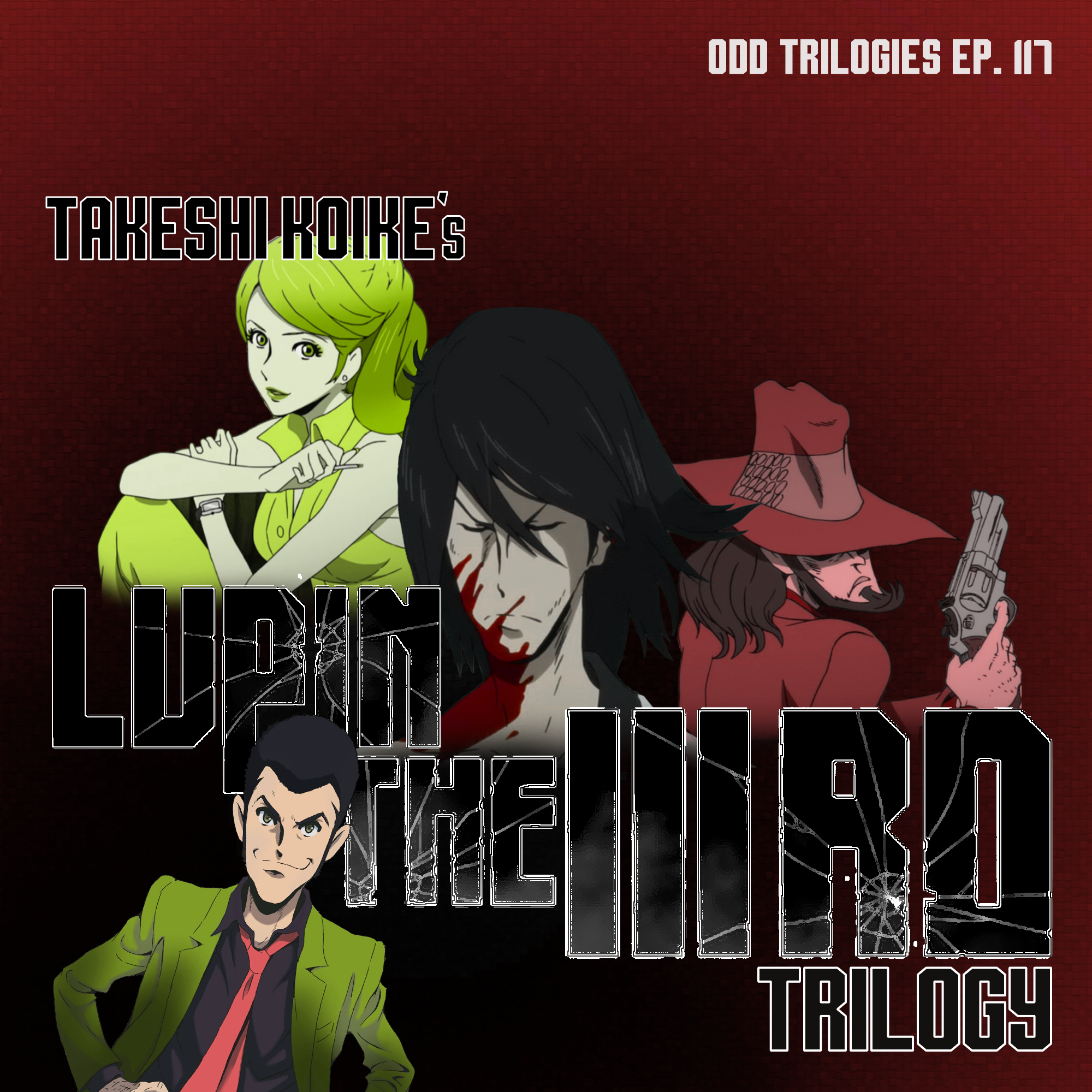
And the first one for January is one that you might not have known about because this trilogy was supposed to tie into a recent release, an American release of a film called Lupin the Third, the Immortal Bloodline that was in theaters for about four days. Because it was a limited release, it'll get a release digitally, I think in the next month or so.
But in honor of key like animator, designer, director Takeshi Koike's final film that is supposed to finally cap off. Cap off his Lupin the Third content for the last decade. Yeah, we decided to take all three of his very short films, but they're still technically features. But three one hour films in the 2000 and tens that basically follow each one of Lupin's crew.
Which leads us to be talking about Takeshi Koike's Lupin the Third spinoffs.
[00:03:48] Speaker B: Yeah. So if all of that sounded like a bunch of nonsense jargon to you, it's probably because this is maybe one of our more niche trilogies in that it is nested within a larger franchise from another country that you may or may not have ever heard of. And that is Lupin iii. Yes, kind of. He's an, he's an icon in Japanese pop culture. It's a long running series. Started as a manga in the 60s, turned into a long running anime in the 70s, and has had theatrical films, television specials, crossovers with other big popular animated characters in Japan. And still to this day, obviously with release in January of this year, is still a popular property coming out of Japan. And it's, it's, you know, it's a. Primarily, most of the franchise is like a kind of crime comedy saga of Lupin, this French professional thief and his. His misfit crew of. Yes, of a gunslinger, a samurai and a femme fatale. Yes, a temptress.
[00:05:03] Speaker A: The. I would say probably the template for Femme Fatale in many ways an example of it. I know femme fatale is a phrase and as a character existed before the show, but in the manga.
[00:05:16] Speaker B: But it is, I believe she was explicitly described that way in like the original. Yeah, she's the femme fatale.
[00:05:22] Speaker A: I mean she's the quintessential femme fatale. And yeah, it is a manga for two years, I think from 67 to 68. Then it becomes an anime that runs for off and on, runs for about, I think six parts. I think we're now part six.
[00:05:39] Speaker B: Part six was in 2021, I think. But basically it ran almost continuously throughout the seventies.
[00:05:46] Speaker A: Yes.
[00:05:47] Speaker B: And then came back like in the mid eighties and then left like serial TV for over a decade. Probably close to two decades.
[00:05:57] Speaker A: Yeah.
[00:05:58] Speaker B: But was. They were doing all sorts of like feature length TV specials throughout the 90s and 2000s.
In the last decade it's kind of come back to serial form.
[00:06:08] Speaker A: This is a series that's been around for a franchise that's been nearly around for 60 years.
[00:06:13] Speaker B: Yeah.
[00:06:14] Speaker A: Has I believe with Immortal bloodline added to it. 33 films and specials combined. Yes.
[00:06:23] Speaker B: Film length products.
[00:06:24] Speaker A: Yeah. The amount of crossovers, the amount of manga. There's different manga. Actually as we are talking about this, there just was an announcement that there is a Lupin the third manga that's going right now. It's an Isekai.
[00:06:36] Speaker B: Oh.
[00:06:36] Speaker A: Where Lupin and crew get put into a fantasy realm and they just do fantasy antics.
[00:06:41] Speaker B: That actually sounds fun.
[00:06:42] Speaker A: They finally. They just announced like a end date for that. But I think that has run for like 16 volumes.
[00:06:47] Speaker B: That's a. Oh, okay.
[00:06:48] Speaker A: Yeah. So it's run for. And the art design is very. It's. It's very delightful because it's very much. You just see like classic fantasy designs and then fucking Lupin's monkey face.
[00:06:57] Speaker B: Of course. Yeah.
[00:06:58] Speaker A: But yeah, yeah. The original creator was named Monkey Punch. He was involved with pretty much a lot of the adaptations in the series up until his passing, I believe in 2019. 2020, maybe even before that. But around the time of the trilogy we're talking about today, there was a solid gap between parts as well as television specials as well as films from the 90s and 2000s is a little bit iffy in terms of the amount of lupin the third content.
And then in 2012 there is a television series like spin off reinterpretation of the Lupin III crew that is made by Sara Yamamoto called the Woman Called Fujikomine, which is basically, I would argue is a.
Is a wonderful entry point in terms of like if you want to watch it and for some reason you don't want to go back to like the 70s animation.
[00:07:56] Speaker B: Yeah. 70s era animation and recycled plots.
[00:08:01] Speaker A: It does a phenomenal job of really capturing the essence of each character while also having a fun time using Fujikomine, the quintessential femme fatale who is, you know, an iconic member of the group.
[00:08:13] Speaker B: Yeah.
[00:08:14] Speaker A: And using her to introduce kind of the origins in a sense of Lupin where who Lupin is called Lupin III because he is the third generation of thieves named after Lupin. Yes, named after the iconic French thief, fictional thief, Arson Lupin.
So it's just, it's delightful in its own way because you don't even know who Lupin II is.
Except for being his dad. I don't think they ever really show.
[00:08:43] Speaker B: So thanks to doing this trilogy for the podcast, I've now kind of, you know, deep dived on Lupin. And I just found an episode of part two the other night that featured Lupin II in a flashback.
[00:08:59] Speaker A: Oh, nice, nice.
[00:09:00] Speaker B: It's a flashback involving Goemon's like, master and our son Lupin the second.
[00:09:07] Speaker A: Because I've seen. Because I started watching a little bit of part two as well. Because our friend in real life as well as front of the podcast, Adam LeClaire, is a big Lupin fan and has been slowly going through part two as well. And I watched an episode of him with him where they are fighting mummies because of a curse and they. And they run into Arson Lupin the first and he's like wearing mummy. No, like, basically you find out that the curse itself has been around since the original Lupin and the original Lupin stopped the curse all the way back then. So you get to see what Arson Lupin looks like in the world. It's just Lupin, but like with like a, like a top hat and a cape.
[00:09:47] Speaker B: Okay. That's basically what Lupin the Second looks like.
[00:09:50] Speaker A: Like, it's like it's. It's very funny because yeah, the series is basically the thing about especially a classic anime like this and why it's so, you know, enduring. Enduring because like, in terms of relevance, I think the relevance and I think the Koike Kuike spin offs show this is that the relevance really, I think depends on how much like willingness you are to have fun with the world as well as just be aware that it's pretty straightforward regardless of how you handle it. Because ultimately it is Lupin iii, the third generation of French thieves.
Daisuke Jigen, who is an assassin or assassin turned thief, who is one of the best gunmen, if not the best.
[00:10:34] Speaker B: Gunmen in the world.
[00:10:36] Speaker A: Goemon Ishikawa the 13th.
[00:10:38] Speaker B: Yeah, the 13th in a line of samurai dating back to like feudal times.
[00:10:44] Speaker A: A modern day samurai in the late 60s, early 70s.
And then you have Fujiko Mine, who is again the quintessential femme fatale temptress, who is a cat burglar, who basically is Lupin's main love interest, who he swears one day that he will steal her heart or steal her.
[00:11:01] Speaker B: Yeah. The kind of overarching never ending thread of the show is that Lupin is always like, at least in his mind, like inches away from getting her. And she keeps him thinking that, but he never really gets her.
[00:11:15] Speaker A: The funny thing is. Yeah. Usually it's. Lupin will do anything to help Fujiko, regardless of what kind of conundrum she's in.
[00:11:22] Speaker B: Yeah.
[00:11:22] Speaker A: Daisuke Jigen, I believe canonically hates women.
[00:11:26] Speaker B: Yeah.
[00:11:26] Speaker A: Not in like a women are like useless way, but more just like I think the whole thing of just being understand them.
[00:11:32] Speaker B: He doesn't. Yeah.
[00:11:34] Speaker A: And then Goemon is just a samurai in the 60s 70s.
[00:11:37] Speaker B: Yeah. Anything remotely social or sexual is like lost on him.
[00:11:41] Speaker A: Yeah. Or if he is involved in anything one romantically, it's like a courtship where he's like, I want to marry you.
[00:11:48] Speaker B: Although interestingly, the woman called Fujikomine plays with that a little bit.
[00:11:53] Speaker A: Yes.
[00:11:54] Speaker B: Goemon has a little thing for Fujiko.
[00:11:57] Speaker A: And they play with Jigen too because Jigen actually has a love interest in the show. But it shows that to him anything's going to be complicated in his mind because of just his past.
[00:12:08] Speaker B: Yeah.
[00:12:09] Speaker A: So he's just kind of written off. Written off most people, but women as well.
[00:12:13] Speaker B: Yeah.
[00:12:14] Speaker A: As. Yeah. Because of that. And yeah. The. In 2012 there's a 13 episode series that I.
I don't know how much you love compared to me. We talked a little bit about it.
[00:12:24] Speaker B: I think you liked it more than I did, but I enjoyed it. I still think it's fun.
[00:12:28] Speaker A: Spoiler alert. That's probably gonna be the case for most of these films. But like, yeah, I think it's a perfect kind of summation of just like how even when that series coming out in 2012 basically sets the series in the early 60s, there's a great modernization of these characters that feel perfect for the early 2000 and tens, but still is very 60s coded intentionally.
And through that series there is a key animator and character designer named Takeshi Koike who is known in the space for many years.
He is tied to one of the most iconic, difficult productions of any kind of anime film in the 2000s, which is redline, a gorgeous like, you know, racing, racing action adventure film that is nutty and also has one of the craziest ridiculous endings that was in development hell like that one was. But basically that movie, the studio that made that movie fell apart. But they still released the film and post redline. There's not a lot of work with Koi Koiki doesn't do a lot until Fujikomine.
[00:13:42] Speaker B: Right.
[00:13:43] Speaker A: In the process of doing this series, there is, I think, talkings and rumblings of, you know, while they're working on new parts of like classic era Lupin in a modern sense. Like it's modern animation, but it's still like in the mainline series per se.
Koike is being asked if he wants to do something in his own vein.
[00:14:05] Speaker B: Yeah.
[00:14:06] Speaker A: Take a lot of his talents he's had over the years because he used to be a protege of Yoshiaki Kuwajiri, who is a most notably known for Ninja Scroll, Vampire Hunter D Wicked City. Which Wicked City is insane.
[00:14:22] Speaker B: Isn't that the movie where you mistakenly watched a different.
[00:14:25] Speaker A: Yes.
[00:14:26] Speaker B: Movie and absolutely found it. Okay, 100 Demon City, Shinjuku or something.
[00:14:30] Speaker A: Yeah, yeah. Wicked City is a film that basically has gorgeous animation, but it's absolute.
It's just slop with just nudity, gore demons.
[00:14:42] Speaker B: Honestly, that's kind of most of Kawajiri that I've seen.
[00:14:45] Speaker A: I mean, it makes sense. Yeah.
[00:14:46] Speaker B: Especially it's beautiful and it's cool, but it's also like trash.
[00:14:50] Speaker A: Yes. Very sultry and kind of just like nasty at times.
But Koike learned a lot from Kujiri, did his own stuff, early stuff as well as if you've ever seen the Animatrix. There's a short in the Animatrix where it's a 100 meter dash and like it's someone who is, you know, running so hard, like his glutes are exploding almost.
That is a Koike short as well.
He has a lot of really cool things under his belt. Redline is also. I would recommend really fun animation wise and really good time. But just in terms of actual substance, really hold off.
[00:15:29] Speaker B: Like don't go in expecting an inspiring racing movie or anything like that.
[00:15:33] Speaker A: Expect to really just have a gorgeous. Just wild mess at times.
[00:15:38] Speaker B: Yeah.
[00:15:39] Speaker A: But in the process of working on Fujiko Mine series as a key animator as well as a character designer, he is given the opportunity to take the Lupin the third franchise and have his own spin on it, while not having to worry about being attached to at the time, part four and then later part five and part six.
So in 2014, 2017 and 2019, he makes three spin offs following Lupin's crew.
[00:16:10] Speaker B: Yeah.
[00:16:11] Speaker A: The first one being Jigen's gravestone. The second one being Goemon's blood spray. And the third one being Fujikomine's Lie. Or just Fujiko's Lie. Yeah, Goemon's blood spray actually came out the 50th anniversary, I believe, of Lupin.
And then for the longest time, that.
[00:16:31] Speaker B: Was 67 was the manga.
[00:16:33] Speaker A: Yeah. But for the longest time, it was just those three films for the time.
[00:16:37] Speaker B: Yeah.
[00:16:38] Speaker A: Until 2025, when Japan got not only another spinoff film, but it's about Zenigata. And Zenigata is a inspector who is.
[00:16:47] Speaker B: Yeah, he's kind of the ever present foil adversary to Lupin's crew.
[00:16:53] Speaker A: He's iconic to Lupin III as a series and definitely as a franchise. But he's not technically a part of the crew.
[00:17:00] Speaker B: Yeah, he's technically their enemy. But he finds himself helping them reluctantly a lot.
[00:17:06] Speaker A: Especially in the movies. I think a lot of the movies ends up getting tied into things.
[00:17:11] Speaker B: Yeah, he's kind of the Tom cat to Lupin's Jerry the mouse in that. It's just a perpetual chase. He's never gonna catch Lupin. He's always gonna get close.
Half the time they're gonna end up working together to stop something bigger.
[00:17:25] Speaker A: Yes.
[00:17:26] Speaker B: Or not even to stop something bigger. But just because Zenigata refuses to let Lupin die, he's like, I have to put you behind bars. I'm taking you in. And then Lupin gets out every time.
[00:17:37] Speaker A: Every time. He always gets out of the cuffs.
[00:17:39] Speaker B: And so he get.
He gets his own film last year in this series.
[00:17:45] Speaker A: And then I think a few months after that is when Japan got the immortal bloodline initially.
And now several months later is when we finally are getting a dub as well as a release of probably both of those. Because I think they just announced that all five films are getting, like, new packaging, new artwork, new artwork, physical collection. Yeah, it looks like all the new artwork is kind of like.
It sounds bad, but kind of like when they do like a re release and everything kind of fits more uniformly.
[00:18:13] Speaker B: Yeah, yeah. Like how like Disney rereleases the Marvel movies.
[00:18:20] Speaker A: That. But 10 times better because the artwork is like, they actually care about their artwork is kind of rad, the consistency. But yeah, we thought in terms of the having two new Koike, you know, installments, especially the final one, which is Koike's first actual Lupin the third film.
[00:18:40] Speaker B: Yes.
[00:18:41] Speaker A: And possibly last Lupin the third film.
[00:18:43] Speaker B: And I think I can say this for both of us that it felt like a good excuse to kind of get a little more Lupin on our plate because we've both kind of been sort of tangentially familiar with Lupin, maybe watched a little bit here and there. Of course, our friend Adam likes Lupin.
Oh, absolutely. And so for me, at least, like, when this came up as an idea, I was like, oh, yeah, let's do that. Then I can watch a bunch of Lupin. As if I've never been able to watch Lupin before.
[00:19:11] Speaker A: Oh, yeah. Well, a lot of it is because, like, and it's something that our listeners might not be aware of, or if you are out there hearing this and you are very well aware of this and you will definitely agree that if you just stop watching live action television movies, even stop reading books, if your only sense of media is anime, genuinely, you will never run out. Oh yeah. There is so much of it, even more so than I think most television that, like, including prestige television miniseries and other countries, the amount of anime that comes out every single season, not even year, is ridiculous. And so, like, you know, when it comes to us who are like, you know, have grown up with anime in many different ways and have different stuff that we're interested in, and especially with modern anime, it's kind of been fascinating just to see how people respond to it. It's always been fun to be like, oh, but yeah, there are the classics. There is like something like Lupin, which has always been there.
[00:20:10] Speaker B: Yeah.
[00:20:10] Speaker A: And has like, you know, kind of.
[00:20:12] Speaker B: A James Bond type figure in pop culture.
[00:20:15] Speaker A: And especially if you're. If you're out there and most people, if you know anime and you might just be known of it because of the shonen aspect of like a Dragon Ball Z or like a Jujutsu Kaisen Demon Slayer or like My Hero or Boruto's dad. Boruto's dad, also known as Naruto and Naruto Shippuden.
It is kind of one of those situations where it's fun to watch Lupin, where literally it is a series where you could skip around episodes if you want to, and you will still have a fun time. You won't have to worry about continuity and you know exactly what an episode is. An episode starts with the team being like, hey, we're gonna go to this country, steal this jewel called this thing, and there's probably gonna be some wacky hijinks that might be supernatural, that might just be normal. Just like skullduggery with like, just asshole millionaires or maybe like corrupt cops. And then.
[00:21:04] Speaker B: Or Hitler or Hitler.
[00:21:05] Speaker A: A lot of Hitler. There's a lot of Hitler. Those original series which they. They fight Nazis constantly.
[00:21:11] Speaker B: Yeah.
[00:21:12] Speaker A: And they. They've run for at least 300 to 400 episodes.
Yeah.
[00:21:19] Speaker B: Part two alone is 155.
[00:21:22] Speaker A: Yes.
[00:21:23] Speaker B: And I think part three is like 80 episodes and then the rest of them are all like 20 some episodes. So however much that is something 3.
[00:21:31] Speaker A: 400, but still that's a lot. And that is not even the longest running classic anime that's been going for like because that's like Detective Conan, which is like a thousand plus episodes and also has that same. Like most people who watch that show love that show. But like it is literally very formularic, it's very weekly and it's now, I think about to hit its 40th anniversary, maybe maybe 30th.
But I think this year is its anniversary. But yeah, Lupin is one of those things where it's like an easy jump in, jump out, you get some fun antics. If you even want to be like, I don't want to watch the series, I'd like to watch some movies. Well, good news, there's a fuck ton.
[00:22:13] Speaker B: Of movies which, yeah, I think there's including Immortal Bloodlines, seven theatrical features and then like, I don't know, a dozen or more feature length television specials, which.
[00:22:24] Speaker A: Is not even counting like the crossovers that she's done.
But yeah, and maybe a lot of you might just know Lupin kind of indirectly because Hayao Miyazaki's first film is the second ever Lupin film, which is the Castle Cagliostro, a film that I still need to watch.
[00:22:42] Speaker B: Really?
[00:22:42] Speaker A: I haven't watched in full.
[00:22:43] Speaker B: I didn't know that.
[00:22:44] Speaker A: Hilariously, the first time I was ever introduced to that film was there used to be an arcade game that turned that into like a Space Ace Dragons Lair style.
And I remember seeing the animation of it and just like it basically is just making you play through the movie while like doing like quick time events.
[00:23:01] Speaker B: Yeah.
[00:23:02] Speaker A: And that was the first time I'd ever seen anything from that movie and be like, that's interesting. That's wild.
[00:23:05] Speaker B: Yeah.
[00:23:06] Speaker A: Then later on found out that they just like cut the film into a video game.
But yeah, so like there is this huge legacy surrounding Lupin. But what's so great about the brand is that the brand doesn't feel like it is super strict enough that it's not gonna let Koike have a flexibility in what he wants to talk about. The tone he wants to handle, the look and feel of it.
Because with the Woman Called Fujikamine the series, it actually amps up violence, the nudity, the intrigue, the kind of the idea of like an entire series long arc.
[00:23:45] Speaker B: Yeah. That is like a mystery, cohesive narrative and it's, it's this may be a little reductive, but unlike a lot of Lupin out there, it's actually has a goal of being about something specific.
And I say that with a bunch of love in my heart for Lupin.
[00:24:05] Speaker A: Same here.
[00:24:05] Speaker B: That show is mostly, you know, kind of frivolous crime comedy entertainment.
[00:24:11] Speaker A: As someone who loves, like season long arcs that really have a nice payoff, it's also fantastic to jump into a.
[00:24:18] Speaker B: Lupin episode, be like, I don't know what's going on. And this is great.
[00:24:21] Speaker A: Being told they're gonna hang out with Niki Lauda and like, get a jewel. And then they may or may not get that jewel and leave. And then the next episode, they're in a different country.
It's episodic format to a really wonderful T. And the Koike films kind of, you know, attempt to give it just a bit more of a cohesiveness, but still keep the energy of, like, being able to jump into any one of these and not be fully confused at the fact like, oh, there's this is not the third one. This is the. This.
[00:24:51] Speaker B: Yeah, well, yeah. I mean, the Woman Called Fujiko Mine came out at a kind of pivotal time for the franchise in that, like, you know, it hadn't had a TV show in a while.
[00:25:03] Speaker A: Yes.
[00:25:04] Speaker B: And so it was kind of the, you know, perfect way to bring those characters back, but offer something new and maybe a little bit more fitting for the times and what people were interested in from anime and then from that. Koike's directorial work on Lupin. These films that followed Woman Called Fujikamine are not.
I wouldn't say they're doing. They're definitely not doing the exact same thing as Woman Called Fujikomine. But they're kind of following in those footsteps of like, yeah, let's do something that is long form narrative, a little more serious in tone, and, you know, just explore other options with what we can do with this property rather than just, you know, let's make another globetrotting crime comedy.
[00:25:54] Speaker A: Yeah. Because again, I mean, it's hilarious that we talk about the lack of Lupin content before these films, because once these films run for like the next five years, there are two more parts added to the series. And then the film's first ever fully animated CGI film.
[00:26:13] Speaker B: Yes.
[00:26:14] Speaker A: Which is called Lupin the Third. The First. Of course it is.
Would recommend that film. That film's a lot of fun.
[00:26:20] Speaker B: I could be wrong. I have not seen the film, but I think it's just called the first because it's the first. Like 3D CGI?
[00:26:26] Speaker A: I think so.
[00:26:27] Speaker B: Yeah.
[00:26:27] Speaker A: Yeah, that's the one. And it's also like, I don't think.
[00:26:30] Speaker B: It'S meant to be an origin story. Right.
[00:26:32] Speaker A: No.
[00:26:33] Speaker B: Kind of drops you in.
[00:26:34] Speaker A: No. Because it adds, it adds characters you never see again.
[00:26:37] Speaker B: Yeah.
[00:26:37] Speaker A: In the series. But like. Or fun like almost like a, you know, viewer analog where it's like, who is this monkey man with a goofy suit that just has the every rubber mask known to man.
[00:26:49] Speaker B: Yeah.
[00:26:49] Speaker A: And yeah, it's, it's. So there is, there's a plethora of Lupin the third content, which is basically what we're trying to say now. And with Koike it was this kind of energy of well, how do you stand out from that?
[00:27:01] Speaker B: Yeah.
[00:27:02] Speaker A: And the way you stand out from that is basically take a lot of what Yamamoto and Koike did with the series Fujikomine and decide to make it, I would say, sleeker, more, I think, straightforward design wise and visually, but still make it pretty sleek.
[00:27:23] Speaker B: It's a cleaner look for sure. Instead of the very hand drawn, very cross hatched look of Fujikomine.
[00:27:31] Speaker A: I kept thinking of like this is not even like a derogatory statement. Very Austin Powers Y in terms of just like the 60s aesthetic that is like blown into beautiful proportions and the Fujikamine show.
But with the three films there is. Yeah. Like Andy said, sleeker and more cohesive. It also, it's, I would say, more mature.
[00:27:53] Speaker B: Yeah.
[00:27:53] Speaker A: And darker usually. Because the thing is, is there's still things that happen in these movies that are absolutely batshit.
[00:27:59] Speaker B: Yeah.
[00:28:00] Speaker A: And goofy to a degree that I feel like you can play these characters in classic Lupin and it still feel in on brand.
But now we're going to take it more seriously because people are getting hurt more consistently. People are dying. Which is something like people do die in classic Lupin, but it's in a very cartoony sense.
[00:28:17] Speaker B: Yeah.
[00:28:18] Speaker A: In these films it's like, you know, blood spurts, just clearly like actual damage.
[00:28:23] Speaker B: Somebody gets their arm hacked off or.
[00:28:25] Speaker A: Yes.
[00:28:25] Speaker B: Shot in the head. Yeah.
[00:28:27] Speaker A: In the first film with Jigen's gravestone, one of the bigger action moments is when we get introduced to our antagonist who is basically a sniper that is like doing 4D chess in his brain. Yeah.
[00:28:38] Speaker B: He's like the world's first genetically engineered sniper.
[00:28:41] Speaker A: Yeah. Who has a tiny sniper rifle, tiny red bullets, and uses a fucking die to determine how many shots he gets to kill.
[00:28:50] Speaker B: Somebody's little game with himself.
Two face like, do I get to kill this person?
[00:28:56] Speaker A: Because the plot of all three of these films. Again, these three films are just under an hour, so about 50, 50, 55 minutes. I think the Zetty got a one that came out last year is the longest of the of them of the. The non fully featured feature length.
But the premise in the first one is basically Lupin and Jigen are in Europe. They're here to. They're here to steal a necklace. They steal the necklace. Everything doesn't go as planned, but they still find a way to get out of it. A sniper starts to attack them. And then they find out that Jigen realizes that the way that the. The assassination attempt nearly failed initially it felt very familiar to these rumors of an iconic notorious assassin who when he has his sights on you, he builds your gravestone and then goes after you. So of course Jigen finds the Daisuke Jigen gravestone and then becomes this whole plot about who hired the assassin. Who is the. It's like, what is he attached to? There's also a B plot with Fujikomine that ends in the most batshit way possible of every of these three films. Which is funny because the Fujiko film has some pretty wild. Has an antagonist that is genuinely like on the verge of supernatural in a way.
[00:30:17] Speaker B: Oh yeah, yeah.
[00:30:18] Speaker A: But in Fujiko's plotline in Jigen's gravestone is she's also trying to steal something at the same time.
[00:30:25] Speaker B: Right.
[00:30:26] Speaker A: She fucks up. It's like a Eyes Wide Shut cabal.
[00:30:29] Speaker B: Of rich people, like this weird cult.
[00:30:31] Speaker A: And. And because they had. They capture Fujiko and they decide, oh, we're going to play. We're going to use our riches and to play around, they throw her in an oily cage.
Oily glassy box with a red gimp. Giant.
[00:30:47] Speaker B: Red giant gimp suit with a giant drill penis.
Yeah.
[00:30:53] Speaker A: The reason why there's a little bit of a pause is because we don't have an answer as to why this is happening.
[00:30:57] Speaker B: Doesn't have anything to do with the rest of the story. And honestly, really, like the rest of the movie is not like that. You know, like some anime is, you know, just super filled with that stuff. This movie just has that scene out of nowhere.
[00:31:10] Speaker A: Again, it generally has this feeling of like the. The classic X Men meme where Scott is like, I wonder where Logan is and it's fucking Wolverine.
He's strapped to a nuke. It's like Fujiko. Because classic Fujiko antics are. She. There's a lot of times she's not even attached to the main crew. Yeah, she's off doing her own, doing her own thing. And then the trio find her.
They meet up. Maybe they're looking for the same treasure. Maybe they're looking for different treasures that are somewhat connected.
Fujiko ends up finding a book, a black book that shows that the assassin who's coming after Jigen actually is tied to a bigger cabal that might actually have something more to do with political doings, as well as the fact that they might be dealing with them more in the future, which, spoiler alert, they do. Yeah, it is basically building into something that you don't actually fully get a resolution to until the immortal bloodline. But it's more of just kind of something to add more to the world and a mystique that, honestly, classic Lupin doesn't usually kind of care about.
[00:32:16] Speaker B: Yeah.
[00:32:16] Speaker A: So it's kind of fun to see Lupin and the crew be like, why does anyone want anything to do with us?
And then they ghastly get pulled in. And what's great about these three films, I think, are their best is that when they really focus on Jigen in this film, Goemon in the second one, Fujiko in the third one, they do a good job at times to really show why they are as good as they are.
The Fujiko Mine show does that incredibly well as well. But if you hadn't seen that and you just go into these films being like, you kind of vaguely know how each character works.
It does a good job of giving each character a villain that is not a perfect mirror to them in terms of an arch nemesis they have to overcome by the end of the film. But it still is a fun dynamic to see.
Basically, Jigen's biggest enemy, biggest arch nemesis at a certain point, is a man who overthinks everything while Jigen isn't.
[00:33:15] Speaker B: Jigen's a hip fire gunslinger.
[00:33:18] Speaker A: He's a quick draw, six shots, his.357 Magnum. He doesn't use any other gun. I think at one point they offer a different gun and he just like, that's stupid.
[00:33:29] Speaker B: Yeah, I think I was. I was thinking when I was watching that movie, I wonder if Jigen ever uses a sniper rifle. And then I like, went home and threw on an episode of he does Lupin, like old Lupin. And he indeed used a sniper rifle. But yeah, he mostly sticks to his six gun.
[00:33:47] Speaker A: Yeah. He basically can get everything done with his magnum. And when he can't, for example, when he has to take on something long range, he does in fact have a classic rifle that is not a modern sniper rifle, which is Hilarious. But yeah, it's fun to see.
It is at these movies at their best. It is fun to see characters that have been around for decades come across these new villains that are just like, pushing them to their limits in a way that is like, well, what the fuck am I if I am. If I'm considered the best at what I do at this or this or this.
How do I use what I think I'm the best at against this wild, weird dude that clearly is doing very similar things to me, but has more resources, is even craftier at times than I can be in certain situations and ultimately will might, I mean, lead to a showdown that could end my life.
Which is another fascinating thing too, is because, like, death in classic Lupin is kind of non.
It exists, but not really for the Lupin crew.
[00:34:53] Speaker B: Not for the main characters.
[00:34:54] Speaker A: Yeah, they can get stuck in situations where you think like the team goes, oh, no, I think Lupin just died. And he'll just pop out of nowhere.
[00:35:01] Speaker B: It's a very status quo show.
[00:35:04] Speaker A: There's literally a whole episode in classic Lupin where Lupin is being tricked into thinking that he is killing people like Jekyll and Hyde style. And so he asks Goemon and Jigen to kill him.
[00:35:18] Speaker B: Right.
[00:35:18] Speaker A: And they. They constantly keep missing him because he accidentally. He doesn't want to kill himself.
[00:35:23] Speaker B: Yeah.
[00:35:24] Speaker A: And then the end of that goes. Jigen goes, kill yourself. No read for this. And they just both leave. And then he tries to hang himself and he fails.
It's like this. Very dark ideas, but that in a 70s anime are just very kooky and fun. And then in this, it is.
They treat it genuinely seriously, when I mean, spoiler alert. There's times where you think maybe one of these guys will die, but if you're aware of Lupin in fashion, there's no way that they're gonna die. So, like, the closest I think, of these three that get to that is Jigen. Because Jigen at a certain point is treated like he gets shot in the head.
[00:36:00] Speaker B: Shot in the head in like the.
[00:36:01] Speaker A: First act of the film. The first act. And then he's gone for a while. And then when he returns, it's a phenomenal return. I love his return. Yeah, it is a great finale for Jigen. And then basically he just blows the arm off of the dude that tries to shoot him in the most goofy, like, Matrix esque way, which is using the.357 Magnum bullet to change the trajectory of the sniper bullet, right?
[00:36:35] Speaker B: Or no, he bounces his bullet off the Sniper bullet, right?
[00:36:40] Speaker A: Yes.
[00:36:40] Speaker B: To hit the sniper.
[00:36:42] Speaker A: And it is just.
[00:36:45] Speaker B: It's a very wanted esque scene.
[00:36:47] Speaker A: And I also want to talk about too, when it comes to these films because it's.
Because I think it is a different.
It's an offshoot of the classic Lupin.
We watched the majority. We watched all three of these in the dub.
[00:37:01] Speaker B: Yeah.
[00:37:02] Speaker A: Which in the early 2000s, classic lupin finally got dubbed for the first time for many American audiences.
There was an earlier dub, I think, for the 70s show as well as the Castle Cagliostro.
But in the early 2000s, they got the rights, I believe, to the first 80 episodes of Part 2, as well as certain films. And so they started dubbing them with a consistent cast that is the same cast all the way up. In terms of classic Lupin, they're still using that same cast now.
But because that same cast is doing the classic Lupin, it seems like, well, they're busy. But also it's funny because one of the original voice actors in the 2000s dub is Richard Epkar, who played Daisuke Jigen. He plays Zenigata in these films, which honestly, in my opinion, he's a good.
I love his Zenigata. His Jigen's also great. But I think the way that Zenigata is built, design wise, this might be a hot take. Every time I see I hear his original voice, it always throws me off.
But with Epkar's voice, especially in a serious tone for Zenigata, it's like perfect.
But Epkar worked as the director for the original run. And then I believe for one of these films, Tony Oliver, who is Classic Lupin's voice in American sense, was the director for one of these, like anime like voice directors for one of these films. So like they just had those. Those voice actors probably could have done this. But I think it's interesting to have a different cast.
[00:38:39] Speaker B: Yeah, I mean, it makes sense, right? Like you're in a different. Doing something different with Lupon. Let's maybe get a different cast in there. So it's.
[00:38:46] Speaker A: Except for Goemon, I think the original actor who played the American dub for Goemon, I think either passed away or retired. And so the guy that they have for the spin offs actually is the same guy for like the later parts.
But the reason why I bring this up is not because not only did we watch the dubs of each three, all three of these.
I think it's important to talk about the fact of the choice of Lupin voice, because the Lupin voice in the classic State is that Tony Oliver is very bouncy, is very goofy, is very energetic, very monkey like. Yeah.
[00:39:22] Speaker B: He embodies the monkey spirit of Lupin.
[00:39:25] Speaker A: Which a lot of classic Lupin and even modern day Lupin has like a monkey face built into him.
For the Koike films, the dub decides to do something very interesting, which is use Keith Silverstein, who's a. Who's a voice actor who's been around for a while, for decades. He's in Hunter Hunter. He actually is in the Sonic series.
The reason why I wanted. We did the dubs. I actually was the one that I think suggested doing the jobs for these three because Keith Silverstein.
Keith Silverstein is the voice, or at least of all as many voices he at one point is. He's personally my favorite voice for Char Asnobal in the Gundam series because when they did the Gundam origin ova films, he plays Char. And I think he's a phenomenal Char.
And I think he's currently been Shar in the modern stuff.
[00:40:21] Speaker B: Yeah, he's Shar in just about everything.
[00:40:23] Speaker A: I think in Hathaway, he's Shar too, for like the one brief, brief moment.
[00:40:28] Speaker B: He also voices the. I think he voices the shark clone in Unicorn.
[00:40:34] Speaker A: Yes, I think he does something like that.
What is. What is the Char unicorn?
[00:40:39] Speaker B: Full frontal.
[00:40:40] Speaker A: Full frontal.
Yeah. That is you. Oh, man. It was. There are moments when we record something that I just wish other people could see how Andy looks at me when he says certain things as fans of Gundam. Yeah. It is funny how there are just names that are just a. Like, he's like, what is that guy's name? It's like, oh, yeah. Paptimus Scirocco.
Just like characters like that where it's like, that's not real. I was like, no, it is. But yeah, Keith Silverstein plays Lupin. And I was very personally curious when I found this out when they released the dub cast for Immortal Bloodline, because he did all of the spinoff films.
And I was like, how does that guy do such an iconic goofy, very energetic like, voice when most of the things I've heard him do are very sleek, are very cool, or very. Almost like mysterious because he can perfectly handle that. Even intimidating at times.
[00:41:36] Speaker B: Yeah, almost a little bit like whisper voiced too.
[00:41:39] Speaker A: And I would say is probably the most controversial take out of all three of us watching this is that there's not really that much change in his voice for the. Keith Silverstein's voice for his Lupin. It does sound a lot like his Shard.
[00:41:54] Speaker B: Yeah, it really does.
[00:41:55] Speaker A: But what's kind of fascinating, though, is the fact that while that is clearly a deliberate choice to make a sleeker, less perverted, less goofy Lupin. He's still perverted, he's still goofy. He still got that thief. That thief itch that never goes away.
[00:42:14] Speaker B: But like, the knob, the volume knob is just turned way down on all that stuff.
[00:42:18] Speaker A: Yeah, it very much has the energy of, like, I would say comparing, even though it's a much bigger gap in this case in terms of interpretation versus the Tony Oliver Lupin and the key Silverstein. But it does feel like a massive change. Like in, like, in between bonds.
Like, maybe even like something like compared to like Roger Moore compared to a Pierce Brosnan where it's like something where like, they are technically the same character. But I'm not surprised that, you know, while we were watching these movies, while I think I have.
The more I've thought about Silverstein's performance, I think I've liked it more and more, little by little. I understand why for both, I think you and especially Adam, it didn't click as well, especially initially. And I think by the end of it, you were. It was like. It's not entirely what I would want from Lupin, which is fair. It is. It is a lot. He's a lot cooler than you'd expect, voice wise.
[00:43:16] Speaker B: He's a little too cool for my taste. But I think honestly, like, what kind of irked me about it, the more we got into it, was how similar he and Jigen sounded.
Or not Jigen.
Maybe it's Gomu, because Jigen is.
What's his name?
[00:43:37] Speaker A: Is it Scott?
I don't.
[00:43:40] Speaker B: No. Yeah. I am thinking of Jigen. I was. I confused myself for a second because Chris Sabat voices Jigen in Fujiko. Yeah. In the Woman Called Fujikomine, but in this trilogy or in this now a pentalogy, but trilogy of the time, Jigen. To me, Jigen and Lupin just sounded a little bit too similar. And. And I had not like, literal trouble telling them apart, but like just thematic, you know? Yeah.
[00:44:13] Speaker A: Confusion with that because in classic Lupin, you kind of have.
And again, this is. This is not a one to one, but it is kind of like, you know, have Lupin kind of up. Up here like Fujiko, like very, very wily, higher pitch. And then Jigen's a little bit lower because it's Richard Epcor. And in his voice is just. I mean, the dude does like Joseph Joestar. Yeah, he's done a lot of like, introductory kind of like tutorial stuff in video games. So like he's got that like very matter of fact, I say like a perfect government va. Like vo. Like if you like having like a. Having something like very serious being told to you, you can do that very well.
[00:44:58] Speaker B: Like very firm but not aggressive.
[00:45:00] Speaker A: Yes.
If you like. If you gave me like a drawing of like a colonel of any kind, regardless of the military affiliation, I could probably just be like Richard F. Clark.
[00:45:10] Speaker B: Richard.
[00:45:12] Speaker A: And it is. When you go into Jigen's gravestone, the guy they get for Jigen, I think at the time, he sounds very similar to Epkar, but is clearly not him because it's. Again, it's hard not to go into Jigen and not think of like, where's my basis for Jigen? And it's either Chris Sabat or the guy that has been doing it for 20 years or for a decade at this point.
And then when you have for. Then you have, yeah, Keith Silverstein's Lupin, which is not at all what you're kind of expecting initially, but it's still really fun. And it's still the character.
It is just much, much chiller than I think some people would have kind of wanted at the time. It. It also is the fact that these, these voices do feel like they're getting a handle on what these characters are now trying to be execution wise. Because by the time that we get to the Fujiko's Lie, and even with the films that came out last year, yeah, there is a confidence there that I feel like you can hear compared to in Jigen's gravestone, where they're still doing a really good job. But you can tell they're still trying to find their interpretation of the characters. And I think with when it comes to Goemon, it's that that character has a good job of. You know, that guy barely speaks. He's not in Jigen's gravestone.
[00:46:27] Speaker B: Yeah.
[00:46:27] Speaker A: And he's not. He's barely in Fujiko's Lie, if he even is in Fujiko's Lie.
[00:46:32] Speaker B: I think he is, but not very much.
[00:46:34] Speaker A: Not very much so like. And he's very. He doesn't talk that much.
[00:46:37] Speaker B: Right.
[00:46:37] Speaker A: And is very consistent in terms vocally. There's never.
I don't think there's anything I've seen of going on besides in going on. Even in Going on's bloodspray where like things are going bad for him, he still pretty much has the same tone.
[00:46:51] Speaker B: Yeah, he's.
[00:46:53] Speaker A: And then you got.
It is.
[00:46:56] Speaker B: Yeah.
[00:46:56] Speaker A: Like everyone, I think, does A really good job with their interpretations. But it is clearly like a different take. And for Chigen's gravestone, it is kind of like at times like, oh, okay, I'm gonna see how this works as we go on the movie to movie. And I think, you know, Jigen's gravestone being a solid template and foundation for this world is why I would argue. And I don't know if you'd disagree with me on this. It'd be fun if you did, because I'd be curious to see what you'd say otherwise. But that would lead Goemon's Blood Spray, the next film in our trilogy, to be, I think, the best out of all these films.
[00:47:30] Speaker B: I think it's my favorite. At least I think it might be.
[00:47:32] Speaker A: Mine too, because I think in this one you. Because the thing is, yeah, this is the loop on the third spinoff trilogy. But it is kind of funny that we say that in. And Lupin the third is a prominent part of all three of these.
[00:47:44] Speaker B: Yeah, yeah.
[00:47:45] Speaker A: And so the question is, you might have out there is. Well, what makes this different than like a Lupin III film? Well, the thing is, is that Lupin has a very.
Unlike a lot of the films as well as even the television show, he's got a very passive role in all three of these movies. He's very. He's always there, but he's very passive in terms of like, it is never going to be a point where the movie treats him like the main character. Character. He really doesn't get any character development of all three of these other than just hearing his response. Yeah, really hearing his responses to like, his friends. Really what you get from Lupin is like his best moments in all three of these all have to pertain to him discussing or just him having scenes with the leads in each one. Like, I would say the best scenes in Fujiko's Lie have of him and Fujiko together and seeing Koike's interpretation of their decade spanning will they, won't they kind of romance. And Goemon's Blood Spray, I think, has some of the best Lupin stuff because a lot of it is really just him sitting there being there for Goemon if he needs it, but he never needs it. And it's fun to just listen to a character who's mainly the lead and is mainly the one who is running around getting in trouble, getting shot constantly while everyone else is following him. It is kind of fun to watch him be second or third fiddle at times to his cohorts and see that he's like, there's no jealousy for someone not trying. Like, there's no jealousy that someone's trying to kill his friends and not him. Like, there's clearly. Like, he is shocked at times when there is like action that has nothing to do with him pertaining. But he still enjoys it.
[00:49:31] Speaker B: Yeah.
[00:49:32] Speaker A: But I think with Goemon's Bloodspray having this kind of situation where Goemon is hired to be a bodyguard.
The a giant blond man with an axe and like jaws teeth.
[00:49:45] Speaker B: Yeah.
[00:49:46] Speaker A: He's like tomahawks. Yeah.
[00:49:48] Speaker B: What?
[00:49:49] Speaker A: He has tomahawks? Oh, specifically tomahawks.
[00:49:51] Speaker B: But he's like a giant lumberjack of a man with metal teeth.
[00:49:55] Speaker A: He's like a soldier who supposedly was supposed to die in a massacre and he ultimately caused the massacre and got away.
He is now a hitman as well. Similar to the sniper in the first film.
And basically leads Goemon to fail his mission. Goemon tries to make up for that.
And he is up against someone he has never fought before in terms of a foe that it's basically watching.
He's trying to fight someone who's fully blunt in how he attacks things.
[00:50:31] Speaker B: Yeah.
[00:50:32] Speaker A: And it's not enough for us.
[00:50:34] Speaker B: It's kind of that classic trope of like. And I mean, you see this a lot with like ninjas and samurai and media is like, I will overpower a stronger enemy through technique. And that's kind of Goemon's whole thing throughout Lupin is his technique. He's great with his sword. His sword can cut through anything. He can dice up anything. You know, he can confidence. He's got that razor sharp reflexes and everything.
And it's like kind of what happens when the guy who spends his whole life, you know, overpowering more powerful people through technique comes up against somebody who's just so strong and so tough that he can't be overpowered. Yeah.
[00:51:17] Speaker A: And has a technique that is just genuinely the inverse of his meaning that ultimately he can come at it with his cloud. Because again, Goemon in the. In the series is hilariously known for cutting planes, slicing up, cutting things in half regardless of the strength. Unless, you know, sometimes he can't. Which leads into the classic series being like, this is too strong for my sword.
I must find another way.
This is the first time Goemon has come up against somebody who is arguably better than him in every way.
[00:51:52] Speaker B: Yeah.
[00:51:52] Speaker A: And has to find out how do I. How do I improve or how do I change my mentality in a combat setting. That could lead me be. That could lead me to finish this man, to find him, to finish him off and to actually one up him. And the solution leads. I think the weakest part about Goemon's bloodspray is the fact that there is a. Once he kind of fails for a second time, he is. He's gone. Which again is hilariously. That's pretty classic Goemon. He will just either go off and do his own thing.
[00:52:27] Speaker B: I must go back to my temple.
[00:52:28] Speaker A: Yes.
[00:52:29] Speaker B: I must go learn the ways.
[00:52:31] Speaker A: My sword can't cut this. I will see you all when you need me. Is basically what he does. And so in this film, it is doing that. But instead of just like not showing what he's doing, we are watching him basically break down his body layer by layer in different ways.
In a sense. Way that he becomes like. Basically gets a third eye.
[00:52:54] Speaker B: Yeah. He goes Sixth Sense Ultra instinct.
[00:52:56] Speaker A: Like, Goku basically builds his. Breaks his body through like, you know, fire and water and like, just constantly beating his body down, not eating to get his mind in a. In an ultra instinct, just euphoric state where he can now basically have a third eye. Sixth sense to his opponent, regardless of who his opponent is.
[00:53:21] Speaker B: Yeah.
[00:53:22] Speaker A: Which leads to a rad introduction. Introduction fight to that.
That is basically a slaughter. But it's a great slaughter scene. And it also shows just how different Koikes.
How much Koike is going for the much more graphic, more mature version.
[00:53:39] Speaker B: Yeah. A lot of dismemberment.
[00:53:40] Speaker A: A lot of dismemberment. A lot of blood spurts in a way that is not shown in classic Lupin.
And then also has a finale fight that actually made all of us squirm. Because it does something that I don't think I've ever seen, especially in an animated fight with sword fight with like, sword fighters watching, like, just tendons. Like watching meat get like filleted off of an arm and bone. And you're seeing the tendons of his arm.
[00:54:13] Speaker B: Yeah, it's. He does a little. He takes part in a little bit of pugilism in the final fight. He's like, I'm gonna take a blow. To give a blow.
[00:54:21] Speaker A: Yeah.
[00:54:22] Speaker B: So he takes a tomahawk, like, down the length of his arm, starting at his shoulder. And it just like. Like you said it, like, fillet flays him. Yeah. Takes off a whole, like, sliver of his arm. And it's kind of nasty.
[00:54:35] Speaker A: And it goes. And again, while all this is kind of happening with Goemon, I think it makes it.
It's so funny when shit like this happens in the main series. But, like, while this is happening to this one character, the rest of the crew get their. Get their ending that they wanted and are just like, they're smoking a bong. They're chilling.
Fujiko's outfit is incredible. It, like, is unlike what she looks like in the rest of the series because she has, like, this blonde orange hair.
[00:55:05] Speaker B: That blonde orange, brown gradient. Yeah.
[00:55:07] Speaker A: And it's really cool. But in this film, she has, like, this short cut that she's clearly wearing a wig. A different look. And then, of course, you get, like, more. The goofiest Lupin you get is in this movie because he gets really high and gets really silly.
But this is also, like, how it brings the team back into it is very interesting because it turns out that Hawk, while he was tasked to.
You initially think he's tasked to killing the Yakuza boss that Goemon was supposed to protect.
Ultimately, Hawke was tasked to killing Lupin and the crew.
And leads to. Of course, when Jigen gets his time to shine, it shows just how powerful this foe is because Ji Gun shoots, unloads his entire six bullets onto Hawke, and Hawke blocks them all with his tomahawk.
And again, Hawke as a character, I think also makes it one the best villain of the three, because while I think all three villains are well designed in unique ways, Hawk is the most fascinating because he is designed like blonde Paul Bunyan.
[00:56:11] Speaker B: Yeah.
[00:56:12] Speaker A: Is the way it is. He is gigantic. And he also is. He has a gut.
He's, like, just wearing a pink shirt and jeans and has two tomahawks that he uses to block everything and has, like, this wild shark grill that's, like metal. And when he shows up, it is like. And I think the funny.
I think it was.
There's a funny litter box. I think it's like bear versus twink warfare, where it's this giant burly man going up against the skinny, just like, very mysterious yet very efficient samurai.
And just trying to find that samurai being like, how the fuck do I take this brute out? And the fight is great. I think it's very well done. I think Lupin, again, Lupin is fascinating too, in this movie because he's the only one who fully understands what Goemon is going through, even though he's not a samurai.
At one point, Fujiko just leaves because she's bored, and she's like, you guys are just annoying men. Which is true. They are very annoying and silly. But it's funny how Jigen has no idea what Goemon is doing, and yet Lupin shows just how much he cares about his crew in each one of these films, but definitely Gomon. And consider. Because he's aware of the torture that Gomon is putting himself through in order to achieve this sixth sense that is just, like, unheard of in reality. And to have Lupin understand. Understand that. And also just kind of like, it's. It's just fun to see an interpretation where it's like, you know, Lupin doesn't even say that many words to Goemon.
[00:57:48] Speaker B: Yeah.
[00:57:48] Speaker A: I think a lot of his conversations pertain to Goemon are with other characters.
And every now and again, he's just like, oh, my gosh, Gomon, you're here. Because another thing, too, is like, the inciting heist and fight and everything that happens on, like, this giant casino ship is supposed to have nothing to do with Goemon. Goemon just happens to be on the ship watching this guy.
[00:58:09] Speaker B: Yeah.
[00:58:10] Speaker A: And leads to, again, another, I think, a very fun 50 minutes that also, I think, arguably is better than Jigen's gravestone because it has Zenigata in it.
Zenigata is in one of three of these. And he is, again, doesn't automatically make something worse like a bad film without Zenigata. But it is fun.
He's a lot of fun. And it's funny to see him look at Hawk, a man that has slaughtered countless cops and his hitman, and to put a gun in his face and say, halt. Because he's just that.
That much of a standup cop. He's got to follow the rules by the book, even if he's against a giant with two tomahawks.
But, yeah, I mean, I think Goemon's blood spray is definitely the best of these three. And I would probably say that you wouldn't disagree with me when I say that Fujisko's Lie is probably the weakest of the three.
[00:59:05] Speaker B: Yeah, yeah. It's.
I think in one.
On one hand, Fujiko's Lie is maybe the most, like, thematically ambitious of the three, but also, unfortunately, is kind of the clumsiest in how it goes about that.
[00:59:24] Speaker A: Yes.
[00:59:25] Speaker B: And is maybe the most convoluted plot wise.
[00:59:28] Speaker A: Oh, for sure. Because I think in terms of, like, the connective tissue between the three of these, you can see probably out the gate of Fujiko's Lie, what this film is like, how this film ties into, like, the overarching kind of assassination network.
[00:59:45] Speaker B: Yeah.
[00:59:46] Speaker A: That is in all three of these movies. But this movie does take a solid amount of screen time trying to be like, what is this Assassin network? Look like, and it's like.
Didn't really have to do that, really. Because in all honesty, by the time you actually, when we saw Immortal Bloodline, kind of get the response to that, I was fine. Like. Like, it is kind of like having Fujiko's lie end on, basically. Holy shit.
We have the assassin from Jigen's gravestone popping back up, which looks like a winter soldier vibranium arm just doing his.
[01:00:23] Speaker B: Things again since Jigen shot his arm off.
[01:00:25] Speaker A: Yeah. Because Jigen puts a giant asshole in his arm.
But to get to that point.
[01:00:32] Speaker B: Yeah.
[01:00:32] Speaker A: There is a lot of meandering.
[01:00:35] Speaker B: There's kind of a sleepy backstory thing with Fujiko playing this part of basically a mother to a kid who lost his mother.
[01:00:48] Speaker A: Yeah.
[01:00:48] Speaker B: And she gets kind of sucked into that, which is kind of where I go back to, like, okay, thematically ambitious. You know, you're doing something a little bit more, you know, meaty for this character. Like, oh, you know, we're playing with Fujiko's, like, maternal instincts and stuff like that. But it does kind of resolve in a weird way that sort of just. It simultaneously resets Fujiko to sort of the status quo version of herself and also feels. It just feels like a strange finale to that setup of like, oh, well, maybe Fujiko wasn't just made to be a femme fatale. And then the end of the movie is like, nah, yeah, she's a seductress.
That's what she does. That's fine.
[01:01:41] Speaker A: So I guess the question I would have for you because I'm curious about your interpretation of this, because again, from this point, the other two films, their subtitles are pretty straightforward. Where Jigen's Greenstone is, of course, about the gravestone that is made by the assassin for Jigen. And it is a film that is kind of almost Jigen having to contemplate actually dying against someone he might not be able to handle. Goemon's Blood Spray is, of course, you know, a reference to classic samurai cinema, as well as the fact that when Goemon is at full Ultra instinct, Third Eye, Sixth Sense mode, he is just like, blood spray city all around him, blood tornado. But I guess the question I have for you is Fujiko's Lie is such a silly. Is a silly name in a certain way, because that's all she does.
[01:02:27] Speaker B: Yeah.
[01:02:27] Speaker A: There are so many Fujiko lies consistently in this movie. But I guess in your head, what do you think is the lie, maybe thematically, or just the lie that is considered to be the titular title?
[01:02:41] Speaker B: Yeah.
[01:02:42] Speaker A: Because I have an Answer.
[01:02:43] Speaker B: I have kind of two answers. One being like, in terms of the lie that basically sets the plot in motion. The MacGuffin lie was to me like her playing mother to this kid.
[01:02:58] Speaker A: Mm.
[01:03:00] Speaker B: And. And I think with that she's also. She also tells the kid that her dad's dead, right? She does, yeah.
[01:03:05] Speaker A: Yes.
[01:03:06] Speaker B: That is the kind of plot lie, surprise lie. Yeah. The other one, if you were to, you know, make like a go for the thematic analysis of the films, like lying to herself about who she is or what she is.
[01:03:23] Speaker A: Oh. Yep.
[01:03:24] Speaker B: You know, with her whole kind of questioning motherhood and.
[01:03:28] Speaker A: Well, God.
[01:03:29] Speaker B: Yeah.
[01:03:29] Speaker A: God damn it, Andy.
[01:03:30] Speaker B: What did I do?
[01:03:31] Speaker A: That's exactly what I was gonna. I would say. No, I think that's. But I think it's perfect. It shows that. I think the film succeeds in introducing those concepts. It's just the execution, especially with certain ideas with the characters. Yeah. Because I do think it's like the. The lie ends up being that the whole film is about her trying to keep this kid from getting attacked by this corporation who wants all this money stolen from them.
And the father, his. The kids.
[01:03:56] Speaker B: Kid is like the heir to this fortune, Right.
[01:03:59] Speaker A: The kid has the code.
[01:04:01] Speaker B: The kid has the code.
[01:04:02] Speaker A: The kid has the code to get into it because the father, basically, Fujiko, pretends to be like a live in school teacher nanny in this shack in the middle of nowhere. Which I will say one of the things I do like about these three films which I think arguably hurts. Hurts the Zenigata spin off is its locales because I think the European location in Jigen, I love the Japanese setting is no. A no brainer for a Goemon story. And then Fujiko is fascinatingly in like a. Las Vegas, Nevada.
[01:04:33] Speaker B: Yeah.
[01:04:34] Speaker A: New Mexico. Yeah.
[01:04:35] Speaker B: Yeah.
[01:04:36] Speaker A: And it works really well in a way that I was like, kind of surprised by. And it's probably one of my favorite aspects of that of the third film. But. But yeah, they're just in a random shack in like the desert.
She takes the kid and says like, you know, her dad told him. Told her to protect him and whatnot. And yeah, the. The line narratively is the fact that the father is fine.
[01:04:58] Speaker B: Yeah.
[01:04:59] Speaker A: The father had a bunker built in and was able to trick the assassins. And Fujiko is aware of that, but she lied to the child in order to try to convince the child to give her.
[01:05:10] Speaker B: Yeah.
[01:05:10] Speaker A: Than money. But I do think in terms of like, why it's called Fuji Koso, I think it's more in line with the fact that, like, the character as A as a whole is someone who is constantly. It's in. It's in the main series. I think as well is the fact that she is I think an absolutely sappy like loves love. Is a very emotional person at heart, but is constantly lying to herself.
[01:05:36] Speaker B: Much more of a romantic than she lets on.
[01:05:38] Speaker A: Yeah, she is. She's a very sweet, loving person that has been hardened by life to a degree that she lies to herself that she is not sappy or emotional.
[01:05:48] Speaker B: Yeah.
[01:05:48] Speaker A: And I think that's what leads the Lupin's part of the story being so much fun because it's like he is. He is very much aware of that as well as very much aware that anytime she is playing mother to this child, it is very much like, oh, so that's what you're trying to. To do. Interesting. Is constantly just like egging her on and just messing with her and ultimately leads to like, you know, it's one of those things where I feel like I put it by review for it but because again, we haven't really said necessarily, but you don't have to watch the Woman Called Fujiko Mine to like. It's a completely different thing attached to. It's. Yeah.
[01:06:27] Speaker B: I mean it's like very.
The. The Koike films are obviously like a tonal extrapolation of what Fujikomine is doing. But I would say Fujiko's Lie is the first time where I sat there and felt like, oh, this kind of feels like it could be a sequel. It doesn't explicitly reference plot things, but it feels like, oh, this is doing similar things with Fujiko that the woman called Fujikomino was doing and you know, feels like it's in the same world in that way. But yeah, you. You don't have to watch that show to watch these movies.
[01:07:03] Speaker A: But I bring it up because I feel like if you have seen that series, Fujiko's Lie feels like a weaker, faster version of what I think that series does incredibly well with 13 episodes. It's like trying to handle. It's like trying to handle a piece of what that series does with 13 episodes, but with 50 minutes.
[01:07:23] Speaker B: Yeah. And a lot more tropes of contemporary anime.
[01:07:28] Speaker A: Yeah. Because again, I think the series that. That series is a phenomenal job of letting it be. Feel very episodic, villain wise up until a certain point, but leads a lot of every single episode having a Fujiko moment.
[01:07:41] Speaker B: Yeah.
[01:07:42] Speaker A: Whether it's how she affects other people and how that it comes back to her or ultimately, you know, that series is just filled with so many moments of her manipulating people in order to try and get a treasure, but clearly being invested in them in some way and trying our best not to get way too invested. Which is why I think with Fujiko's lie, you get that again. But since it's in 50 minutes and arguably I think it has weaker characters than it does in the series because the kid's. The kid.
The kid lost his dad. He thinks, and he's in a traumatic state, that he's still very annoying. He's very annoying kid.
And I would also argue that the villain of Fujiko Slack, while I love his design, his design feels. It does. It has this energy of like, his design is great, but it also feels like it belongs in a different anime.
[01:08:37] Speaker B: Yeah.
[01:08:38] Speaker A: It is a. He is a pale, thin snake man who has seven feet tall. He's like seven feet tall.
Who has. Who has this, like. He has like this pheromone dust thing that is used to coerce people to do his bidding. Basically mind control powers to an extent. Yeah.
[01:08:58] Speaker B: They're like these. They look like walnuts and then he cracks them open and inhales them and then he breathes it on people and like, it like.
[01:09:04] Speaker A: Yeah. Mixes in with his own natural kind of pheromones or like, kind of like scent. And then, yeah, mind controls people. And of course it makes sense in terms of like, thematically because like a Jigen's going up, an assassin showing like, that's his head to head. His nemesis. Of course, Gomon's head to head being like, you know, a exquisite, beautiful sword with one slice kills all versus a tomahawk maniac that is gonna bash everything down to whittle. You have Fujiko being someone who can make people do anything that she wants without any real mind control. It's all charisma. It's all persuasion.
[01:09:39] Speaker B: It's all talent and likely some pheromones.
[01:09:42] Speaker A: Yeah. And horniness as well.
Sexuality for sure. And then you have a fucking snake man who has that just built into his power set.
[01:09:50] Speaker B: Yeah. Just purely biological.
[01:09:51] Speaker A: And is completely clearly just like he is treated like a monster man and clearly is.
It's not ever specifically said he is a virgin. Yeah, there's no way. It's not really. It's. It makes a lot of sense.
[01:10:05] Speaker B: Definitely some incel energy to the character.
[01:10:08] Speaker A: It would make sense to have the head to head for the woman that is constantly having sex, having a great cat burglar, life doesn't give a damn. Versus someone who has never had physical touch that has ever been loving in their entire life. And again, I think that's a fun, interesting concept that is very weird, but I would say that I think it's just a bit too weird.
I think it's a little off.
And now that we've watched the Immortal Bloodline as well, I would argue it gets a little weirder in there.
But I would say I think the other kind of loose part about this character is Bingham.
[01:10:50] Speaker B: I think Bingham is the Snake Man.
[01:10:51] Speaker A: Yeah, Bingham the Snake Man.
Hilarious name that we have.
It is. It's like ul.
I think it's Y U E L is the first guy.
[01:11:01] Speaker B: Ul.
[01:11:01] Speaker A: Hawk. Hawk. And then Bingham. You don't look at the Snake man and think, ah, yes, Bingham, right.
But he just doesn't have a lot of development character wise. And his kind of.
Once you see kind of what he's doing and you get thematically what they're trying to use him for, there is kind of like at this point you're like, okay, Jigen wins by shooting a dude.
Goemon wins by slicing a guy.
The worst way to handle this fight is that Fujiko fucks the Snake Man. She's not going to do that, but she is clearly going to use her sexuality and her persuasive skills and her talent as a master manipulator to basically get a one up on him.
And it is.
It again, it leads to a final fight that I think has some like, fun choreography in terms of like the use of the gun and her like flipping and move, like doing stuff with Fujiko that I think is a lot of fun because a lot of times in the classic Lupin, which is totally fine as well. Again, love classic Lupin for what I've seen. She just has like a machine gun and is just mowing people down and has a pistol. I think she has a Walt. No.
What is Lupin's gun?
[01:12:12] Speaker B: Is it a Walther P38? Yeah.
[01:12:15] Speaker A: Yeah. And then I think she has, I thought a ppk.
[01:12:18] Speaker B: She might. I think so. Like James Bond's gun.
[01:12:20] Speaker A: Yeah, I think so. I think one of them has James Bond's gun. And I think it might be Fujiko. But their fight is fun, but also, like, I think a little too long. And I think especially with the dub.
[01:12:32] Speaker B: Also leans on the horny a lot.
[01:12:33] Speaker A: Yeah.
[01:12:34] Speaker B: Which like, obviously she's trying to seduce him, but like, feels a little voyeuristic.
[01:12:38] Speaker A: Yes, it is, very much. It is. It's kind of. It's fascinating again, because also, despite it being Fujiko's film, it is I would say the least horny amount of Fujiko stuff compared to, like, Jigen's gravestone.
[01:12:51] Speaker B: Well, Jigen's gravestone is, yeah, full, Almost full on.
[01:12:53] Speaker A: Like, why. Why is she naked in an oily glass box getting with a drill, cornered.
[01:12:58] Speaker B: By a drill dick, man?
[01:13:00] Speaker A: Every time we say it, it doesn't get any more normal, which is great because it really shouldn't be normal. He looks. He looks like a monster in, like, Persona or like fucking Kingdom Hearts.
[01:13:10] Speaker B: Yeah.
[01:13:10] Speaker A: In the worst way. But, yeah, I mean, it's, It's. It's one of those things where it is, I think if you have seen. If you listen to this and you go and watch the Woman Called Fujiko Mine, I think it's just to give a good, you know, disclaimer that you do get a lot of that similar kind of stuff that works in that series in Fujiko's lie. Yeah, but it's a little bit more rushed and I would argue the execution isn't as good as it could have been because it isn't in a series format. It's in a film format. And I think it's just hard to overshadow a series that is entirely about her. And it spends 13 episodes really building up to like, diving deep into this character and almost tricking you into thinking they're gonna do something vastly different with the character than anyone else has. And then just like pulling the religion and doing something. Because I love the end of that series. But I mean, Fujiko's. It ends in a solid way. I think it has like the moment where Fujiko falls asleep on Lupin. I think it's a love lovely moment that is like my favorite of the film.
I love how Lupin is constantly showing up and is just fucking up and nearly getting smushed. Like when he grabs onto the truck that pulls away and he's stuck on the front of the truck.
[01:14:22] Speaker B: Oh, yeah.
[01:14:24] Speaker A: And we also get a get again. Jigen is basically headcanon, like Lupin's platonic, Platonic boyfriend at this point. They are just the. The closest of friends, the best of buddies. And we have a classic in the dub sense Jigen moment where he calls Binkum.
[01:14:48] Speaker B: Oh, what was it?
[01:14:50] Speaker A: Snake Fairy with dust the Dust. Like with dust powers or something. Like the Dust Fairy or something. He just says something that is so.
Just completely out of pocket.
[01:15:01] Speaker B: Dusty the Snake Fairy or something like that is what he calls it.
[01:15:04] Speaker A: Yeah, Dusty the Snake Fairy, which is.
[01:15:06] Speaker B: Just coming out of Jegan, who's wearing.
[01:15:08] Speaker A: Who's wearing a Disguise and like, they're shooting bad guys and they're trying to get away from again, Dusty the Snake Fairy, a snake man that is using dust to control people. It is, it is. It's a solid. It's a solid entry. I think it's fine. I. I think in terms of the three of these, this is the one I would probably go to the least because again, if it, If. If I had to choose between this and the woman called Fujiko Mina, it's an. It's unfair because one.
[01:15:35] Speaker B: One has more time to strongest comparator and kind of suffers as a result.
[01:15:40] Speaker A: Yeah. And this was. I mean, when this movie can't win, Fujiko's Lie came out around the time that these again were coming out. Like I said earlier, Lupin Part 4 was coming out. Lupin Part 5 came out as well. And then at the. When Fujiko's Lie came out, that came out in 2019 in the summer. And then by winter of 2019, Lupin III, the first came out. So again, a massive time to be a Lupin the third fan in the late 2010s. You've got some very fascinating kind of interesting kind of concepts that I think in your case, and you can always disagree, but it's something that. It was very interesting seeing a different take on it, but it's clearly not as engaging, maybe as classic stuff, whether it's Mystery of Mamo or Castle Cagliostro or even just.
[01:16:28] Speaker B: Well, it's funny you mentioned Mystery of Mamo because that's another thread of this trilogy that's kind of just barely touched on in this trilogy and comes up more in the Zenigata film and in the new film, the Immortal Bloodline. These are actually like a backdoor prequel to the original Lupin film, Mystery of Mamo.
[01:16:51] Speaker A: Yes.
[01:16:51] Speaker B: Which is just weird.
Yeah. An interesting choice.
[01:16:55] Speaker A: Which is a.
[01:16:57] Speaker B: Sorry, go ahead.
[01:16:58] Speaker A: No, it's a film that you can't even get, I think, on streaming. I think it's a film that is like. It is a film that, like, you can get on dvd. But I don't think it's been picked up to get a re release in a while.
[01:17:08] Speaker B: Hasn't certainly had nearly the same, like, legacy that Castle of Cagliostro, which had.
[01:17:14] Speaker A: I think, just got a new dub and a 4K restoration in the last, like two years. Really. Yeah. It is fascinating to see what the next. You know, because. Yeah, because there is more to this. And we covered these three because for the longest time this was all you had.
Yeah, we didn't I don't think many people. I think there's rumblings for a while that he was going to do more. But it. Instead of it being like a two to three year gap between each one of these iterations, it was six years.
[01:17:42] Speaker B: Yeah. From Fujiko's lie to the Zenigata film.
[01:17:45] Speaker A: And then. Yeah. Then in those six years it's like, oh, here's the Zenigata one and the.
[01:17:49] Speaker B: Zenigata one more just kind of feels like, you know, a prologue to the Immortal Bloodline.
[01:17:56] Speaker A: And I would also argue that if you counted, if you wanted to have the conversation about that spin off in terms of where I would rank, that I would put Zenagata lower than Fujiko.
[01:18:05] Speaker B: Side my least favorite.
[01:18:06] Speaker A: Because I think. Yeah, because dull it is, but it's.
[01:18:10] Speaker B: Also like it's so grimly serious.
[01:18:12] Speaker A: Yeah.
[01:18:12] Speaker B: Like no fun to be had.
[01:18:15] Speaker A: Yeah.
It is one of those things where like, it's fascinating when we saw the Mortal Bloodline that clearly the creator Koike and the team knew that, you know, maybe not everybody was going to do what we did and watch all the films leading up into a Mortal Bloodline. So the first solid five to seven minutes of the film is a recap of all you really need to know to get into Immortal Bloodline.
Which is fascinating because at the end of the day, while it was kind of very nice, I would say that the Zenigata and the two Lupins one is the one that feels like it gets touched on the least excluding the.
Basically that spinoff leads into Immortal Bloodline in terms of how they get the team together and get the shit the plane to get there.
[01:19:05] Speaker B: Yeah. The ending of Of Zenigata is like the setup for.
[01:19:10] Speaker A: What's funny though is you can really just re edit the film, just show the final moments of the Zenigata, put it onto Immortal Bloodline. And that's all you really need because the aspect also the villain of Zenigata and the two Lupins, if you haven't noticed with the title, is that there's.
[01:19:25] Speaker B: A fake Lupin, Right.
[01:19:26] Speaker A: And they talk about him at the very end of a mortal bloodline. They barely discuss what he could be.
And so it's, you know, there it is. I mean the best part about this trilogy is that if you. If you watch these and you like them even more than both of us do, that's great because guess what? You got two more that in the next few months we'll probably get an English dub for Zenigata, get a release for that. Because we watched the Zenigata one. Also in Japanese, which was.
I'm curious to see if they keep.
Because there's a serious tone in the Japanese dub. So I wonder if they're gonna keep that serious tone.
[01:20:04] Speaker B: For the Zenigata one. Yeah.
[01:20:05] Speaker A: For the Zeno one. Yeah. Cause it's. Yeah. Cause the Zenigata. The Zenigata one is so.
Again, it's so funny too because again, watching these, we talked about possibly doing all of them back to back to back to back when we were discussing doing this episode for the pod. Because this is like our shortest trilogy in terms of a full trilogy. You can watch all three of Gravestone Bloodspray and lie in under three hours.
[01:20:31] Speaker B: Right.
[01:20:31] Speaker A: Which the last time I think we did something like that was when we did Kung Fu Panda.
We watched all three of those back to back to back.
[01:20:38] Speaker B: Four and a half hours.
[01:20:38] Speaker A: Yeah, four and a half hours.
And you know, those are just. And we watched all of them. We was. We were having a good time as we kept going through. But I mean, I'm telling you, when we watched the Zenigata one kind of.
[01:20:51] Speaker B: Breaks on the momentum.
[01:20:53] Speaker A: And it's so funny too because again, it is something where it's like. And there's nothing wrong with this. I completely understand why he's in this mode. But Adam is like, of the three of us, I think the closest to. If it ain't classic Lupin, I don't think I'm really engaged.
So if it's not. So like, if you just go to the most dour, desolate location, which you do with it being basically Cold War esque. Not Soviet Union.
[01:21:21] Speaker B: Yeah.
[01:21:23] Speaker A: The Roviet Union.
You open up with a terrorist attack.
[01:21:27] Speaker B: Yeah.
[01:21:28] Speaker A: By fake Lupin Lupon.
And then you just immediately cut to like. Which is the most hilarious part about the two Lupin's is the fact that real Lupin could not be bothered by the fact that fake Lupin is committing atrocious, like atrocious acts in his name. He's just like, that can't be me.
[01:21:46] Speaker B: Yeah.
[01:21:46] Speaker A: There's no way that could be me.
[01:21:47] Speaker B: Right.
[01:21:48] Speaker A: Because I'm right here.
[01:21:49] Speaker B: Like, you guys know me.
[01:21:50] Speaker A: He's like Zenigata. He's like Zenigata. You know, it sounds me.
[01:21:52] Speaker B: And then. Got it. The whole time is pretty much like, I know it's.
[01:21:55] Speaker A: I know it's not. But the Soviet Union doesn't know. And they are assholes.
[01:21:59] Speaker B: Yeah.
[01:21:59] Speaker A: They are rugged and they're going to come after you.
[01:22:01] Speaker B: It is to your. Yeah. To your point. And I felt for Adam in that experience because, you know, I have my gripes with this trilogy, and understandably so.
But they do at least still have some of that kind of wild and crazy momentum to him, if not in the same way as classic Lupin in other ways. You know, you got these crazy, cartoony, you know, very anime villains who are superpowers and they're all sorts of weird. You know, the capers are crazy. And then you end with Zenigata on the most, like, straight, hard boiled, dark, depressing, Cold War noir mystery with like no gags, no crazy, kooky villains. Yeah, just very straight, very plain.
[01:22:51] Speaker A: It is also like the use of the gang feels very different than the other ones because another classic because again, it's funny because I think they talked about why Goemon's not in Jigen's gravestone. And I think ultimately they're like, it's a film about gunslingers and assassins that use guns.
Yeah, he can cut bullets, but it's not the kind of story for Goemon to show up. He's not really going to add much.
And then I think with Fujiko's lie, it's also like, yeah, it's a film about horniness and sexuality.
[01:23:20] Speaker B: And he doesn't.
[01:23:22] Speaker A: Yeah, he's. He's just probably doing other things. Probably trying to bandage up his muscle, tagging his skin.
[01:23:28] Speaker B: Yeah.
[01:23:29] Speaker A: And then ultimately at the end of Zenigata, he just shows up because it's like, it's almost like they ask, why would Goemon be in the Soviet Union?
[01:23:37] Speaker B: It's like, well, Japan's.
[01:23:39] Speaker A: And it's like, well, it's because Lupin asked. And of course, he shows up at the very end to introduce Immortal Bloodline.
[01:23:44] Speaker B: And.
[01:23:44] Speaker A: And it is kind of, I think, if anything, about the. The Koike kind of run. Yeah, well, I understand like in Adam sense, the fact that like, by the time you get to Zenigata, it is just completely devoid of the classic Lupin fun. Intentionally so. Because Zenigata, if anyone's going to take their spin off Zenigata, doesn't see the.
[01:24:05] Speaker B: Fun in Lupin and crew.
[01:24:07] Speaker A: It is actually.
[01:24:08] Speaker B: That is probably the best thing you can say for this movie. It is fitting to Zenigata's perspective.
[01:24:13] Speaker A: Even though it is my least favorite of all the movies, I would probably give Zenigata another watch with the dub just to see how much Epkar's performance and Silverstein's performance because again, the most interesting part of the Zenigata film is the fact that Zenigata clearly, I think, likes Lupin. In a personality sense, they have a sense of justice they can almost kind of agree on, except for the fact that. That Lupin's a thief and he's a cop and like, has this kind of energy of the fact that like Lupin, you know, Zenigata has a. Has a drive that Lupin has for. But it's not for thien. It's for justice.
[01:24:52] Speaker B: It's for catching Lupin.
[01:24:53] Speaker A: And yeah, Lupin just like rolls his eyes and also there's something. Zenigata gets shot at his spin off. And the way that they just brush that off in a weird way.
[01:25:06] Speaker B: He gets shot. He gets impaled. Gets impaled from a metal rod.
[01:25:10] Speaker A: Yeah, he's.
[01:25:11] Speaker B: He goes through it.
[01:25:12] Speaker A: He goes through it and then it just ends with him.
The way it ends with him is so funny too.
[01:25:19] Speaker B: It's.
[01:25:19] Speaker A: It is. It is a solid. It is. That one is fine. It is definitely the weakest.
[01:25:24] Speaker B: Yeah.
[01:25:26] Speaker A: But.
But it's still also very funny because you go for the most serious spin off, the most dour, intense spin off, and then you go into easily the most batshit thing Koike has done with Lupin iii, which is a film that, like Andy said, is almost like practically a prequel.
[01:25:46] Speaker B: It's a prequel and it's also like kind of a very loose remake of Mystery of Mama.
[01:25:52] Speaker A: It's. It's a love letter to classic Lupin in the only way Kwik can, which is in a batshit.
[01:25:58] Speaker B: Yeah.
[01:25:59] Speaker A: Kooky way.
[01:26:00] Speaker B: Monster collection movie.
[01:26:02] Speaker A: Yeah. And honestly, I had a really good time with it. Unfortunately, you guys didn't have as much of a good time with it as I did. But I think they were similar to Zenigata. I think even at these films lowest points, I think Kawike and the team are doing something very fascinating with classic Lupin in a serious setting. That is. I think it's great that they are doing it in a way that is like.
As far as we're aware, Koike is not doing anything more.
[01:26:28] Speaker B: Yeah. Lupin, final note.
[01:26:31] Speaker A: And you know what? I think that's. That's a really cool idea just to basically have like a final film that adds a lot of the callbacks to the later films of his own kind of interpretation. And then just basically be like, if you want more Lupin, guess what? You're in good luck. There are decades of content and Yeah, I mean, Koike's Lupin on the third spinoff spinoffs are very fascinating trilogy wise. I think they very much show that as a creator, he has a vision Visually and works with a lot of people that have a really interesting narrative change in tone that shows that nothing about any of these films or even the ones that come after it with two Lupins or Immortal Bloodline feel like anyone's going, yeah, but Lupin's lame. We're gonna make him cool.
None of that really feels like the energy from these movies. They just feel like, hey, almost. I think the way I was talking to Adam after we saw Immortal Bloodline is I think one of the things I really admire about these movies are, like, they feel like someone who's been a fan of these guys for decades being like, I want to put them on the screen almost how I perceive them. And as a kid, and then when as an adult, I realized that they were so much sillier.
[01:27:49] Speaker B: Yeah.
[01:27:49] Speaker A: So much goofy. Like, so much wilder. Even more perverted if you lead the manga. Yeah.
[01:27:54] Speaker B: Like, you watch the old James Bond movies as a kid, and you're like, wow, he's the pinnacle of cool. And then you watch him as you're like, these movies are silly. As.
[01:28:02] Speaker A: Like, the. Like, the Craig movies are a great example of how, like, they are quintessential Bond, but also, like, there is, I think, think the weaker parts of those.
[01:28:11] Speaker B: Movies are almost, like, guilty of all the same things as the old film.
[01:28:15] Speaker A: And also being like, what do you expect? Silly things. And it's like, there's nothing about the Queeque films. I feel like they're going, what do you expect, a punching glove to come out of a woman's dress and hit Lupon in the face? It's more just like, if you want that, you have, like, six parts of that, but let's just have a little fun and try something different. And I'm glad they took a decade to get something different out and do, like, five different films. Good for them. Yeah.
[01:28:39] Speaker B: I mean, I'm glad that these. I'm certainly glad that these exist as an alternative option, and particularly this trilogy in specific, because it's like, you know, if. If you are a fan of Lupin or. Or you've kind of dipped your toes and you're like, this is cool. But I'm not huge on the fact that all of these characters are just, like, archetypes and nothing more.
Well, then you could watch this trilogy and get a little bit of, like, a. Oh, well, what if we, like, gave these characters an arc or, you know, explored who they were a little bit more? You have that there as an option. And I mean, but more than anything, for me, I'm I'm grateful for these movies for like opening up the door to Lupin for me because I have not really jumped in much before. Yes.
[01:29:27] Speaker A: Because even though I think Immortal Bloodline, I really liked it. I don't love the movie. It has basically spent maybe spin the last week being like, I gotta watch Mystery of Mamo at some point. I do need to watch Castle Cagliostro. I wonder what other ones are worthwhile or even at a certain point, I don't even care if they're fully that worthwhile unless they're not full blown dog. Yeah, like, I think these movies kind of cemented to me that like, I'm down for a Lupin case paper if it means it's a good time in some way, shape or form. And yeah, really excited to give other ones a watch. And so if you're looking for like a solid, you know, jumping off point and maybe, I mean, you can always give these movies a watch and just be like, oh, okay, I kind of understand a little bit of what people like from this. And then good news for you, like, Classic Lupin is, you know, on streaming services you can buy them and they're pretty.
[01:30:21] Speaker B: They're pretty.
[01:30:22] Speaker A: Are kind of all over the place out there. Because considering it's been a brand that's been around for decades, not every.
In the health scape we live in, not everything is on one streaming service. So like, you kind of have to pick and choose. And certain films might be out of date or this. I would, I would say if you want Classic Lupin outside of these or if you want to like. If you feel like I want to give these a watch, but maybe after I have a bit of a litmus test as to whether I like this or not, I would probably recommend, recommend from everything I've heard. Castle of Cagliostro.
[01:30:51] Speaker B: Oh, yeah.
[01:30:51] Speaker A: Or from what I have seen of classic Lupin as well as the other films, I would recommend Lupin III the first, because even though it is a CG animated film, I think it gets a good.
Gives you a good concept and a good foundation of why these characters have existed for nearly 60 years.
[01:31:07] Speaker B: Yeah.
[01:31:08] Speaker A: But yeah, it was a fun trilogy. It was a great way to start the year. I'm excited for what we're doing next because, you know, we went for globe trotting thievery capers that follow, you know, a classic team of thieves. And now we're going from, you know, thieving capers to whodunit capers. We are tackling the modern, you know, who done it caper from writer director Rian Johnson, who in 2019. 2019. 2019 basically did something that I think a lot of people thought you couldn't do in the modern age, which is basically have an Agatha Christie esque narrative in a modern day, especially with a detective that sounds like foghorn, like horn.
[01:31:57] Speaker B: Yeah.
[01:31:59] Speaker A: So on January 31st, tune in to listen to us talk about the Knives out trilogy, which entails 2019's Knives Out 2022s Glass Onion, a Knives out mystery. And then of course, last year's Wake Up Dead Man. Yeah, a Knives out mystery.
We'll be talking and we talked about for our special we discussed we would talk about it more and I'm excited to talk about it again because I haven't seen Knives out in full in years. I haven't seen Glass Onion since it initially came out.
[01:32:36] Speaker B: I think I saw it twice when it came out, but I haven't seen it since theaters.
[01:32:40] Speaker A: Yeah, I've seen plenty of clips. Every now and again YouTube says you want to watch a Knives out clip right now. And I'm like, I can't say no to a nice out clip, especially if it's, if it's about Mura and about Craig.
But yeah, it's, we're excited to talk about that because in the shuffle of just the end of the year and you know, for your considerations and classic, you know, the IFJ Awards, you know, that's a film that we did talk about on the IJ Awards, but it is something also that like, you know, we couldn't really cover during our Christmas episodes because it comes out, it came out late November, early December. And so why not fill it when January usually doesn't have a lot going on? Why not take the time to, now that it's been like about this point, about two months since that movie's come out.
[01:33:29] Speaker B: Right.
[01:33:29] Speaker A: Does it still hold up after a third or fourth watch? Because I think both of us have watched Wake Up Dead man twice.
Have you watched it?
[01:33:38] Speaker B: I think I've only seen it once.
[01:33:39] Speaker A: So will that hold up on a second on a second watch in Andy's case?
Well, Glass Onion, like we'll re watching those other ones. How will it feel in a trilogy sense and also discuss now that there are three films out in this trilogy, will there be more to come and have that kind of conversation as well? But yeah, tune in on January 31st when we talk about the Knives out trilogy. And as always, I'm Logan, so wash.
[01:34:03] Speaker B: And I'm Andy Carr.
[01:34:05] Speaker A: Thank you so much for listening. Bye.